
On a crypto perpetual, three prices are floating around at once, and confusing them can be costly. The last price is what the perp just traded at; the index price is the fair spot value; and the mark price is the one used to calculate your profit and loss and to trigger liquidations. Here is what each means and why liquidation deliberately uses the mark price, not the last trade.
The three prices
Look at a perpetual and you will see more than one number. The last price is simply the price of the most recent trade on that contract, which can jump around on thin liquidity. The index price is a reference for the asset's true value, and the mark price is a stabilized figure the exchange uses for the calculations that actually affect your account. Knowing which is which is the key to reading a perp correctly.
The index price
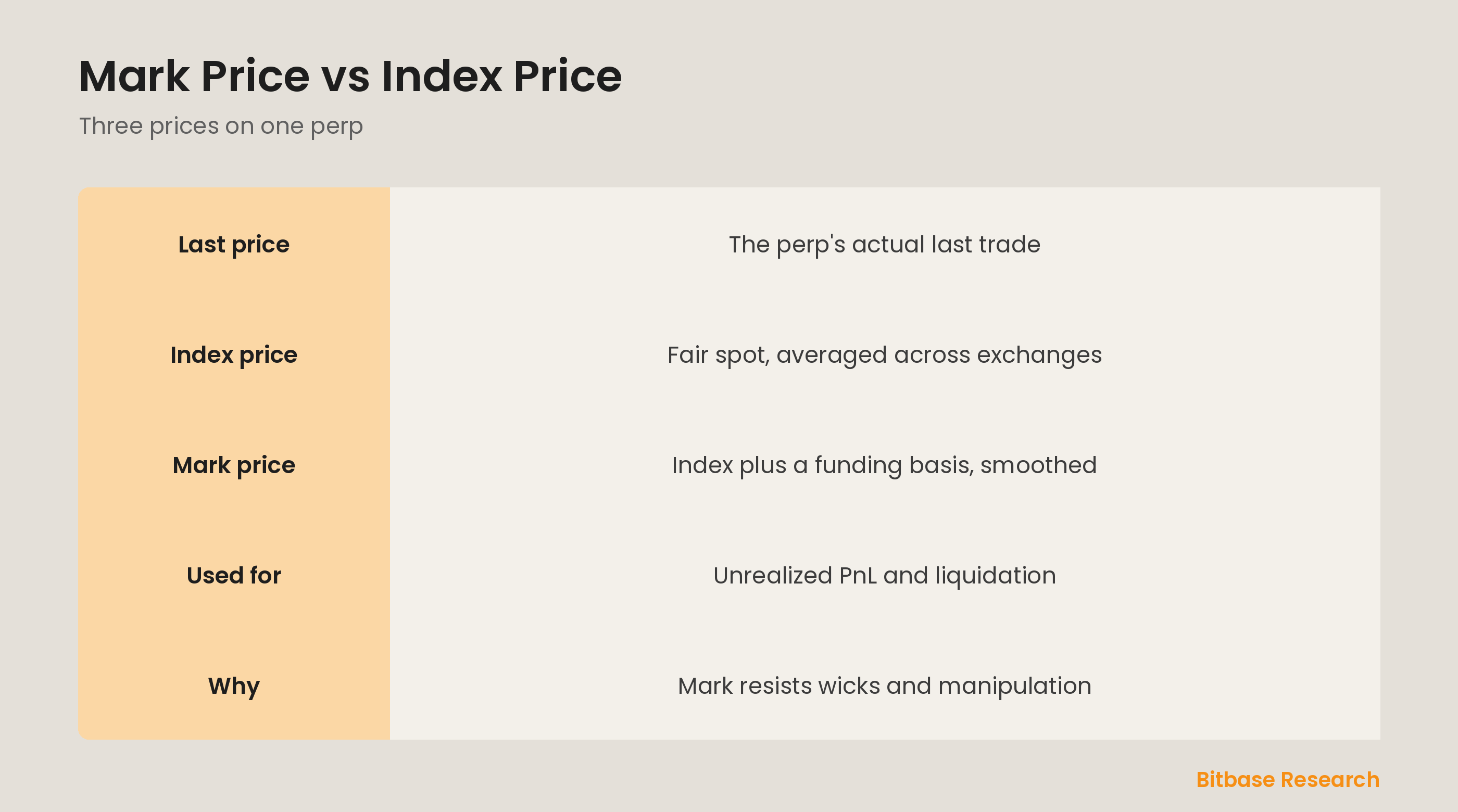
The index price represents the fair market value of the underlying asset. Exchanges build it from the spot prices on several major venues, usually as a volume-weighted average, so no single market's quirk or manipulation dominates it. Because it is drawn from many sources, the index is a robust, hard-to-push estimate of what the coin is really worth right now — the anchor everything else is measured against.
The mark price
The mark price is what your position is valued at moment to moment. It is based on the index price plus a small, decaying adjustment reflecting the funding basis, then smoothed so it does not lurch around. The exchange uses the mark price to calculate your unrealized profit and loss and, critically, to decide when a position hits its liquidation level. Your realized profit or loss, when you actually close, still comes from the price you trade at.
Why liquidation uses mark, not last
Using the mark price for liquidations protects traders from manipulation. If liquidations were triggered by the last traded price, someone could briefly spike or crush the perp with a large order — a “wick” — and force a wave of liquidations at prices detached from reality. Because the mark price is tied to the multi-exchange index and smoothed, a momentary wick on one venue cannot unfairly liquidate your position. It keeps liquidations tethered to genuine market value.
The bottom line
Last price is where the perp just traded, index price is the fair spot value averaged across exchanges, and mark price — index plus a funding basis, smoothed — is what sets your unrealized PnL and your liquidation point. The reason for the split is protection: pricing liquidations off the manipulation-resistant mark, rather than a jumpy last trade, keeps a single sharp wick from wiping out positions unfairly. To keep learning the fundamentals, follow more from Bitbase Academy.
Disclaimer: This article is educational content from Bitbase Academy, provided for information only. It does not constitute investment, trading, tax, or financial advice. Crypto assets are volatile; assess your own risk. Written as of June 2026; refer to the latest official information.
References
[1] Britannica Money, "Perpetual Futures: Meaning, Regulation, and Example" britannica.com
[2] Investopedia, "Mark to Market (MTM): What It Means and How It Works" investopedia.com
[3] Coinbase Learn, "Understanding Funding Rates in Perpetual Futures" coinbase.com