The funding rate is a small, periodic payment that traders on one side of a perpetual future make to traders on the other side. Its job is to keep the perpetual's price tethered to the real spot price, since a perp never expires to force them together. Here is what the funding rate is, who pays whom, how it is calculated, and why it is a real cost of holding a position.
What the funding rate is
A perpetual future has no expiry date, so nothing naturally pulls its price back to the underlying market. The funding rate is the mechanism that does. It is a recurring payment exchanged directly between long and short traders — crucially, not a fee collected by the exchange. By making one side pay the other whenever the perp drifts from spot, it nudges the contract's price back in line without anyone ever settling the contract.
Who pays whom
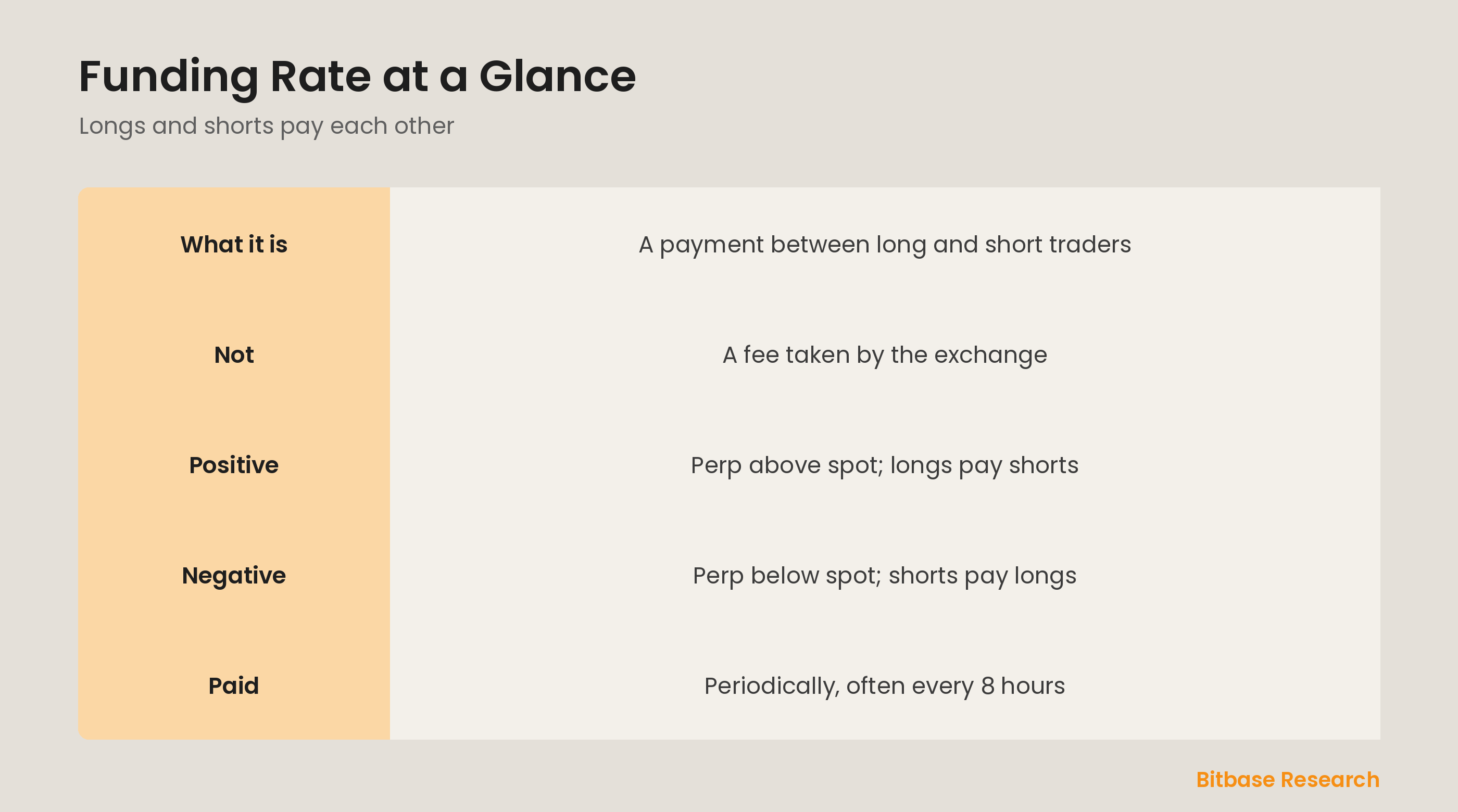
The direction depends on where the perp trades relative to spot. When demand for longs pushes the perp above the spot price, the funding rate is positive and longs pay shorts — which discourages piling into longs. When the perp trades below spot, the rate is negative and shorts pay longs. Either way, the payment penalizes the crowded side and rewards the other, gently steering the perp back toward the real price.
How it is calculated
The rate is usually built from two parts: a small fixed interest component, often around 0.01% per period, and a premium that grows with the gap between the perp and spot prices. Payments happen on a set schedule — commonly every eight hours, though some venues use shorter intervals. You only pay or receive funding if you are holding a position at the exact funding timestamp; open and close between them and you skip it entirely.
Why it matters to you
Funding is a real, recurring cost or income of holding a leveraged position, separate from price moves. Hold a long through long stretches of high positive funding and the payments quietly eat into your returns, especially at high leverage where the position is large relative to your margin. Some traders even trade the funding rate itself — holding the paying side of a market to collect it — but for most, it is simply a carrying cost to factor into any perp position.
The bottom line
The funding rate is how perpetual futures stay anchored to spot without an expiry: longs and shorts pay each other based on which way the perp has drifted. It is not an exchange fee, it flows to whichever side is under-crowded, and it is charged only to open positions at each funding time. Watch it whenever you hold a perp — over time, funding can matter as much as the price itself. To keep learning the fundamentals, follow more from Bitbase Academy.
Disclaimer: This article is educational content from Bitbase Academy, provided for information only. It does not constitute investment, trading, tax, or financial advice. Crypto assets are volatile; assess your own risk. Written as of June 2026; refer to the latest official information.
References
[1] Coinbase Learn, "Understanding Funding Rates in Perpetual Futures" coinbase.com
[2] Britannica Money, "Perpetual Futures: Meaning, Regulation, and Example" britannica.com
[3] Investopedia, "Futures Contract: Definition, Types, Mechanics, and Uses" investopedia.com