
Few people buy an entire position at a single price. More often you buy in pieces, at different prices, over time. To know where you stand, all those buys have to be combined into one number: your average entry price. It sets your break-even and anchors every profit and loss calculation on the position. Here is how the average entry price is worked out, why it is weighted, and what it tells you.
What cost basis and average entry are
Your cost basis for a position is the total amount you spent to build it, adding up every purchase including fees. Your average entry price is that total cost basis divided by the total number of units you hold. It answers a simple question: on average, what did each unit cost me? Even if you bought at many different prices, the average entry collapses them into one figure that represents your overall entry into the position.
Why it is a weighted average
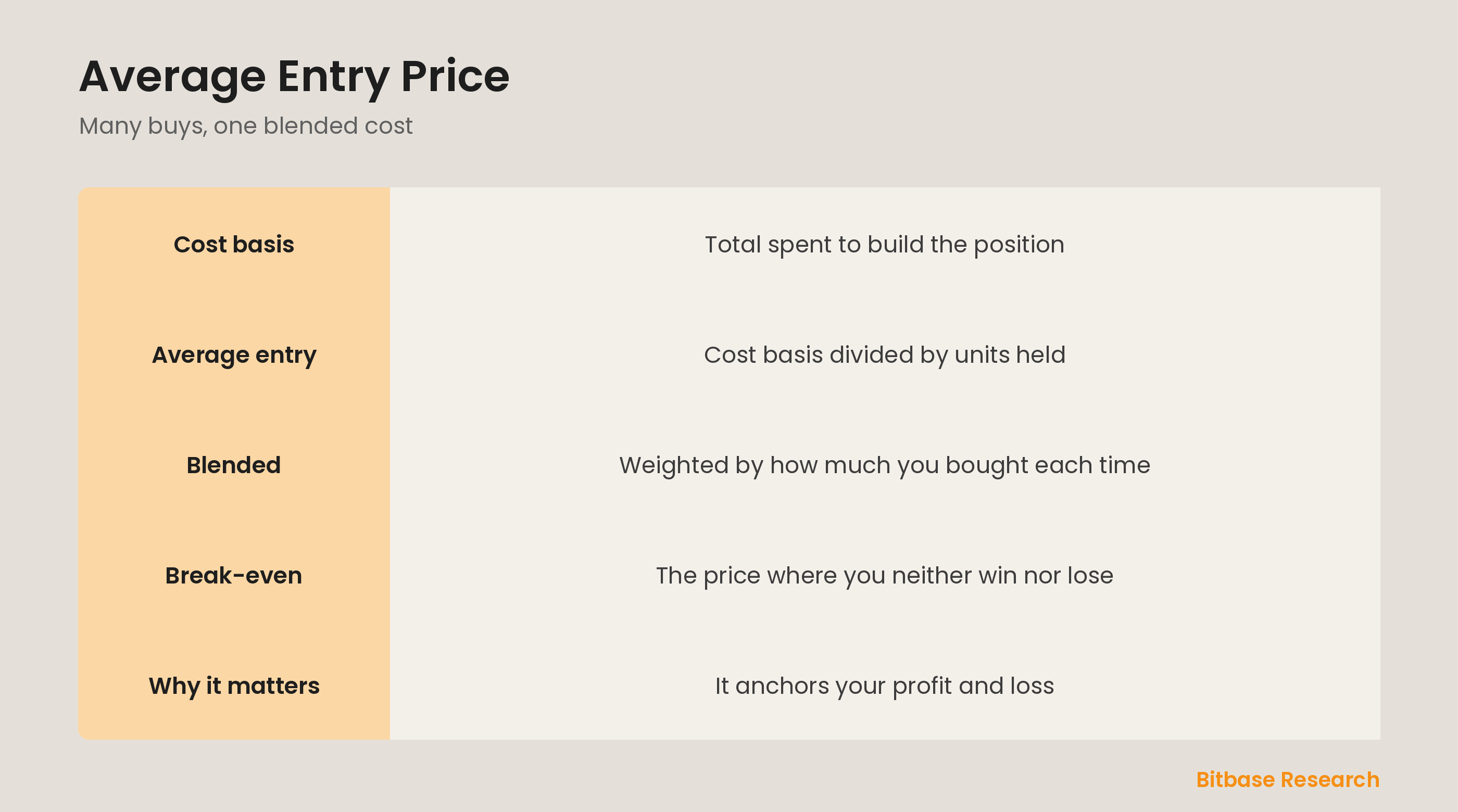
The average entry is a weighted average, not a simple one, because it accounts for how much you bought at each price. If you buy a large amount at one price and a small amount at another, the large purchase pulls the average closer to its price. So it is not just the midpoint of the prices you paid; it is weighted by the size of each buy. This is why buying more at lower prices lowers your average more than a small purchase would.
Break-even and profit
Your average entry price is your break-even point: the price at which selling would return exactly what you put in, no profit and no loss. Above it, the position is in profit; below it, in loss. This makes the average entry the single most important reference for the position, since every gain or loss is measured from it. Knowing your break-even also helps you set targets and judge whether the position is currently working.
How adding to a position changes it
Each new purchase changes your average entry. Buying more at a price below your current average pulls the average down, a practice often called averaging down, which lowers your break-even but increases your position and risk. Buying more at a higher price raises your average, averaging up. Understanding this lets you see exactly how a new buy will shift your break-even before you make it, which is essential for managing a position deliberately rather than by feel.
The bottom line
Your cost basis is the total you spent building a position, and your average entry price is that cost basis divided by the units you hold, a weighted average that accounts for how much you bought at each price. This average is your break-even: above it you are in profit, below it in loss. Every new purchase shifts it, so knowing your average entry is essential for tracking profit and managing a position deliberately. To keep learning the fundamentals, follow more from Bitbase Academy.
Disclaimer: This article is educational content from Bitbase Academy, provided for information only. It does not constitute investment, trading, tax, or financial advice. Crypto assets are volatile; assess your own risk. Written as of June 2026; refer to the latest official information.
References
[1] Investopedia, "Cost Basis: Definition, Formula, and Example" investopedia.com
[2] Investopedia, "Capital Gain: Definition, How It Works, and Taxation" investopedia.com
[3] Investopedia, "Unrealized Gain: Definition, How It Works, and Example" investopedia.com