Many new traders obsess over being right, chasing a high win rate as if it were the goal. But profitability does not come from how often you win; it comes from how your wins and losses combine. A trader who loses more often than they win can still be highly profitable, and understanding why is one of the most liberating insights in trading. Here is how win rate and risk-reward work together to determine your edge.
What win rate is
Your win rate is simply the percentage of your trades that end in a profit. If 6 of 10 trades win, your win rate is 60 percent. It is an intuitive and popular number, but on its own it tells you very little about whether you are actually making money. A high win rate feels good, yet it says nothing about the size of your wins versus your losses, which is the other half of the picture and often the more important half.
What risk-reward is
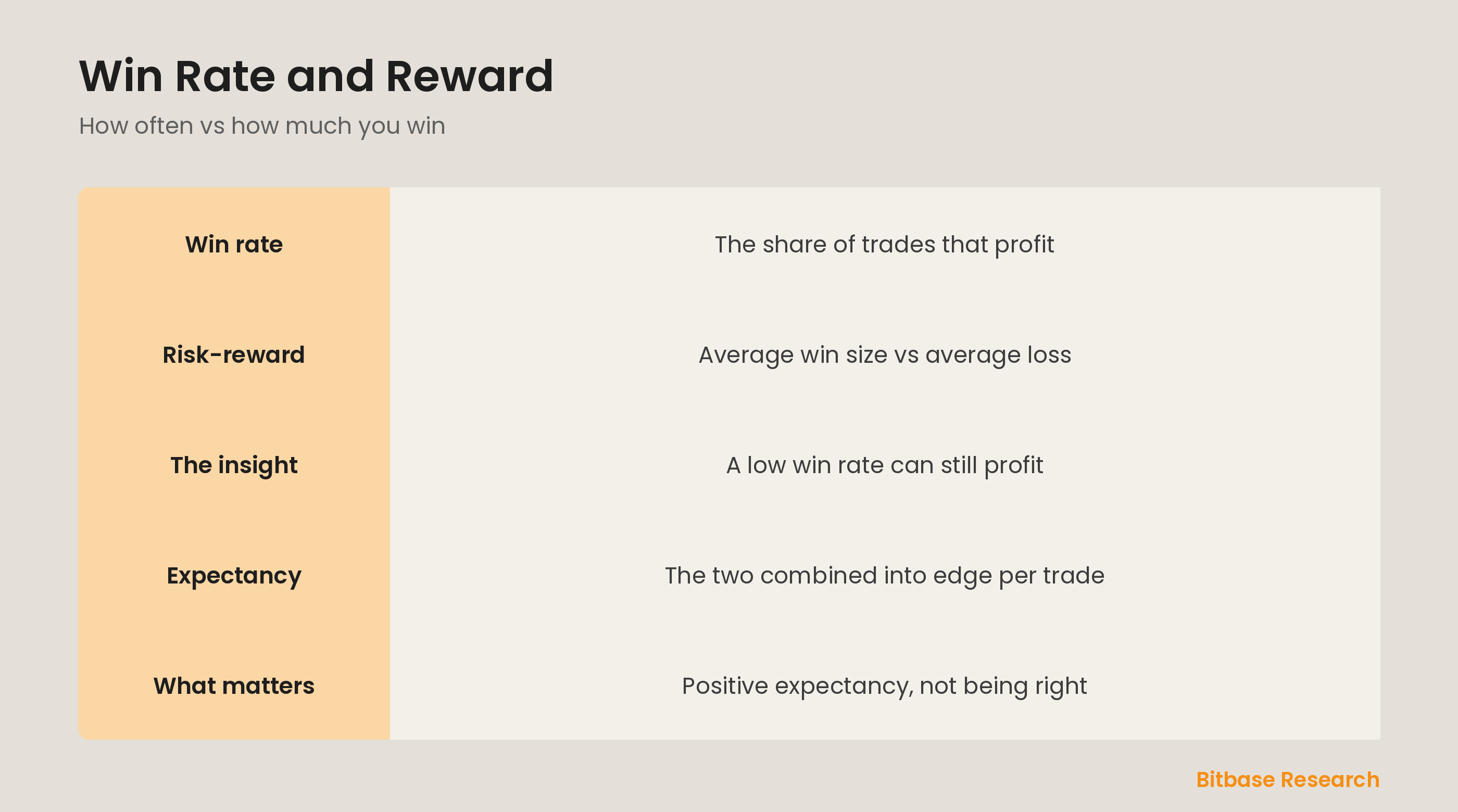
The risk-reward ratio compares the size of your average win to the size of your average loss. If your typical winning trade makes twice as much as your typical losing trade loses, your risk-reward is 2 to 1. This measures how much you win when right versus how much you lose when wrong. A favorable risk-reward, where wins are larger than losses, means each win does more work, which can compensate for losing more often than you win.
Why a low win rate can profit
Here is the key insight: win rate and risk-reward trade off against each other. With a risk-reward of 3 to 1, you can be wrong most of the time and still profit, because the few wins each pay for several losses. Conversely, a very high win rate with tiny wins and occasional huge losses can lose money. This is why chasing win rate alone is a trap; what matters is the combination of how often and how much.
Expectancy is the real edge
The two combine into expectancy: the average profit or loss you can expect per trade over many trades, given your win rate and your risk-reward. A strategy has a real edge only if its expectancy is positive, meaning that on average, across many trades, it makes money. Expectancy, not win rate, is the number that determines whether an approach is worth trading. Focusing on positive expectancy frees you from needing to be right on every trade.
The bottom line
Win rate is how often you win, and risk-reward is how much you win versus lose, and neither alone tells you if you are profitable. They trade off: a high risk-reward lets you win less than half the time and still profit, while a high win rate with poor risk-reward can lose. What matters is expectancy, the two combined into the average result per trade, so aim for positive expectancy rather than simply being right often. To keep learning the fundamentals, follow more from Bitbase Academy.
Disclaimer: This article is educational content from Bitbase Academy, provided for information only. It does not constitute investment, trading, tax, or financial advice. Crypto assets are volatile; assess your own risk. Written as of June 2026; refer to the latest official information.
References
[1] Investopedia, "Win/Loss Ratio: Definition, Formula, and Examples" investopedia.com
[2] Investopedia, "Risk/Reward Ratio: What It Is, How Stock Investors Use It" investopedia.com
[3] Investopedia, "Expected Value (EV): Definition, Formula, and Examples" investopedia.com