Drawdown is the measure that captures how much an account has fallen from its high point, and it reveals something crucial that beginners often miss: losing and recovering are not symmetric. A loss requires a bigger gain to undo it, and the deeper the loss, the more brutal the math. Understanding drawdown is what turns risk management from optional to essential. Here is what drawdown means and why recovery is so hard.
What a drawdown is
A drawdown is the decline of an account or asset from a peak to a subsequent low, usually measured as a percentage. If your account grows to 10,000 then falls to 8,000, you are in a 20 percent drawdown. It measures how far you are below your best point, capturing the pain of a losing stretch. Drawdowns are a normal part of trading and investing; the question is not whether they happen but how large they get.
Maximum drawdown
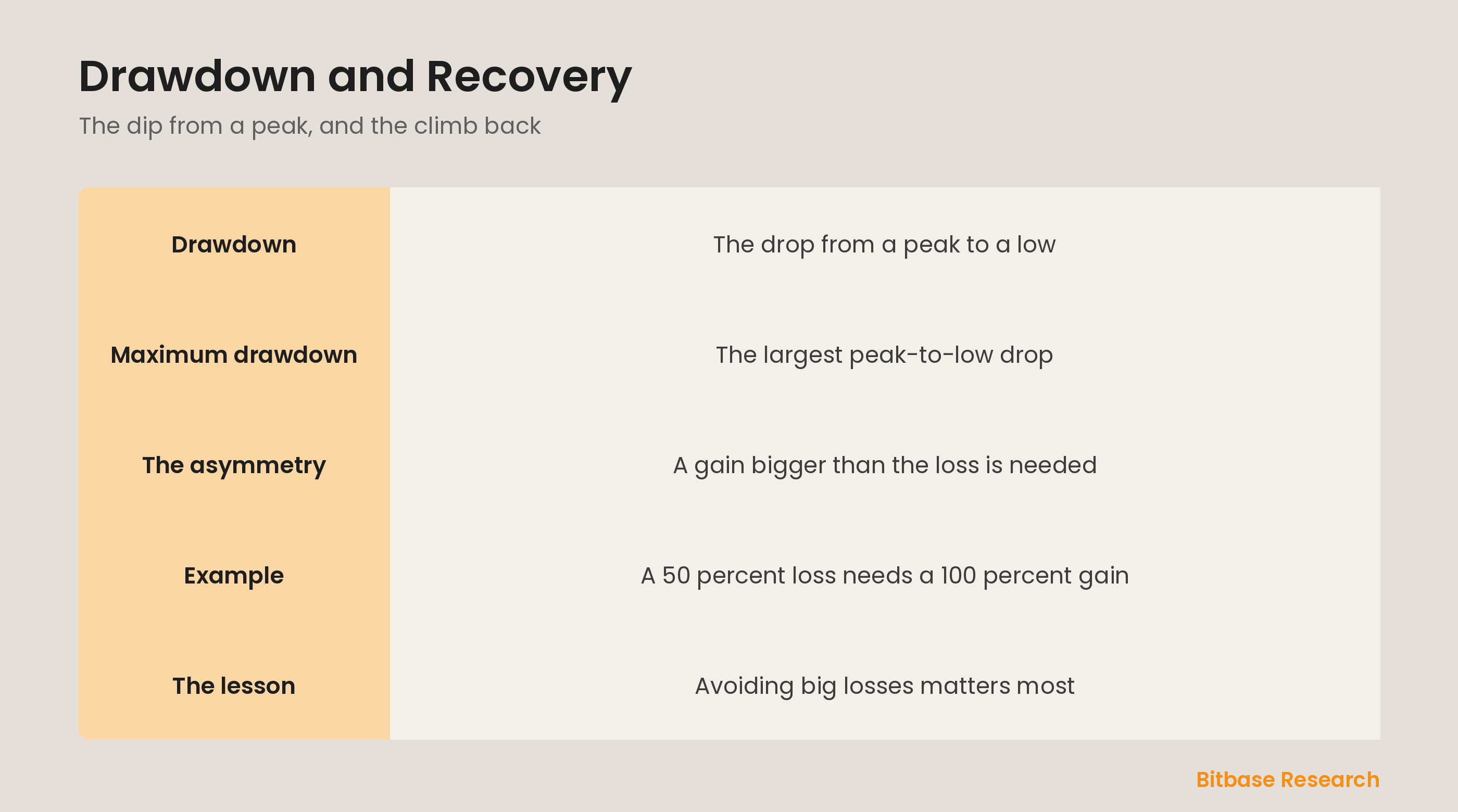
Maximum drawdown is the largest peak-to-low decline over a period, the worst drop from a high to a low before a new high is made. It answers a blunt question: what is the deepest hole this account or strategy fell into? Maximum drawdown is a key risk measure because it shows the worst-case pain an approach has historically inflicted. A strategy with attractive returns but a huge maximum drawdown may be far too risky to actually stick with.
The recovery asymmetry
Here is the crucial insight: recovering from a loss requires a larger percentage gain than the loss itself. If you lose 10 percent, you need about 11 percent to get back to even, because you are now growing from a smaller base. The deeper the drawdown, the worse it gets: a 50 percent loss requires a 100 percent gain to recover, and an 80 percent loss requires a 400 percent gain. Losses and recoveries are dangerously asymmetric.
Why it shapes risk management
This asymmetry is the mathematical reason risk management matters so much. Because deep losses take exponentially larger gains to undo, avoiding large drawdowns is more valuable than chasing large gains. Keeping losses small, through position sizing and stops, means you never fall into a hole that is nearly impossible to climb out of. The whole discipline of protecting capital flows from this single fact: it is far easier to avoid a big loss than to recover from one.
The bottom line
A drawdown is the drop from a peak to a low, and maximum drawdown is the largest such drop, a key measure of an approach's worst-case pain. The crucial insight is that recovery is asymmetric: a loss needs a larger percentage gain to undo it, and a 50 percent loss requires a 100 percent gain to break even. This is why keeping losses small through risk management matters more than chasing big wins. To keep learning the fundamentals, follow more from Bitbase Academy.
Disclaimer: This article is educational content from Bitbase Academy, provided for information only. It does not constitute investment, trading, tax, or financial advice. Crypto assets are volatile; assess your own risk. Written as of June 2026; refer to the latest official information.
References
[1] Investopedia, "Drawdown: What It Is, Risks, and Examples" investopedia.com
[2] Investopedia, "Maximum Drawdown (MDD): Definition and Formula" investopedia.com
[3] Investopedia, "Risk: What It Means in Investing, How To Measure and Manage It" investopedia.com