
The most powerful force in growing money is not a single big win but compounding: earning returns on your returns, so that gains build on gains and growth accelerates over time. It is what turns steady, modest results into large ones given enough time, and it explains why consistency matters more than the occasional home run. Here is how compounding works, why it favors steady growth, and what CAGR measures.
What compounding is
Compounding is earning returns not just on your original capital but on the gains you have already made. When you reinvest your profits rather than withdrawing them, those profits start generating profits of their own. In the next period, you earn a return on a larger base, and the period after that, a larger base still. This is fundamentally different from earning a flat return on your starting amount forever; compounding lets the gains themselves go to work.
The snowball effect
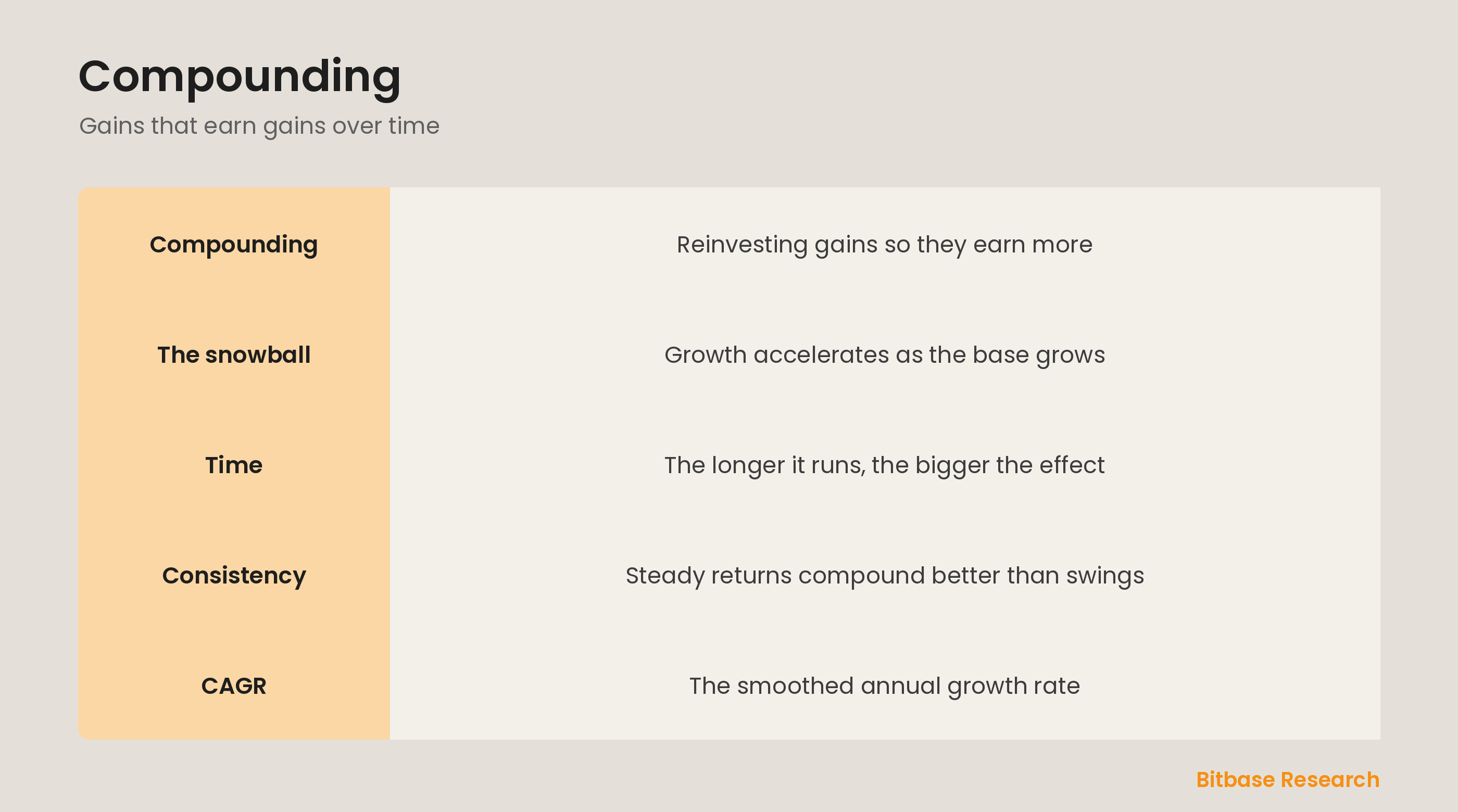
Compounding creates a snowball effect: as your capital grows, each period's percentage gain produces a larger dollar amount, which enlarges the base again, accelerating the growth. Early on, the effect looks modest, but over many periods it curves sharply upward. This is why time is compounding's greatest ally: the same rate of return produces dramatically more wealth over a long horizon than a short one, because the snowball has more time to roll and grow.
Why consistency beats big swings
Compounding rewards steady, consistent returns over wild swings, because of the drawdown asymmetry covered earlier. A big loss shrinks your base, and you then compound from that smaller amount, crippling future growth. Two accounts with the same average return can end up far apart if one is smooth and the other is volatile, because the volatile one's deep drawdowns break the compounding chain. Protecting against large losses keeps the snowball intact, which matters more than occasional big wins.
What CAGR measures
To compare growth over time fairly, traders use the compound annual growth rate, or CAGR. It expresses the smoothed, constant annual rate that would take your starting amount to your ending amount over the period, as if it grew steadily. CAGR strips out the bumps and gives a single, comparable growth number, making it a fairer measure of long-run performance than a simple average, which can be distorted by volatility. It shows what your money truly compounded at.
The bottom line
Compounding is earning returns on your returns, so reinvested gains build on each other and growth accelerates into a snowball, with time as its greatest ally. Because a deep loss shrinks the base you compound from, steady, consistent returns beat wild swings, which is why protecting against large drawdowns matters so much. CAGR measures the smoothed annual growth rate, giving a fair way to compare long-run performance. This is general information, not financial advice. To keep learning the fundamentals, follow more from Bitbase Academy.
Disclaimer: This article is educational content from Bitbase Academy, provided for information only. It does not constitute investment, trading, tax, or financial advice. Crypto assets are volatile; assess your own risk. Written as of June 2026; refer to the latest official information.
References
[1] Investopedia, "Compound Interest: Definition, Formula, and Example" investopedia.com
[2] Investopedia, "Compound Annual Growth Rate (CAGR): Formula and Uses" investopedia.com
[3] Investopedia, "Position Sizing: Definition and Strategies for Managing Risk" investopedia.com