Two calculations turn risk management from a vague idea into a concrete plan you make before every trade: the risk-reward ratio, which weighs what a trade can make against what it can lose, and position sizing, which controls how much you actually risk. Together they let you take losses without being hurt and make sure your winners are worth the risk. Here is how to use both.
The risk-reward ratio
The risk-reward ratio measures a trade's potential reward against its potential risk before you take it. You define three prices: your entry, your stop-loss (where you will exit if wrong), and your target (where you will take profit). The distance from entry to stop is your risk; the distance from entry to target is your reward. Dividing the reward by the risk gives the ratio. A trade risking 1 to make 3 has a risk-reward of 3 to 1.
Why the ratio matters
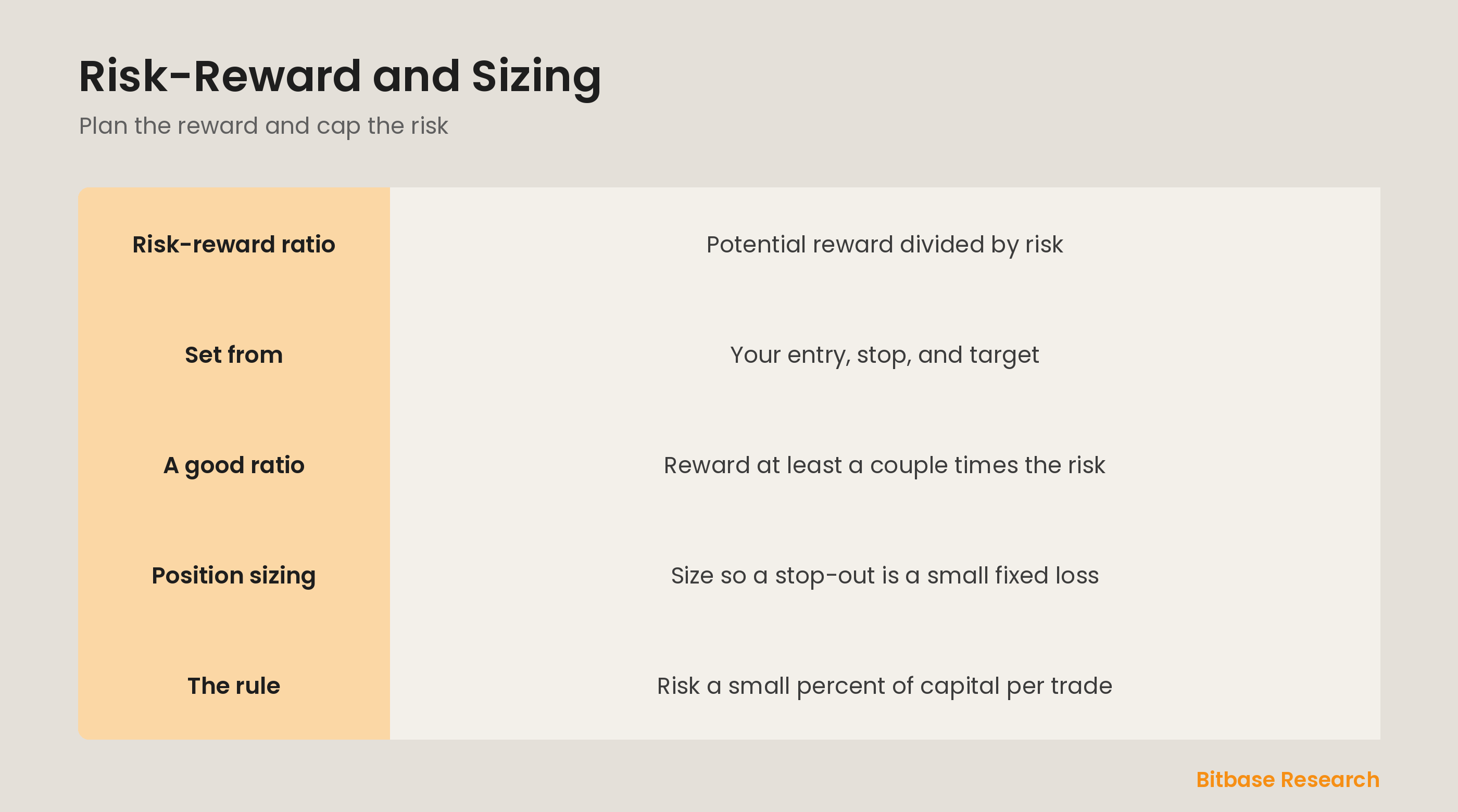
The risk-reward ratio lets you judge whether a trade is worth taking before you enter. A favorable ratio, where the potential reward is at least a couple of times the risk, means you do not need to win often to profit, as covered in the win rate and expectancy discussion. Planning entry, stop, and target in advance also forces discipline: you decide where you are wrong and where you will take profit before emotion enters, rather than improvising once the trade is live.
What position sizing is
Position sizing decides how much to buy so that if the trade hits your stop-loss, you lose only a small, controlled amount. It works backward from your risk: knowing the distance from your entry to your stop, you choose a position size such that a stop-out costs a fixed amount you are comfortable losing. This separates the trade's setup from how much money is on the line, letting you keep every loss to a planned size regardless of the asset or its price.
The percent-risk rule
A common rule ties position sizing to your account: risk only a small fixed percentage of your total capital on any single trade, often cited as 1 to 2 percent. If a stop-out would cost more than that percentage, you make the position smaller. This ensures no single loss can seriously damage your account, and that a string of losses still leaves you with plenty of capital to continue. It is one of the simplest, most powerful risk rules in trading.
The bottom line
The risk-reward ratio compares a trade's potential reward to its risk, measured from your entry, stop, and target, and a favorable ratio means you profit without needing to win often. Position sizing then sets how much to buy so that hitting your stop costs only a small, fixed loss, commonly capped at 1 to 2 percent of your capital per trade. Together they let you plan the reward and strictly limit the risk before every trade. This is general information, not financial advice. To keep learning the fundamentals, follow more from Bitbase Academy.
Disclaimer: This article is educational content from Bitbase Academy, provided for information only. It does not constitute investment, trading, tax, or financial advice. Crypto assets are volatile; assess your own risk. Written as of June 2026; refer to the latest official information.
References
[1] Investopedia, "Risk/Reward Ratio: What It Is, How Stock Investors Use It" investopedia.com
[2] Investopedia, "Position Sizing: Definition and Strategies for Managing Risk" investopedia.com
[3] Investopedia, "Risk: What It Means in Investing, How To Measure and Manage It" investopedia.com