
Knowing whether a trade made or lost money sounds obvious, but calculating it correctly, including fees and the difference between paper gains and locked-in ones, trips up many beginners. Getting profit and loss right is the foundation of tracking your performance and, in many places, your taxes. Here is the simple formula, the crucial difference between realized and unrealized gains, and how fees fit in.
The basic formula
Profit and loss is simply what you received minus what you paid. The amount you paid to acquire an asset is your cost basis, and the amount you got when you sold is your proceeds. Subtract the cost basis from the proceeds and you have your profit, if positive, or your loss, if negative. For example, buying at 100 and selling at 150 gives a profit of 50. This basic subtraction is the core of every profit and loss calculation.
Realized versus unrealized
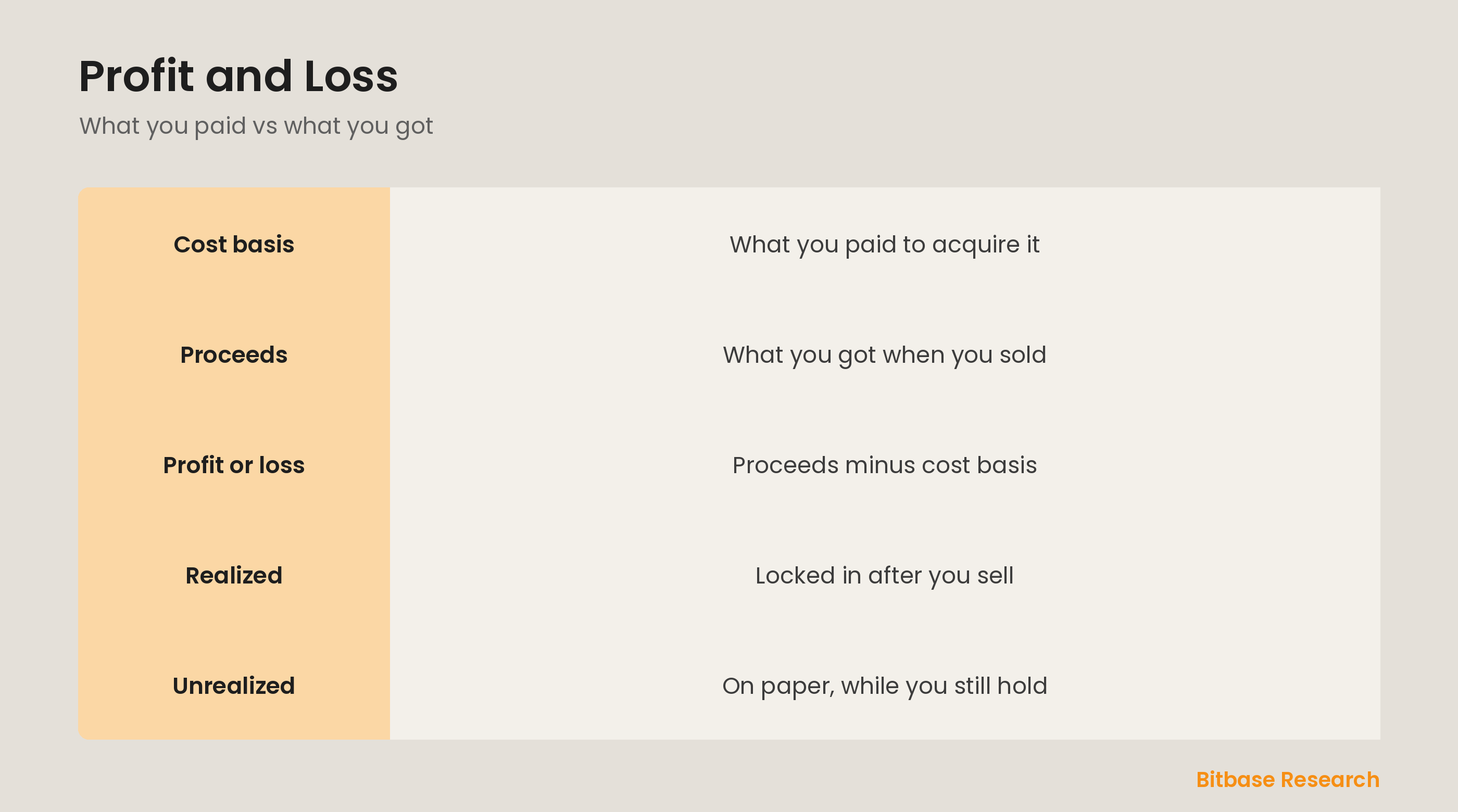
A key distinction is whether a gain is realized or unrealized. An unrealized gain is a profit that exists only on paper: your asset is worth more than you paid, but you have not sold, so nothing is locked in and the gain can still evaporate if price falls. A realized gain is one you have secured by actually selling; it is final. The same split applies to losses. Understanding this tells you whether a number is real money or just a current snapshot.
Including fees
An accurate calculation must include trading fees, which many beginners forget. Fees paid when you buy add to your cost basis, and fees paid when you sell reduce your proceeds, so both eat into your profit. A trade that looks slightly profitable before fees can be flat or negative once fees are counted, especially with frequent trading. Always fold buy and sell fees into the calculation to see your true, net profit or loss rather than a gross figure.
Percentage return
Beyond the dollar amount, it helps to express profit as a percentage return, which lets you compare trades of different sizes. The percentage return is the profit divided by the cost basis, times 100. A profit of 50 on a cost basis of 100 is a 50 percent return; the same 50 profit on a 500 cost basis is only 10 percent. Percentage return normalizes for size, making it the fairer way to judge how well a trade or a portfolio actually performed.
The bottom line
Profit and loss is proceeds minus cost basis: what you sold for minus what you paid, and it should always include buy and sell fees to give a true net figure. A gain is unrealized while you still hold, existing only on paper, and realized once you sell and lock it in. Expressing the result as a percentage return, profit divided by cost basis, lets you compare trades fairly regardless of size. To keep learning the fundamentals, follow more from Bitbase Academy.
Disclaimer: This article is educational content from Bitbase Academy, provided for information only. It does not constitute investment, trading, tax, or financial advice. Crypto assets are volatile; assess your own risk. Written as of June 2026; refer to the latest official information.
References
[1] Investopedia, "Cost Basis: Definition, Formula, and Example" investopedia.com
[2] Investopedia, "Unrealized Gain: Definition, How It Works, and Example" investopedia.com
[3] Investopedia, "Capital Gain: Definition, How It Works, and Taxation" investopedia.com