Liquidation in crypto is when an exchange force-closes your leveraged position because your losses have eaten through the collateral backing it. It is the built-in safety valve of margin and futures trading — and the moment many leveraged traders lose their money. Here is what liquidation is, why it happens, how leverage decides how easily it strikes, and how to keep it from happening to you.
What liquidation is
When you trade with leverage, you back a large position with a smaller amount of collateral, or margin. Liquidation is what happens when the position moves against you far enough that your margin can no longer cover the loss. To stop your account from going negative, the exchange automatically closes the position at market — and the collateral you put up is gone. It is not a penalty; it is the system protecting itself and the lender from an unpayable loss.
Why it happens
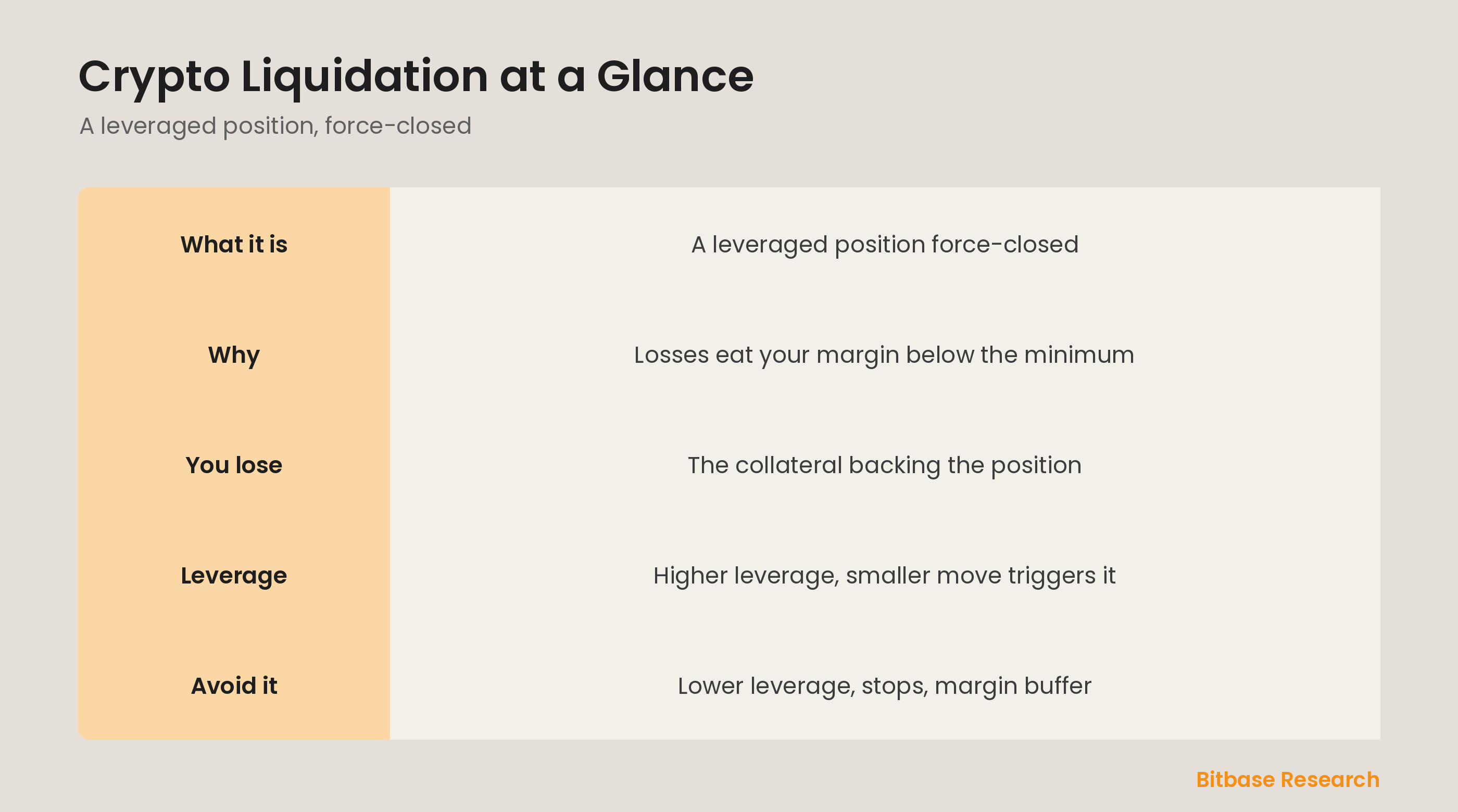
Every leveraged position has a maintenance margin: the minimum collateral it must keep. As the price moves against you, your unrealized loss grows and your effective margin shrinks. Once it drops to the maintenance level — at a price called the liquidation price — the position is closed. The bigger your loss relative to your collateral, the closer you are to that line, so liquidation is really just losses catching up with a thin cushion of margin.
Leverage sets the distance
How far the price must move to liquidate you depends almost entirely on your leverage. Low leverage leaves a wide buffer; high leverage leaves almost none. Roughly speaking, a position at 50x leverage can be liquidated by only about a 2% move against it, while the same trade at 10x might tolerate closer to 9–10%. That is why high leverage is so dangerous in volatile crypto markets: an ordinary price swing is enough to end the trade.
How to avoid it
Liquidation is largely preventable. Using lower leverage is the single biggest lever — it pushes the liquidation price far from your entry. Setting a stop-loss lets you exit on your own terms before the exchange does it for you, usually at a better price. Keeping spare margin in the account, and sizing positions modestly, adds a further buffer. In sharp sell-offs, mass liquidations can even cascade and accelerate the drop, another reason to trade with room to spare.
The bottom line
Liquidation is the forced closing of a leveraged position when losses exhaust its margin, and it costs you the collateral behind the trade. It happens when the price reaches your liquidation level, and how near that level sits is set mostly by your leverage. Trade with lower leverage, a stop-loss, and a margin cushion, and liquidation becomes a rare event rather than the way your position ends. To keep learning the fundamentals, follow more from Bitbase Academy.
Disclaimer: This article is educational content from Bitbase Academy, provided for information only. It does not constitute investment, trading, tax, or financial advice. Crypto assets are volatile; assess your own risk. Written as of June 2026; refer to the latest official information.
References
[1] Britannica Money, "Perpetual Futures: Meaning, Regulation, and Example" britannica.com
[2] Investopedia, "Margin Call: What It Is and How to Meet One With Examples" investopedia.com
[3] CFTC, "Customer Advisory: Understand the Risks of Virtual Currency Trading" cftc.gov