Every trade takes a side. When you expect a coin's price to climb, you go long; when you expect it to fall, you go short. Those two words — long and short — describe the entire direction of a position, and understanding both is what lets a trader try to profit whether the market rises or drops. Here is what each one means, how it makes or loses money, and why one carries a far heavier risk than the other.
What going long means
Going long is the familiar one: you buy an asset because you expect its price to rise, then aim to sell later at a higher price. Your profit is simply the difference between what you paid and what you sold for. If the price falls instead, you lose — but only down to zero, since a coin cannot be worth less than nothing. Most people who buy and hold crypto are, in effect, long.
What going short means
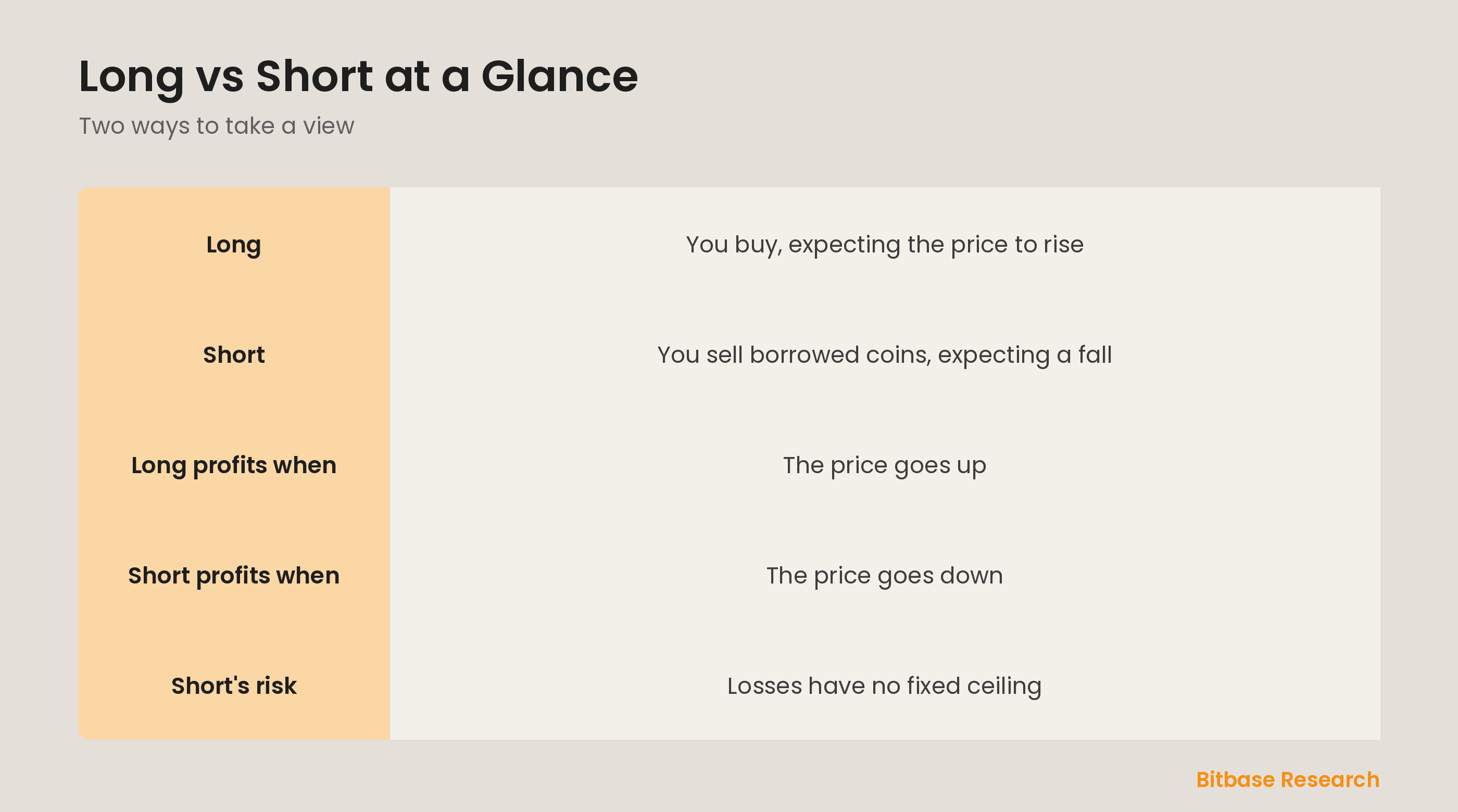
Going short is the mirror image: you profit when the price falls. To do it, you borrow coins you do not own, sell them at today's price, and hope to buy them back cheaper later to return them — pocketing the difference. Shorting lets traders make money in a falling market, but it is mechanically more complex than going long and is usually done with borrowed funds or derivatives.
The key difference in risk
The two sides are not mirror images when it comes to risk. A long position can only lose what you put in, because the price can fall no further than zero. A short position is different: if the price keeps rising, your loss keeps growing, and there is no ceiling on how high a price can go. That asymmetry makes shorting inherently riskier and demands tighter risk management.
Leverage cuts both ways
Both longs and shorts are often taken with leverage — borrowed money that lets you control a larger position than your own capital would allow. Leverage magnifies gains when you are right, but it magnifies losses just as fast when you are wrong, and it can trigger a forced liquidation before your view has time to play out. Whether long or short, more leverage means less room for the price to move against you.
The bottom line
Long and short are the two directions a trade can take: long profits when the price rises, short profits when it falls. Going long risks only what you invest; going short exposes you to losses with no fixed limit. Both can be amplified by leverage, which speeds up the outcome in either direction. Knowing which side you are on — and what it can cost — is the starting point of any trade. To keep learning the fundamentals, follow more from Bitbase Academy.
Disclaimer: This article is educational content from Bitbase Academy, provided for information only. It does not constitute investment, trading, tax, or financial advice. Crypto assets are volatile; assess your own risk. Written as of June 2026; refer to the latest official information.
References
[1] Investopedia, "Long Position: Definition, Types, Example, Pros and Cons" investopedia.com
[2] Investopedia, "Short Selling: Definition, Pros, Cons, and Examples" investopedia.com
[3] Investopedia, "Leverage: What It Is and How It Works" investopedia.com