Leverage lets you open a position larger than your own deposit by borrowing from the exchange — for example, $100 at 10x controls a $1,000 position. It multiplies your gains, but it multiplies your losses just as much. Here's how it works, and how to use it carefully.
How leverage works
When you trade with leverage you put up a small amount of your own money — the margin — and the exchange effectively lends you the rest. The leverage is simply the multiplier: at 10x, $100 of margin controls a $1,000 position; at 2x it controls $200. Your profit and loss are calculated on the full position, not on your margin, so if that $1,000 position moves 1% you gain or lose $10 — which is 10% of your own $100. The bigger the multiplier, the bigger the swing on your capital.
How leverage magnifies risk
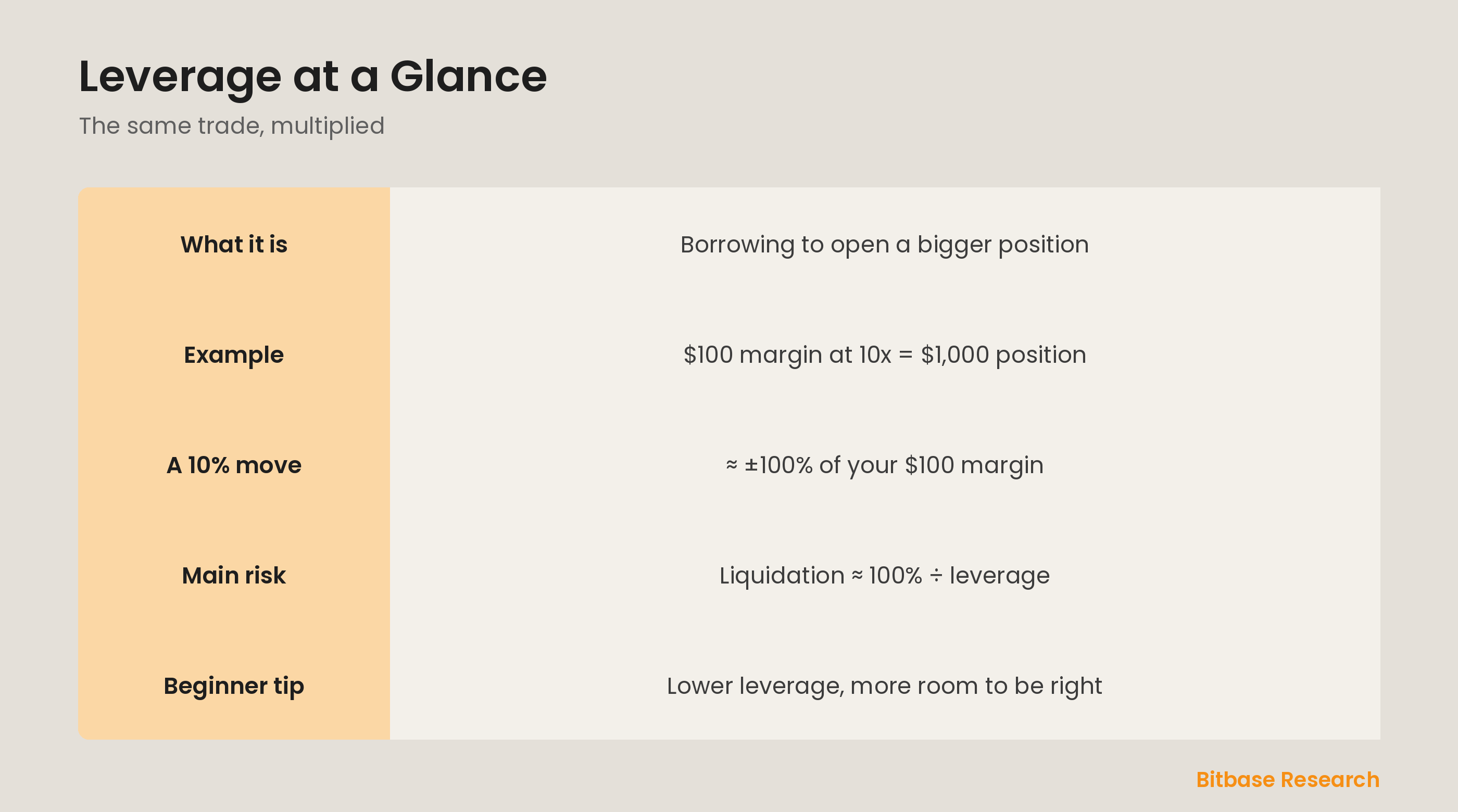
Because losses scale with the full position, a small move against you can erase your margin. As a rough rule, a move of about 100% ÷ your leverage wipes you out: at 10x that is roughly a 10% drop, at 25x only about 4%. When your loss approaches your margin, the exchange automatically closes the position so your balance can't go negative — this is called liquidation, and you lose the margin you put up. Higher leverage puts that liquidation price much closer to your entry.
Leverage vs margin
The two terms are related but not identical. Margin is the collateral you deposit; leverage is the multiple applied to it — two sides of one ratio. 10x leverage is the same as posting 10% margin, and 5x is 20% margin. Exchanges also offer isolated margin, where only the margin on that one trade is at risk, and cross margin, where your whole balance backs the position; the choice changes how quickly you can be liquidated.
How to choose your leverage
There is no single best number, but the math gives a simple guide: your cushion before liquidation is roughly 100% ÷ leverage, before fees and funding. Lower leverage gives a trade room to survive normal volatility; higher leverage leaves almost none. Many newer traders keep leverage low — around 2x to 5x — and size the position so one loss is only a small share of the account. A liquidation-price or position-size calculator shows your exact liquidation level before you enter.
The bottom line
Leverage is a multiplier on both sides of a trade: it can amplify a good call and just as easily turn a small mistake into a total loss. At modest multiples with a clear stop it is a useful tool; at high multiples without a plan it is the fastest way to be liquidated. Start small, know your liquidation price, and treat leverage as risk management first. To keep learning the fundamentals, follow more from Bitbase Academy.
Disclaimer: This article is educational content from Bitbase Academy, provided for information only. It does not constitute investment, trading, tax, or financial advice. Crypto assets are volatile; assess your own risk. Written as of June 2026; refer to the latest official information.
References
[1] Investopedia, "Leverage: What It Is and How It Works" investopedia.com
[2] Investopedia, "Forced Liquidation: What It Means" investopedia.com
[3] Corporate Finance Institute, "Leverage" corporatefinanceinstitute.com