
There are three main ways to store crypto: on an exchange, in a software wallet, or on a hardware wallet. They differ in who holds the keys and how secure they are. The right choice depends on how much you hold and how often you use it. Here's a simple guide.
The three main options
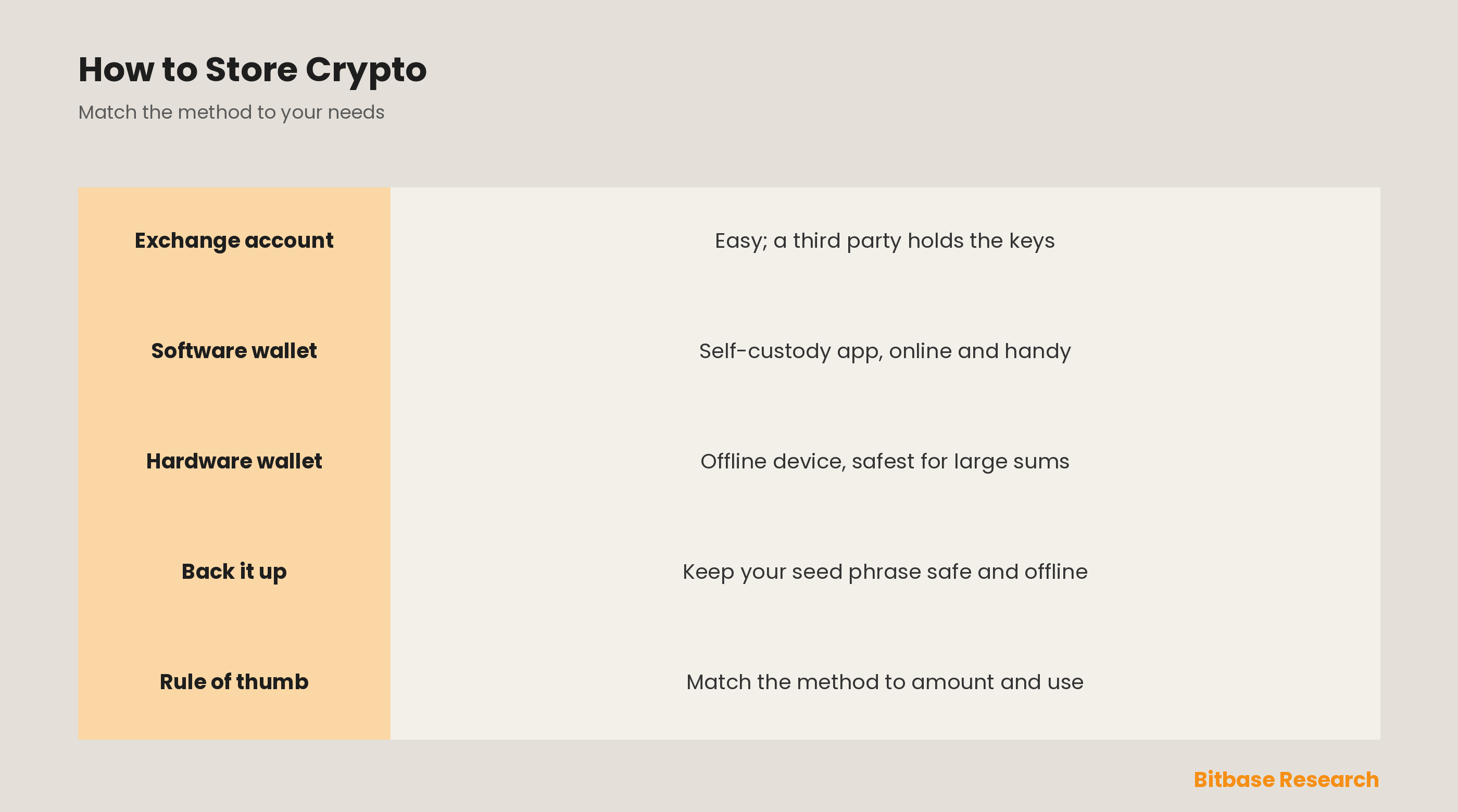
Leaving crypto on an exchange is the easiest to start with, but a third party holds your keys, so it suits smaller amounts you trade often [1]. A software (hot) wallet is a self-custody app that keeps you online and convenient. A hardware (cold) wallet is an offline device that's the safest choice for larger, long-term holdings, since the keys never touch the internet [2].
Choosing and backing up
The bottom line
Match the storage method to your needs: an exchange or hot wallet for small amounts you use often, and a hardware wallet for larger sums you're holding long term. Whatever you choose, back up your seed phrase offline and never share your private key — that backup is what restores your funds if a device is lost. Many people split holdings across methods. To keep learning the fundamentals, follow more from Bitbase Academy.
Disclaimer: This article is educational content from Bitbase Academy, provided for information only. It does not constitute investment, trading, tax, or financial advice. Crypto assets are volatile; assess your own risk. Written as of June 2026; refer to the latest official information.
References
[1] Coinbase, "What is a crypto wallet?" coinbase.com
[2] Ledger, "How to store crypto safely." ledger.com