
A crypto wallet does not actually “hold” your coins — your coins always live on the blockchain. What a wallet keeps are the keys that control those assets. To understand wallets, you need to grasp public and private keys, hot and cold storage, and what “self-custody” really means. This guide explains crypto wallets from the ground up.
What a crypto wallet is
Many people assume a crypto wallet “holds money” the way a physical wallet does. It doesn’t. Your coins are always recorded on the blockchain, a public ledger; what the wallet actually keeps is a set of keys that prove ownership and authorize transfers.
In other words, a wallet is your keyring to the blockchain. Whoever holds the private key controls the assets — which is where crypto’s well-known saying comes from: “not your keys, not your coins.”
Public keys, private keys, and the seed phrase
A wallet holds two kinds of critical information:
- Public key / address. This is like your “account number for receiving” — you can share it openly so others can send you crypto. - Private key. This is the “master password” that signs and authorizes every outgoing transaction, and it must never be exposed.
For easier backup, a wallet usually generates a seed phrase when you create it — a list of words that is the master key to restoring the entire wallet. Writing the seed phrase down and keeping it offline is the single most important way to protect your funds.
The main types of wallets
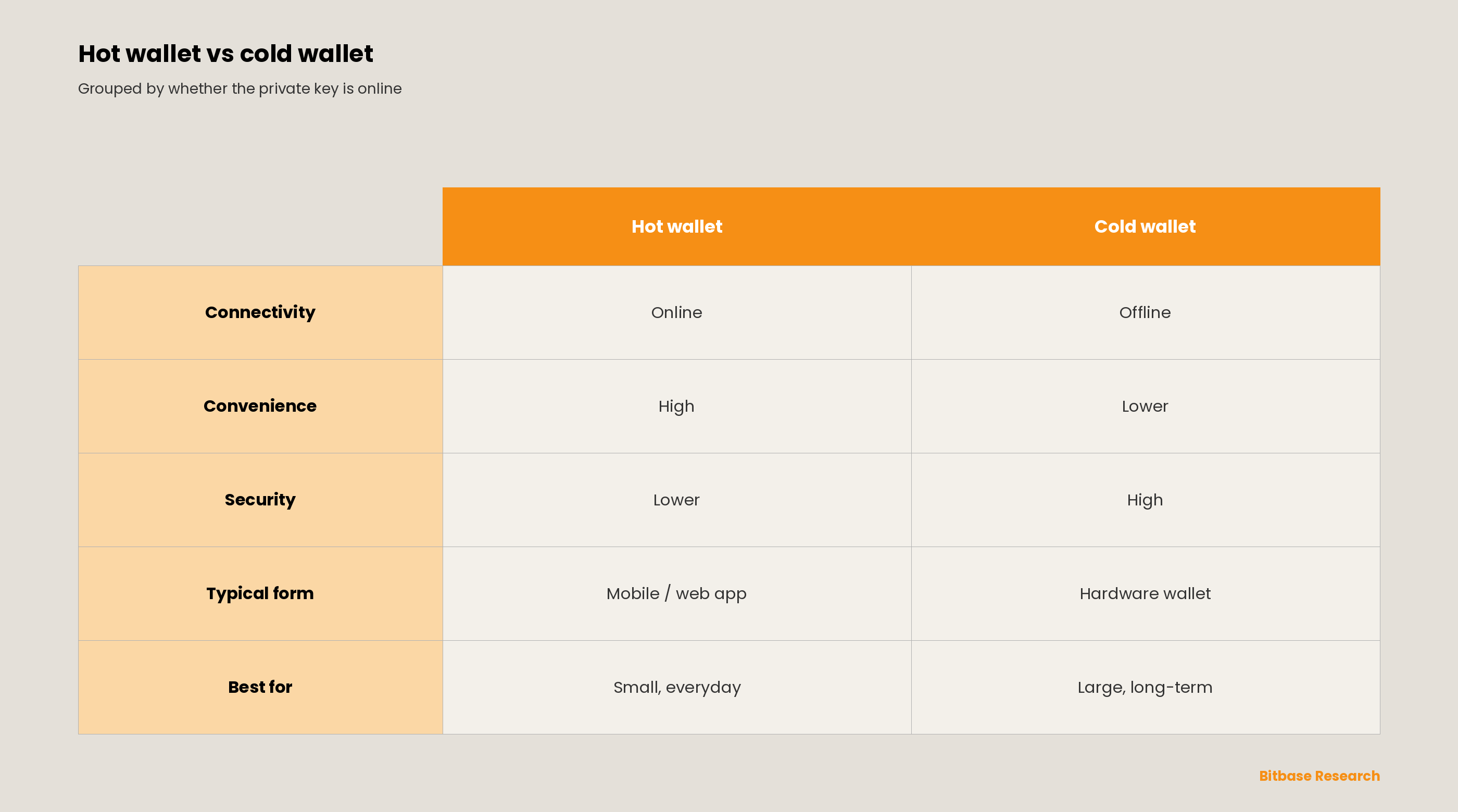
Wallets are usually grouped by how they keep the private key.
Hot wallets
A hot wallet keeps the private key on an internet-connected device — a mobile app, desktop program, or browser extension. The upside is convenience: you can transact anytime. The downside is that an online key is a bigger target for hackers, so hot wallets suit small amounts for everyday use.
Cold wallets
A cold wallet keeps the private key offline, most commonly via a hardware wallet. Signing happens on the offline device and the key never touches the internet, which is far more secure. The trade-off is a few extra steps, the cost of a device, and the risk of losing or damaging it — making cold wallets best for larger, long-term holdings.
Custodial vs self-custody
When a third party such as an exchange holds the private key for you, that is a custodial wallet: convenient, but you must trust the platform. When you alone hold the private key, that is a self-custody wallet: maximum control, but the responsibility is entirely yours — lose the seed phrase, and the assets cannot be recovered.
How to keep your wallet safe
- Back up the seed phrase offline. Write it on paper and store it safely; never screenshot it or upload it to the cloud. - Use cold storage for large amounts. Keep small everyday sums in a hot wallet and large long-term holdings on a hardware wallet. - Watch for phishing. No legitimate service will ever ask for your seed phrase or private key; anyone who does is running a scam.
The bottom line
A crypto wallet manages not your coins but the keys that control them. Understanding public and private keys, hot and cold wallets, and custodial versus self-custody is the foundation for entering crypto safely. To keep learning the fundamentals, follow more from Bitbase Academy.
Disclaimer: This article is educational content from Bitbase Academy, provided for information only. It does not constitute investment, trading, tax, or financial advice. Crypto assets are highly volatile, and self-custody means you bear full responsibility for safeguarding your private keys. Written as of June 2026; platform and product details may change, so refer to the latest official information.
References
[1] Ledger Academy, "Hot Wallet vs Cold Wallet: What's the Difference?" ledger.com
[2] Investopedia, "Cryptocurrency Wallet." investopedia.com