Position sizing is deciding how much to put into a single trade — usually a small, fixed share of your account. It is the main tool that keeps one bad trade from doing real damage, and it matters more than any entry signal. Here's how to size a position.
Why size matters most
You can be right about direction and still blow up an account if the position is too big. Size is the one variable you fully control: the market decides the outcome, but you decide how much is at stake. A sensible rule caps the loss on any single trade at a small percentage of the account, so a losing streak is survivable rather than fatal.
The 1% and 2% risk rules
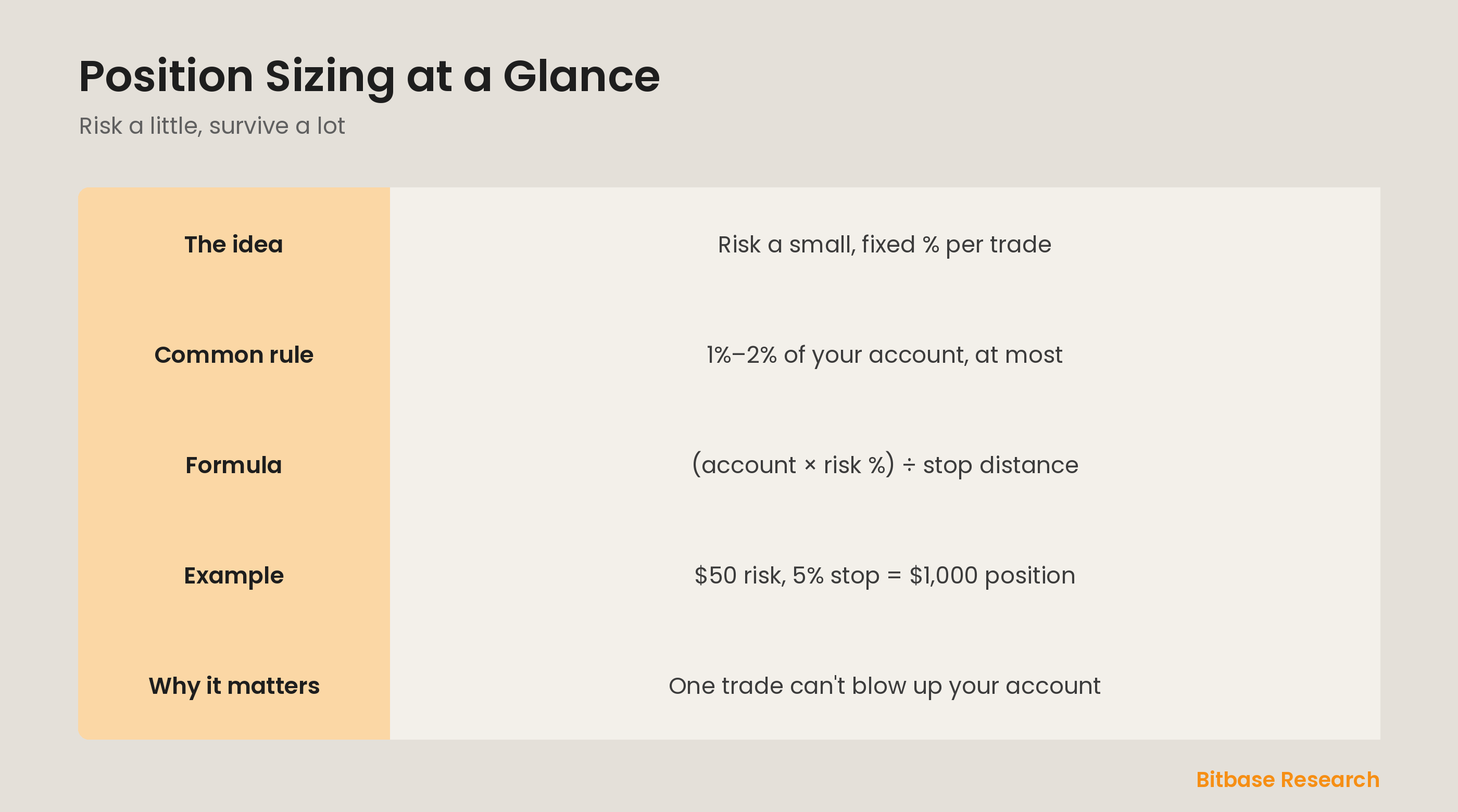
The most common guideline is to risk no more than 1%–2% of your account on one trade. On a $5,000 account, 1% is $50 — that is the most you would lose if the trade hits your stop, not the size of the position. Beginners often start at 1% or less. The rule turns risk into a fixed budget: even ten losses in a row cost only about 10% of the account, which is recoverable.
How to calculate your size
Position size follows from three numbers: your account, the percent you will risk, and the distance to your stop-loss. The formula is position size = (account × risk %) ÷ distance to stop. Risk $50 with a stop 5% away and your position is $50 ÷ 0.05 = $1,000. A closer stop lets you hold a bigger position for the same risk; a wider stop means the position must shrink. That is why stop distance and size are always set together.
Position size vs leverage
Sizing and leverage answer different questions. Size is how much of your capital is at risk; leverage only changes how much margin the position ties up. A $1,000 position carries the same risk whether you fund it fully or with 10x leverage — but higher leverage moves the liquidation price closer, so it can close you out before your intended stop. Decide your risk-based size first, then use only as much leverage as that position needs.
The bottom line
Position sizing is the quiet skill behind consistent trading: pick a small, fixed risk per trade, place your stop, and let the math set the size. Get this right and no single trade can hurt you much; get it wrong and even a good strategy can be wiped out by one oversized bet. To keep learning the fundamentals, follow more from Bitbase Academy.
Disclaimer: This article is educational content from Bitbase Academy, provided for information only. It does not constitute investment, trading, tax, or financial advice. Crypto assets are volatile; assess your own risk. Written as of June 2026; refer to the latest official information.
References
[1] Investopedia, "Position Sizing in Investment: Control Risk Maximize Returns" investopedia.com
[2] Corporate Finance Institute, "Position Sizing" corporatefinanceinstitute.com
[3] Investopedia, "Risk Management in Finance" investopedia.com