Trading on margin means borrowing to open a position larger than your own money would allow, and exchanges protect themselves — and you — with a set of rules about how much collateral you must keep. Those rules are margin requirements, and the warning that fires when you breach them is the margin call. Understanding both is what stands between a manageable loss and a forced liquidation. Here is how the chain works, step by step.
Initial margin: opening the position
Initial margin is the amount you must put up to open a leveraged position. It is your own stake in the trade — the collateral that sits behind the borrowed portion. Higher leverage means a smaller initial margin relative to the position's size, which is exactly why leverage is powerful and dangerous at once: a small deposit controls a large position, so a small price move has an outsized effect on your equity.
Maintenance margin: keeping it open
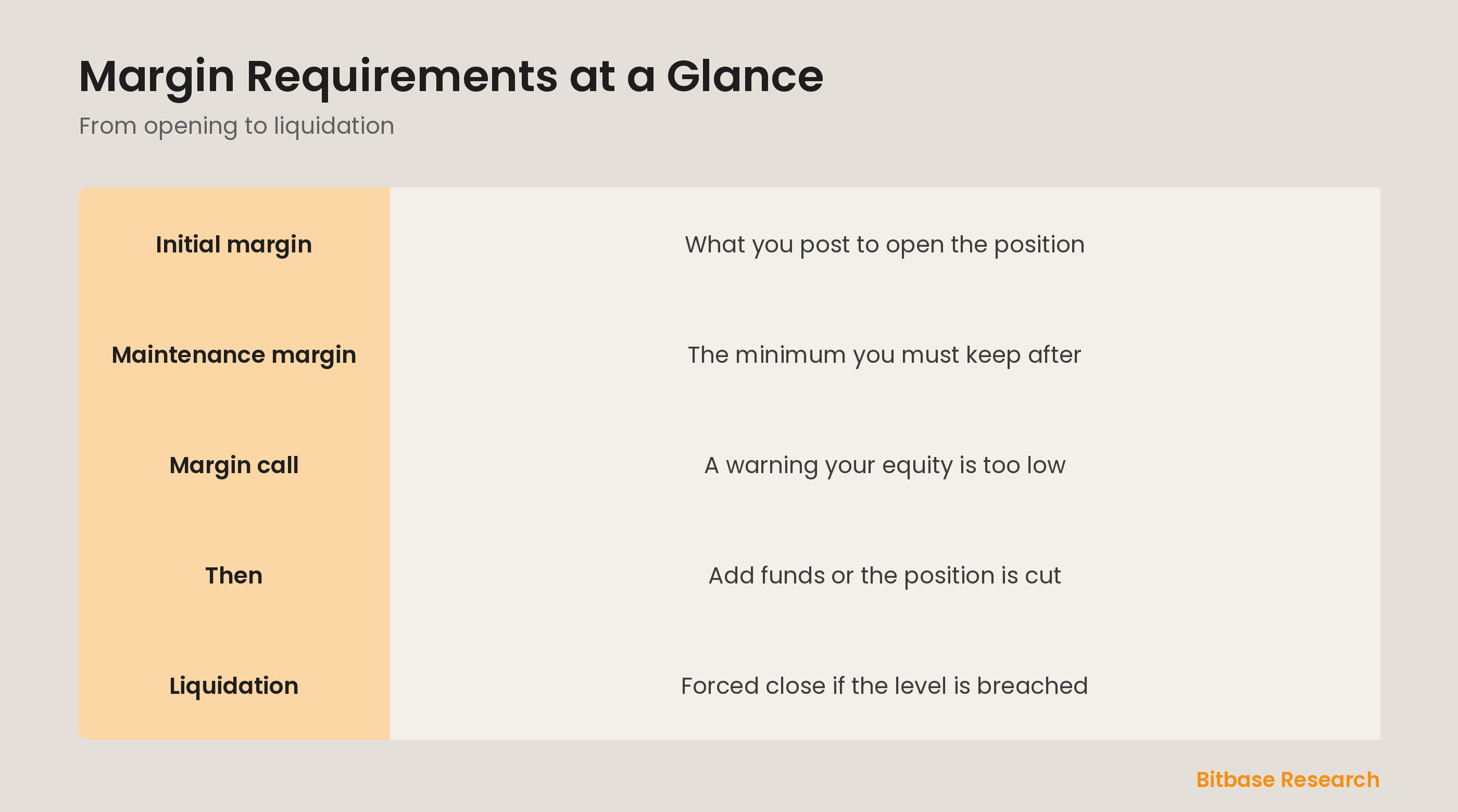
Once the position is open, you must keep your equity above a lower threshold called the maintenance margin. As the price moves against you, your equity falls; as long as it stays above this floor, the position stays open. The maintenance margin is deliberately set below the initial margin, giving the trade some room to breathe before the exchange has to step in.
The margin call: a warning
When your equity drops toward the maintenance level, the exchange issues a margin call — a warning that your collateral is running thin. It is a demand to act: either add more funds to restore your equity, or reduce the position to lower the requirement. In fast crypto markets a margin call can arrive with little warning, and the window to respond may be very short.
Liquidation: when the level breaks
If you do not meet the margin call and your equity falls through the maintenance level, the exchange liquidates the position — closing it automatically to stop the loss from going further. Liquidation locks in your loss, usually along with fees, and in cross margin it can reach into the rest of your account. Avoiding it is the whole point of watching your margin: liquidation is the failure mode these rules are built to prevent.
The bottom line
Margin requirements form a ladder: initial margin opens the position, maintenance margin keeps it alive, the margin call warns you when equity runs low, and liquidation forces the position closed if you ignore that warning. The higher your leverage, the thinner the buffer between each rung. Knowing exactly where your liquidation price sits — and keeping a cushion above it — is the core of surviving leveraged trading. To keep learning the fundamentals, follow more from Bitbase Academy.
Disclaimer: This article is educational content from Bitbase Academy, provided for information only. It does not constitute investment, trading, tax, or financial advice. Crypto assets are volatile; assess your own risk. Written as of June 2026; refer to the latest official information.
References
[1] Investopedia, "Initial Margin: Definition, Minimum Requirements, Example" investopedia.com
[2] Investopedia, "Maintenance Margin: Definition and Comparison to Margin Call" investopedia.com
[3] Investopedia, "Margin Call: What It Is and How to Meet One With Examples" investopedia.com