Behind every crypto futures market sits a chain of safety mechanisms that decide what happens when a losing position can no longer pay its own losses. Understanding this stack — maintenance margin, liquidation, the insurance fund, and auto-deleveraging — explains why even a profitable trade can sometimes be closed against your will. Here is how the layers work and what they mean for you.
The layers of defense
When a leveraged position loses money, the first line is the maintenance margin: the minimum collateral it must keep. Drop below it and the liquidation engine steps in and force-closes the position on the market. In an orderly market that is the end of the story — you lose your margin and the trade is over. The deeper mechanisms only matter when a liquidation cannot be closed cleanly at a good enough price.
The insurance fund
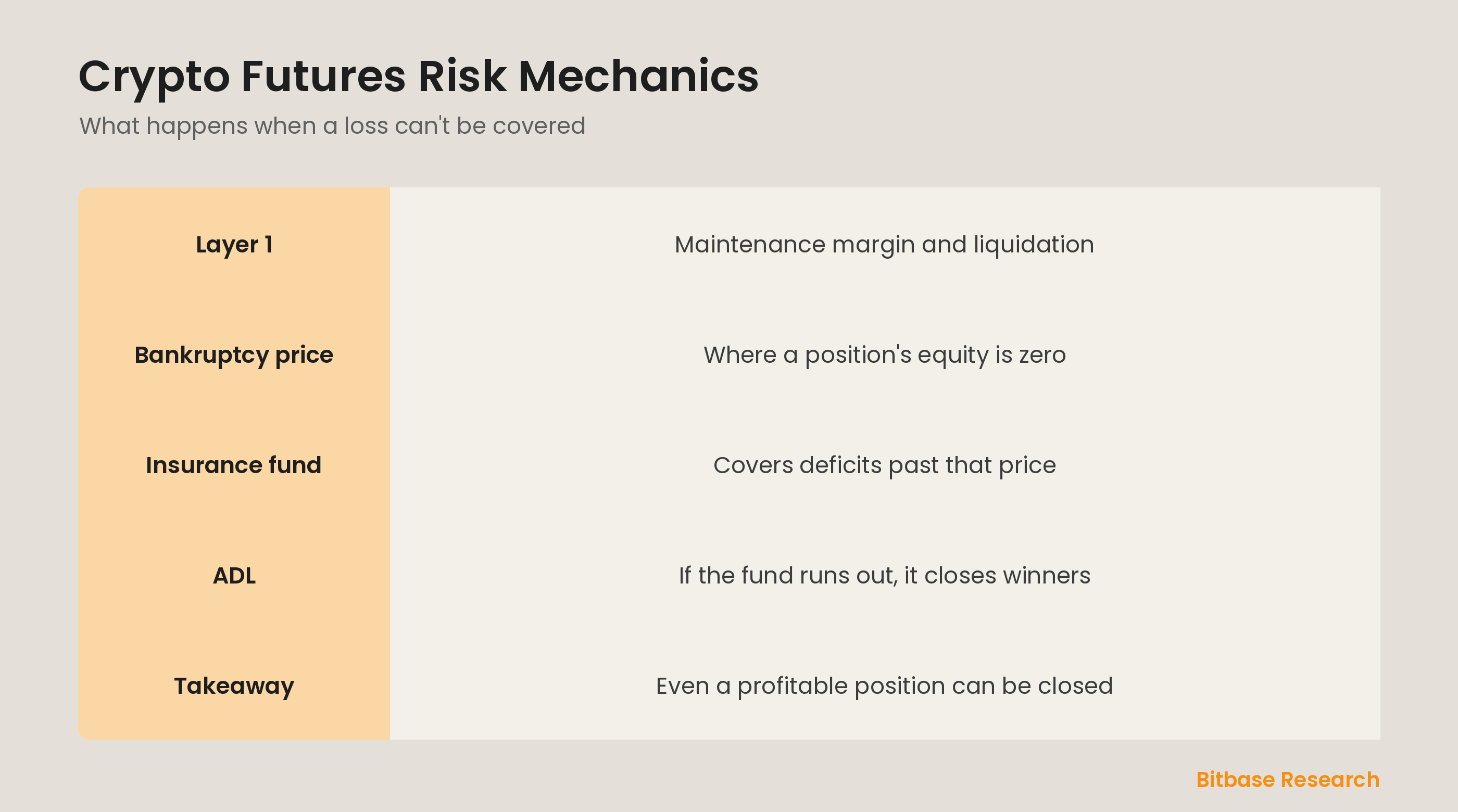
Every position has a bankruptcy price, the point where its remaining equity is exactly zero. Ideally the liquidation engine closes a position a little before that, leaving a small surplus. Those surpluses are pooled into an insurance fund. When the market moves too fast and a position is instead closed below its bankruptcy price — creating a shortfall the losing trader cannot cover — the insurance fund absorbs that deficit, so the winning counterparties still get paid in full.
Auto-deleveraging (ADL)
If losses come faster than the insurance fund can absorb and it runs dry, the exchange turns to auto-deleveraging. ADL covers the remaining bad debt by force-closing positions on the opposite, winning side of the market, usually starting with the most profitable and highly leveraged traders. In other words, when the safety net is exhausted, some winning positions are closed early to balance the books — through no fault of the traders holding them.
What it means for you
These mechanics mostly stay invisible, but in violent, cascading sell-offs they can surface. A heavily leveraged winning position can be partially or fully closed by ADL, cutting a profit short at the worst possible moment. Exchanges usually show an ADL indicator warning how exposed you are. The practical defenses are the familiar ones: use lower leverage, do not sit at the top of the ADL queue, and understand that extreme volatility can reach even profitable trades.
The bottom line
Crypto futures rely on a layered safety system: maintenance margin and liquidation handle normal losses, an insurance fund absorbs shortfalls when liquidations close past the bankruptcy price, and auto-deleveraging closes winning positions when that fund is exhausted. The uncomfortable takeaway is that in extreme conditions even a profitable, high-leverage position is not fully safe — one more reason to trade perps with restraint. To keep learning the fundamentals, follow more from Bitbase Academy.
Disclaimer: This article is educational content from Bitbase Academy, provided for information only. It does not constitute investment, trading, tax, or financial advice. Crypto assets are volatile; assess your own risk. Written as of June 2026; refer to the latest official information.
References
[1] Britannica Money, "Perpetual Futures: Meaning, Regulation, and Example" britannica.com
[2] Investopedia, "Margin Call: What It Is and How to Meet One With Examples" investopedia.com
[3] CFTC, "Customer Advisory: Understand the Risks of Virtual Currency Trading" cftc.gov