
BIP-39 is the standard that turns a wallet's random secret into the 12 or 24 words you write down as a backup. Those recovery words are not decoration — they are a precise, checked encoding of the number your wallet is built from. Here is what BIP-39 is, how the word list works, and how the words become your keys.
What BIP-39 is
A crypto wallet is ultimately built from a large random number. Writing that number down as raw digits would be error-prone, so BIP-39, introduced in 2013, defines a way to encode it as ordinary words instead. People copy words far more reliably than long strings of hex, which is exactly why almost every modern wallet shows you a word list rather than a code. The words are just a human-friendly form of the same secret.
The 2,048-word list
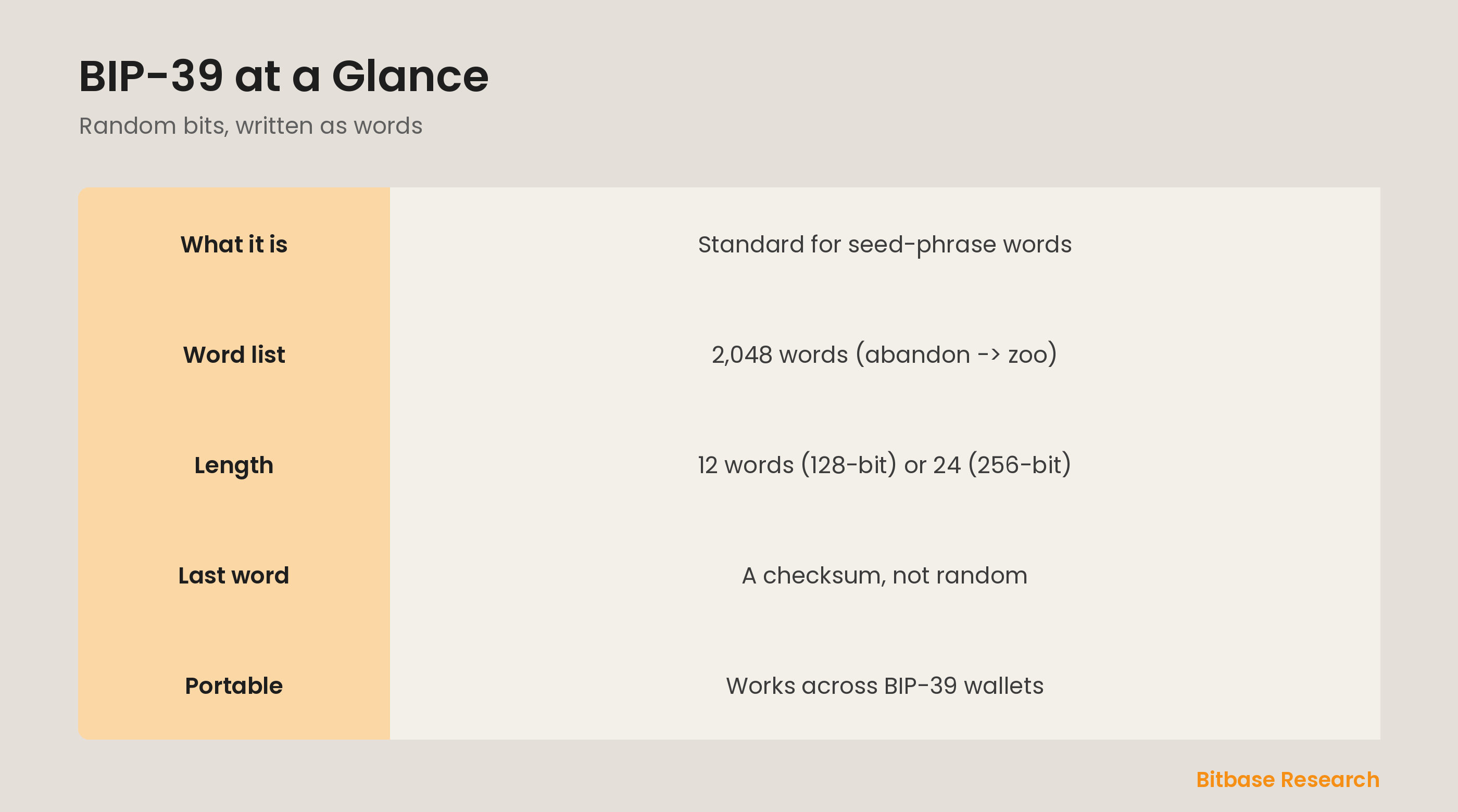
BIP-39 uses a fixed list of exactly 2,048 English words, arranged alphabetically from “abandon” to “zoo.” Each word stands for an 11-bit value, so its position in the list — not the word itself — carries the information. The list is chosen so that the first four letters of each word are unique, which lets wallets auto-complete and check entries. Other languages have their own official lists, but the English one is by far the most common.
12 words vs 24 words
The number of words depends on how much randomness (entropy) the wallet starts with: 128 bits produces a 12-word phrase, and 256 bits produces a 24-word phrase. Both are far beyond any realistic chance of being guessed, so 12 words is plenty secure; 24 words simply adds margin and is the default on many hardware wallets. Importantly, the final word is not random — it includes a checksum, so a phrase with a typo will usually be rejected as invalid.
From words to keys
The words themselves are not your private keys. Your wallet feeds the phrase, plus an optional passphrase, through a slow hashing function (PBKDF2-HMAC-SHA512) to produce a 512-bit seed, and every key and address is then derived from that seed. Because the process is standardised, the same phrase recreates the same wallet in any BIP-39-compatible app — which is what makes your seed phrase both your backup and, in the wrong hands, full access.
The bottom line
BIP-39 is why your backup is a list of words instead of a wall of numbers: it encodes your wallet's secret as a checked, human-readable phrase. Anyone with the phrase can rebuild the wallet, so store it offline and never type it into a website. Twelve words are already secure; the checksum guards against typos; and the standard is what lets you recover your funds in almost any wallet. To keep learning the fundamentals, follow more from Bitbase Academy.
Disclaimer: This article is educational content from Bitbase Academy, provided for information only. It does not constitute investment, trading, tax, or financial advice. Crypto assets are volatile; assess your own risk. Written as of June 2026; refer to the latest official information.
References
[1] Bitcoin Improvement Proposals, "BIP-39: Mnemonic Code for Generating Deterministic Keys" github.com
[2] Trezor Learn, "What Is BIP39?" trezor.io
[3] Investopedia, "What Is a Private Key, and How Does It Work?" investopedia.com