The risk-reward ratio compares how much you can lose on a trade to how much you can gain. Written as 1:2 or 1:3, it turns “is this trade worth taking?” into a number you can check before you enter. Here is how to read it, calculate it, and use it.
What the ratio actually measures
Every trade has a downside and an upside. The risk-reward ratio puts them side by side: the risk is how far price can fall to your stop-loss, and the reward is how far it can rise to your target. A 1:3 ratio means you are risking one dollar to make three. On its own it says nothing about how likely the trade is to work — only about the payout if it does — which is why it is always used together with your win rate.
How to calculate it
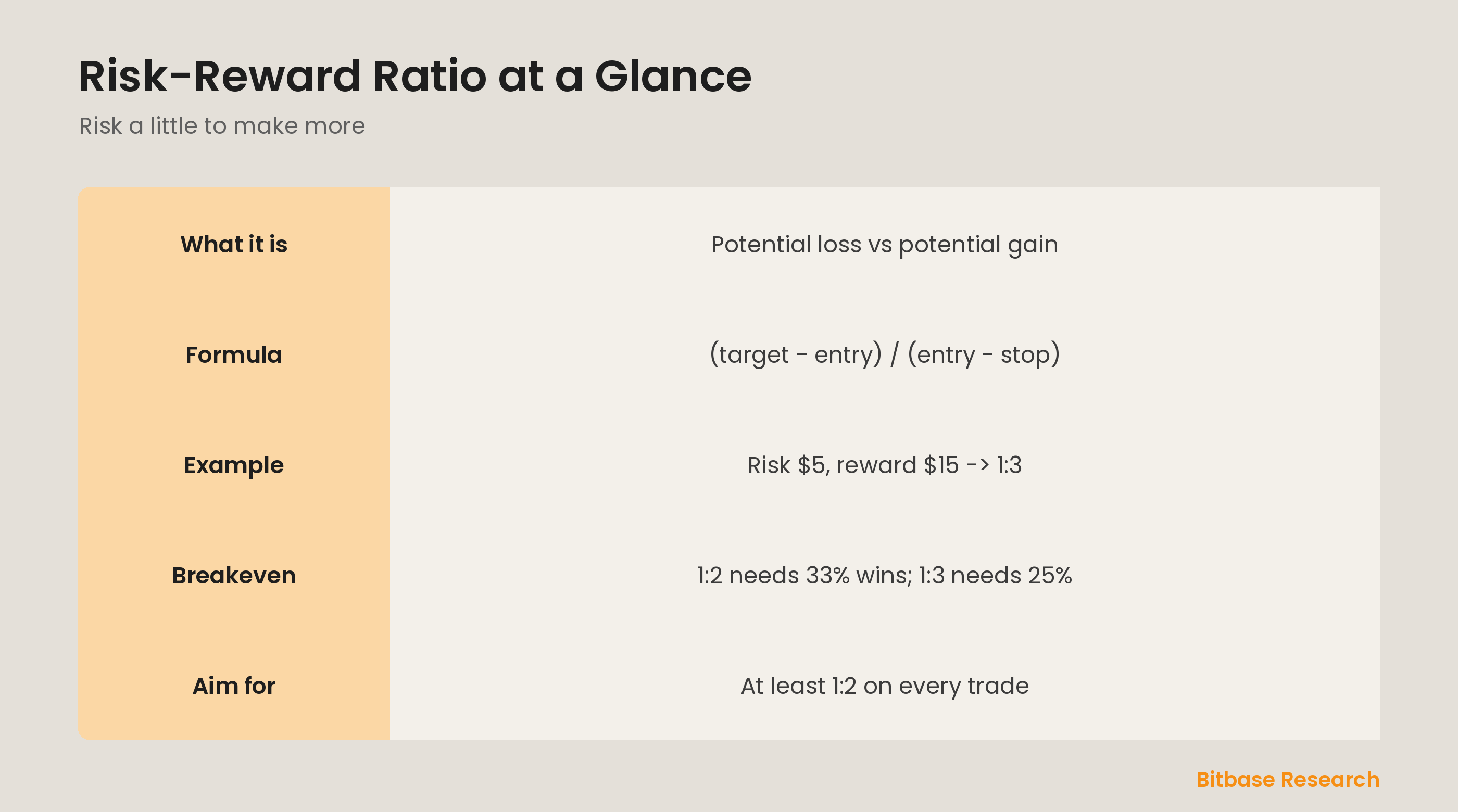
You need three prices: your entry, your stop-loss, and your take-profit target. Risk equals entry minus stop; reward equals target minus entry; the ratio is reward divided by risk. Say you buy SOL at $140, set a stop at $135, and a target at $155. Your risk is $5 per coin and your reward is $15, so the ratio is 15 ÷ 5 = 3, written 1:3. The dollar amounts themselves do not matter — only the proportion between them does.
The ratio is only half the story
A great ratio with a poor hit rate still loses money, so the ratio only means something next to your win rate. The breakeven win rate is 1 ÷ (1 + ratio): at 1:2 you need to win only about 33% of the time to break even, and at 1:3 about 25%. That is the real power of a strong ratio — it lets you be wrong more often than you are right and still come out ahead over many trades.
Choosing a realistic ratio
Most traders aim for at least 1:2, and the range of 1:2 to 1:3 is a common sweet spot. Higher is not automatically better: a 1:10 target that price almost never reaches is worse than a 1:2 target that hits regularly. Set your stop where the trade idea is proven wrong, set your target where price is realistically likely to go, then check the ratio. If it comes out below 1:1, the trade is usually not worth taking.
The bottom line
The risk-reward ratio is a quick filter for trade quality: it stops you from risking a lot to make a little. Pair it with a stop-loss and an honest view of your win rate, insist on at least 1:2, and let trades that do not clear the bar pass by. Consistent trading is less about being right every time and more about making sure your winners are bigger than your losers. To keep learning the fundamentals, follow more from Bitbase Academy.
Disclaimer: This article is educational content from Bitbase Academy, provided for information only. It does not constitute investment, trading, tax, or financial advice. Crypto assets are volatile; assess your own risk. Written as of June 2026; refer to the latest official information.
References
[1] Investopedia, "Risk/Reward Ratio: What It Is, How Stock Investors Use It" investopedia.com
[2] Corporate Finance Institute, "Risk/Reward Ratio" corporatefinanceinstitute.com
[3] Investopedia, "Risk Management in Finance" investopedia.com