Mean reversion is the opposite philosophy to trend following. Instead of assuming a move will continue, it bets that price, after stretching far from its average, will snap back toward it. The core belief is that markets have a normal level and extreme moves away from it are temporary. This makes mean reversion powerful in the right conditions and dangerous in the wrong ones. Here is how the strategy works and when it fits.
The core idea
Mean reversion is based on the idea that price tends to return to an average, or mean, over time. When price stretches unusually far above its typical level, a mean reversion trader expects it to fall back; when it drops unusually far below, they expect it to bounce. The strategy treats extreme moves as temporary overreactions that will correct, so it trades against the recent move, betting on a return to normal rather than a continuation.
Buying low and selling high
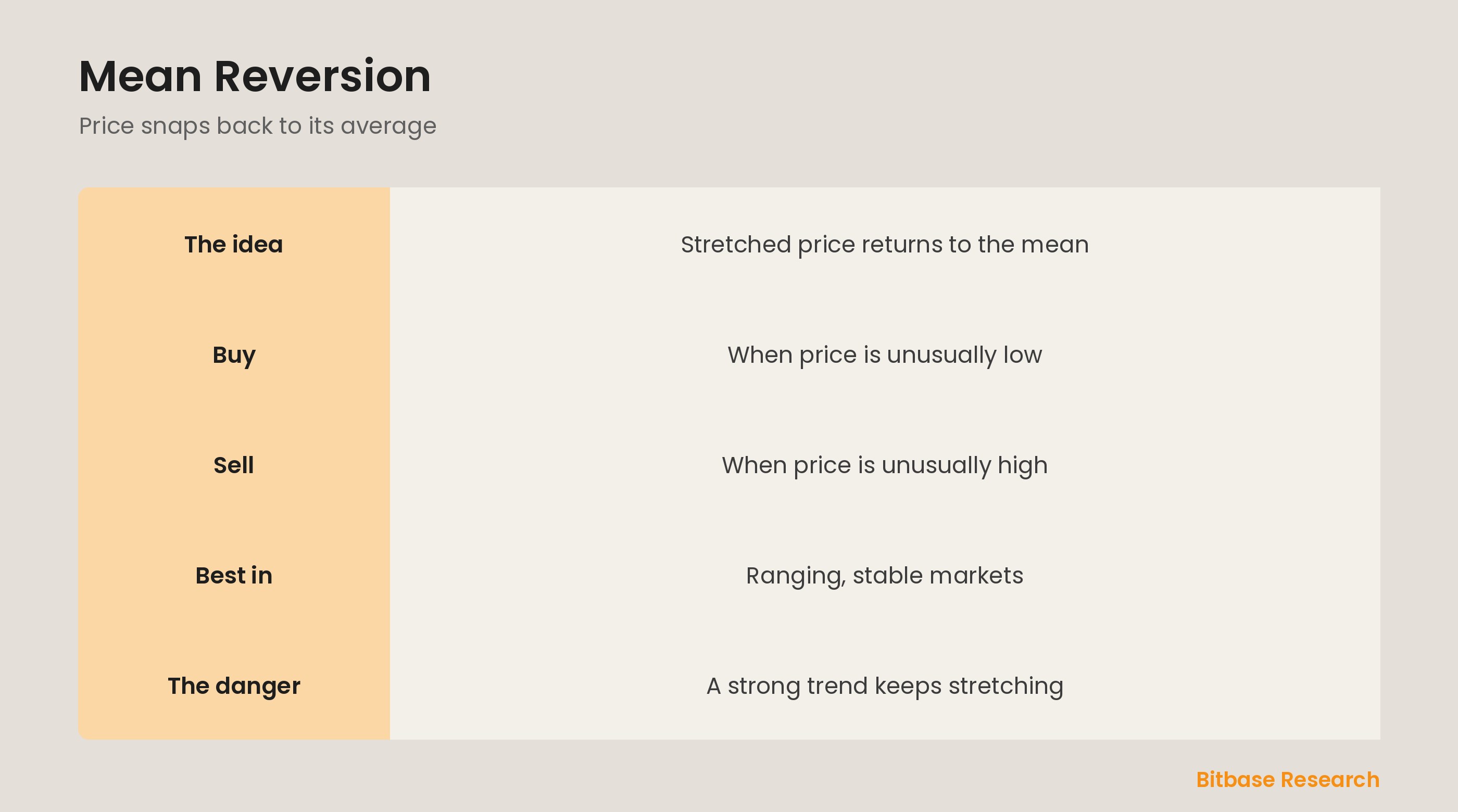
In practice, mean reversion means buying when price looks unusually cheap relative to its average and selling when it looks unusually expensive. Traders define an average, such as a moving average, and measure how far price has strayed from it, often using tools like the RSI or Bollinger Bands to flag stretched conditions. The plan is to enter when price is at an extreme and exit as it reverts toward the mean, capturing the snap-back rather than the move itself.
Where it works best
Mean reversion works best in ranging, stable markets where price genuinely oscillates around a level. In a well-defined range, buying near support and selling near resistance is essentially a mean reversion strategy, and it can be reliably profitable because price keeps returning to the middle. The more range-bound and balanced a market is, the better mean reversion performs, since the underlying assumption of a return to average actually holds.
The danger of a trend
The great danger for mean reversion is a strong trend. When price is trending powerfully, an extreme reading is not a signal to fade; it is the trend continuing, and a mean reversion trader who keeps betting on a snap-back gets run over as price stretches further and further. This is the mirror image of trend following's weakness: what breaks a trend follower is choppy markets, and what breaks a mean reversion trader is a persistent trend.
The bottom line
Mean reversion bets that price, after stretching far from its average, will return to it, so the trader buys when price is unusually low and sells when it is unusually high, fading the extreme. It works best in ranging, stable markets where price oscillates around a level, much like buying support and selling resistance. Its great danger is a strong trend, which keeps stretching and runs over anyone betting on a snap-back. To keep learning the fundamentals, follow more from Bitbase Academy.
Disclaimer: This article is educational content from Bitbase Academy, provided for information only. It does not constitute investment, trading, tax, or financial advice. Crypto assets are volatile; assess your own risk. Written as of June 2026; refer to the latest official information.
References
[1] Investopedia, "Mean Reversion: Definition, How It Works, and Formula" investopedia.com
[2] Investopedia, "Range-Bound Trading: Definition and How Strategy Works" investopedia.com
[3] Investopedia, "Technical Analysis: What It Is and How to Use It" investopedia.com