If you lose your phone, break a device or forget a password, you can usually get your crypto back — as long as you have your recovery details. For a self-custody wallet that's your seed phrase; for an exchange account it's the provider's reset process. Here's how each works.
Self-custody vs exchange
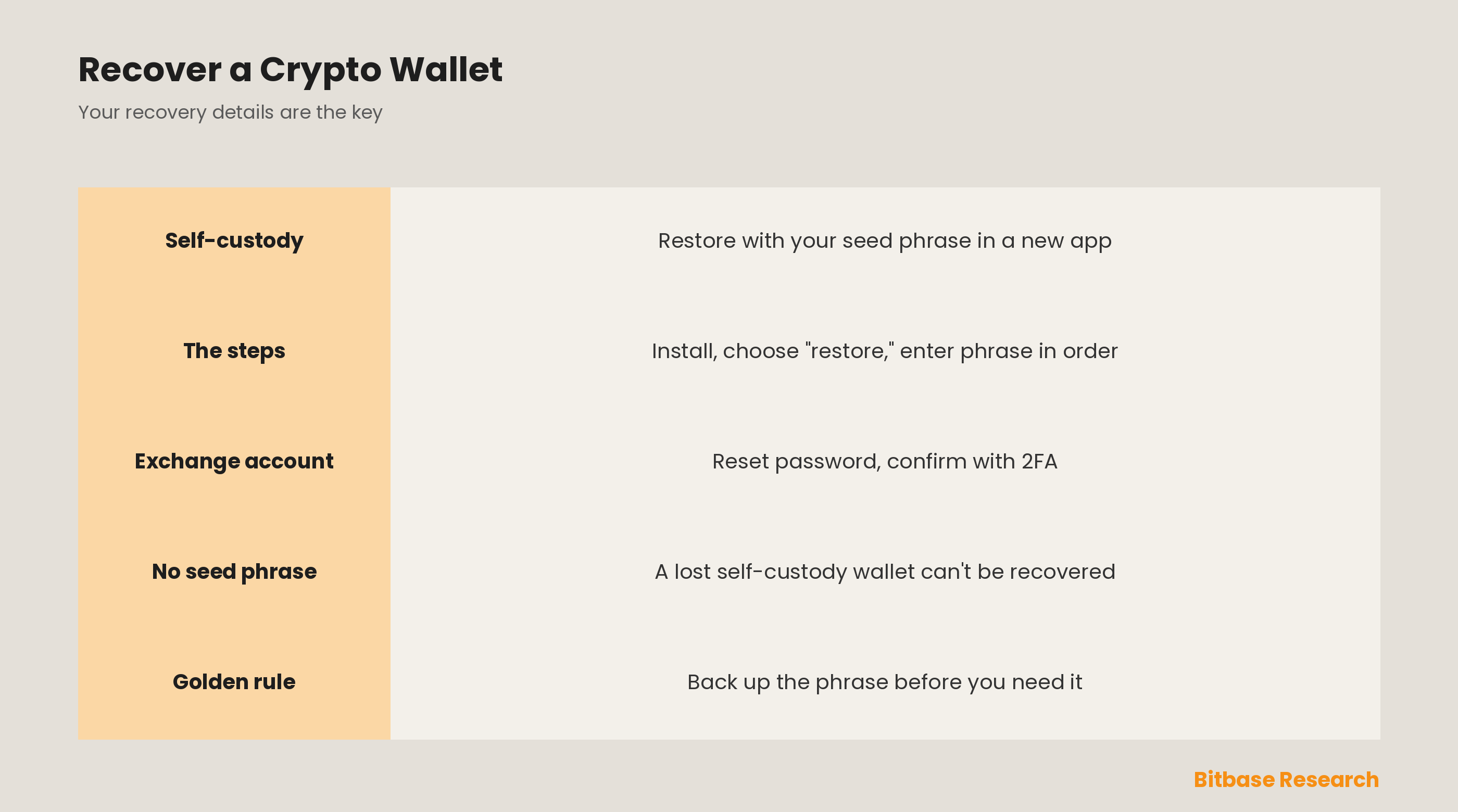
For a self-custody wallet, your funds aren't on the device — they're on the blockchain, and the wallet is restored from your seed phrase. Install a compatible wallet app, choose "restore" or "import," and enter your recovery phrase in the exact order to bring everything back [1]. For a custodial exchange account, you don't hold the keys, so recovery runs through the provider: reset your password and confirm with two-factor authentication or support [2].
The steps and the golden rule
The bottom line
Recovery depends on what you have. A self-custody wallet is restored by entering its seed phrase into a compatible app, so that phrase is the single most important thing to protect. An exchange account is recovered through the provider's password reset and identity checks. The one situation no one can fix is a self-custody wallet with a lost seed phrase — which is why you back it up before you ever need it. To keep learning the fundamentals, follow more from Bitbase Academy.
Disclaimer: This article is educational content from Bitbase Academy, provided for information only. It does not constitute investment, trading, tax, or financial advice. Crypto assets are volatile; assess your own risk. Written as of June 2026; refer to the latest official information.
References
[1] Ledger, "How do crypto wallets work?" ledger.com
[2] Coinbase, "What is a crypto wallet?" coinbase.com