Scalping runs on speed, and its strategies and indicators are built to read the market in seconds rather than hours. The tools look similar to those used in slower trading, but they are tuned to be fast and reactive — and even the best of them cannot overcome the one thing that decides a scalper's fate: trading costs. Here are the common scalping strategies, the indicators behind them, and the cost math that makes or breaks the whole style.
Common scalping strategies
A few approaches dominate. Spread scalping tries to profit from the small gap between the bid and ask in a very liquid market. Breakout scalping enters the instant price pushes past a level on a one-minute chart, aiming to grab the initial burst. Range scalping buys and sells repeatedly as price ping-pongs between tight support and resistance. All of them share tiny targets, tight stops, and very fast exits.
The key indicators
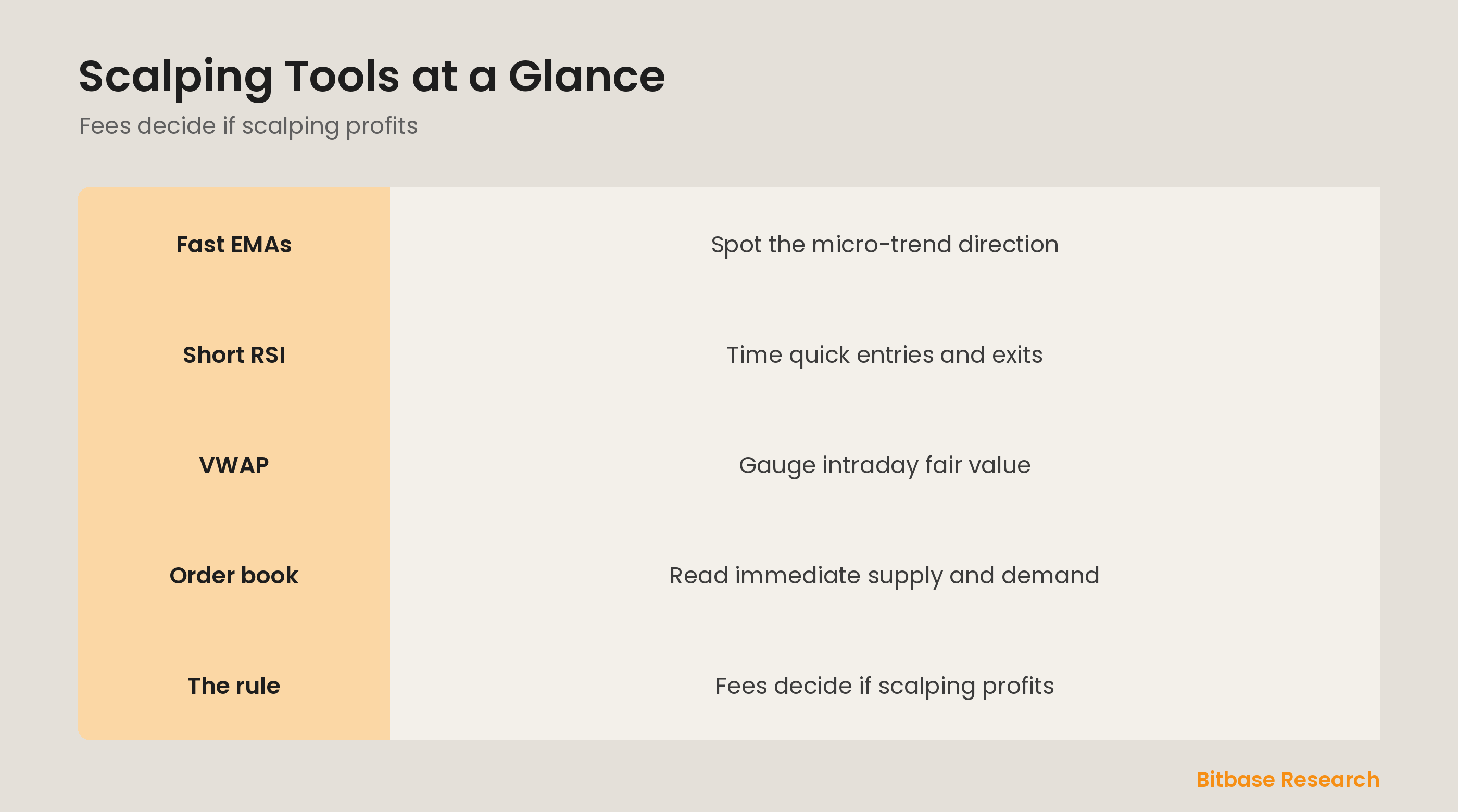
Scalpers favor fast, reactive tools. Short-period exponential moving averages reveal the immediate micro-trend and its direction. A short-length RSI helps time rapid entries and exits within that trend. VWAP, the volume-weighted average price, shows where value sits during the session. Above all, scalpers watch the order book directly to read the immediate balance of buyers and sellers, since that is what moves price second to second.
How to use them
Scalping demands fast signals, tight stops, and instant exits, plus a high win rate because each target is so small. Indicators here are used for split-second confirmation, not deliberation — a setup either lines up now or it does not. Discipline is everything: take the small profit, cut the small loss immediately, and never let a scalp turn into a hopeful longer-term hold when it goes against you.
Why fees decide everything
No indicator matters more than your cost per trade. Because each scalp targets a sliver of profit and you place many trades, fees and the spread can quietly turn a winning strategy into a losing one. Before trading real money, backtest your approach with realistic costs included, practice in paper trading, and add up the fees honestly. Guard against overtrading and burnout, which quietly erode both your account and your judgment.
The bottom line
Crypto scalping strategies like spread, breakout, and range scalping rely on fast tools — short EMAs, a short RSI, VWAP, and the order book — to make split-second decisions. But the deciding factor is cost: because targets are tiny and trades are many, fees and the spread determine whether scalping profits at all. Test with real costs, keep discipline tight, and never forget that in scalping, the math of fees rules everything. To keep learning the fundamentals, follow more from Bitbase Academy.
Disclaimer: This article is educational content from Bitbase Academy, provided for information only. It does not constitute investment, trading, tax, or financial advice. Crypto assets are volatile; assess your own risk. Written as of June 2026; refer to the latest official information.
References
[1] Investopedia, "Scalping: Definition in Trading, How Strategy Is Used and Example" investopedia.com
[2] Investopedia, "Technical Analysis: What It Is and How to Use It in Investing" investopedia.com
[3] Investopedia, "Moving Average (MA): Purpose, Uses, Formula, and Examples" investopedia.com