
Traders spend most of their energy deciding when to buy, but the exit is what actually determines whether a trade makes or loses money. An exit strategy is the plan for how you will close a position — both to take profit when it works and to cut losses when it does not. Deciding it in advance is what separates a controlled trade from a hopeful one. Here is what an exit strategy is and how to build one.
What an exit strategy is
An exit strategy is simply your plan for getting out of a trade, decided before you get in. It has two sides: how you will take profit if the price moves your way, and how you will limit the damage if it moves against you. Without one, exits become emotional — you hold winners too long out of greed and losers too long out of hope. The plan replaces both with a rule.
The two kinds of exit
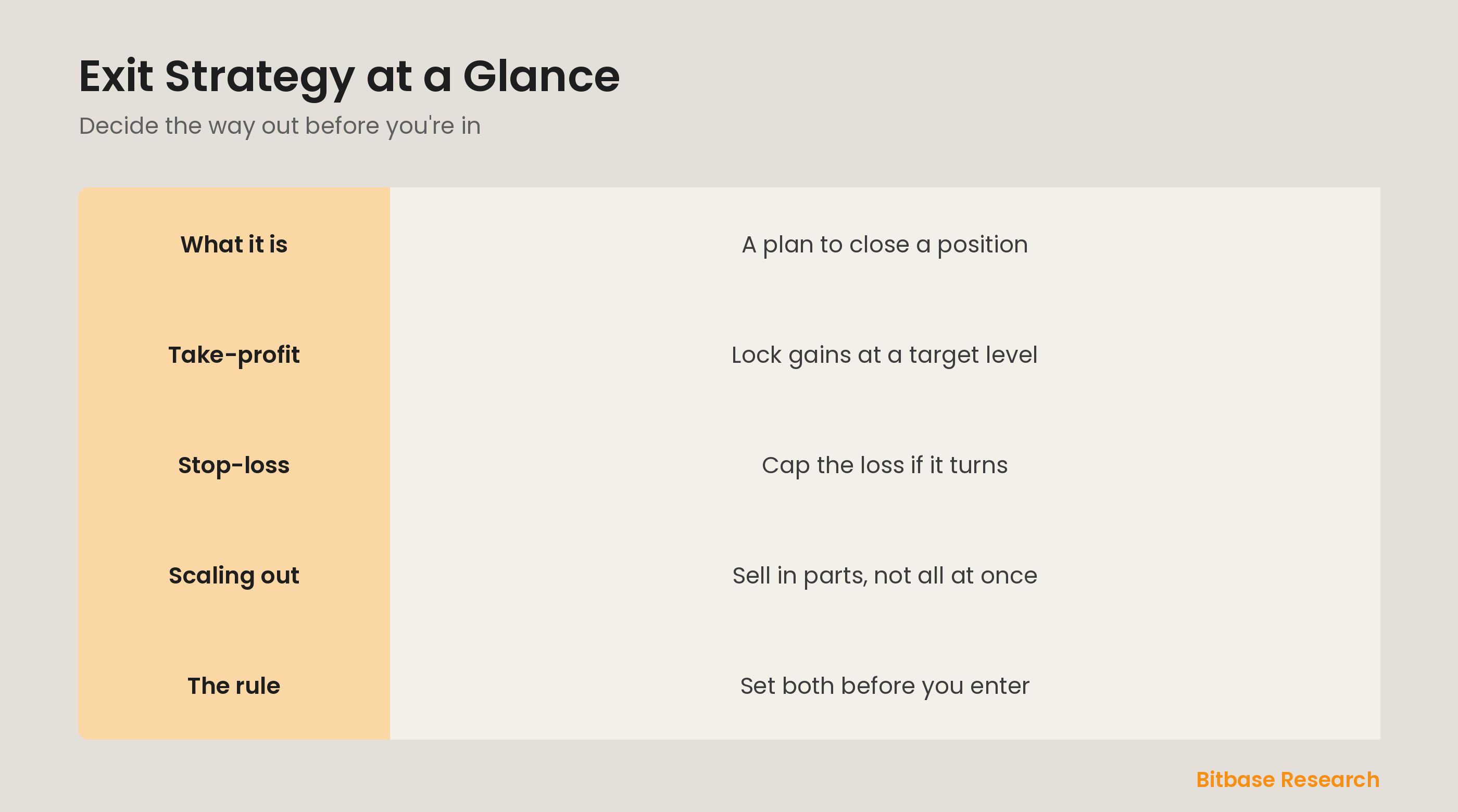
Every position needs both exits defined. A take-profit is the level where you close for a gain, locking in the profit rather than waiting and watching it evaporate. A stop-loss is the level where you close for a loss, capping how much a bad trade can cost you. Together they define your range of outcomes before you ever enter, so the trade has a known best and worst case.
Common exit methods
There are several ways to structure exits. You can use fixed price targets, or a trailing stop that follows the price up and locks in gains as it climbs. Scaling out means selling in parts as the price rises, rather than all at once, which takes some profit while leaving room to run. Many traders also anchor exits to a risk-reward ratio, aiming for a reward that is a multiple of the risk they took.
Exiting with discipline
The hardest part is following the plan when emotion pushes back. Set both your take-profit and stop-loss before you enter, so the decisions are made calmly. Do not move a stop-loss lower just because you hope the price recovers — that turns a small planned loss into a large unplanned one. Respect your targets too, and resist the urge to abandon a good exit because a coin might keep rising.
The bottom line
A crypto exit strategy plans how you close a position, covering both a take-profit to lock gains and a stop-loss to cap losses. Methods like fixed targets, trailing stops, and scaling out give you flexibility, but the core rule is the same: set your exits before you enter and stick to them. The entry gets the attention, but a disciplined exit is what protects your results. To keep learning the fundamentals, follow more from Bitbase Academy.
Disclaimer: This article is educational content from Bitbase Academy, provided for information only. It does not constitute investment, trading, tax, or financial advice. Crypto assets are volatile; assess your own risk. Written as of June 2026; refer to the latest official information.
References
[1] Investopedia, "Take-Profit Order (TP): Definition, Use in Trading, and Example" investopedia.com
[2] Investopedia, "Stop-Loss Order: Definition, How It Works, and Examples" investopedia.com
[3] Investopedia, "Trading Plan: Definition, How It Works, Rules, and Examples" investopedia.com