
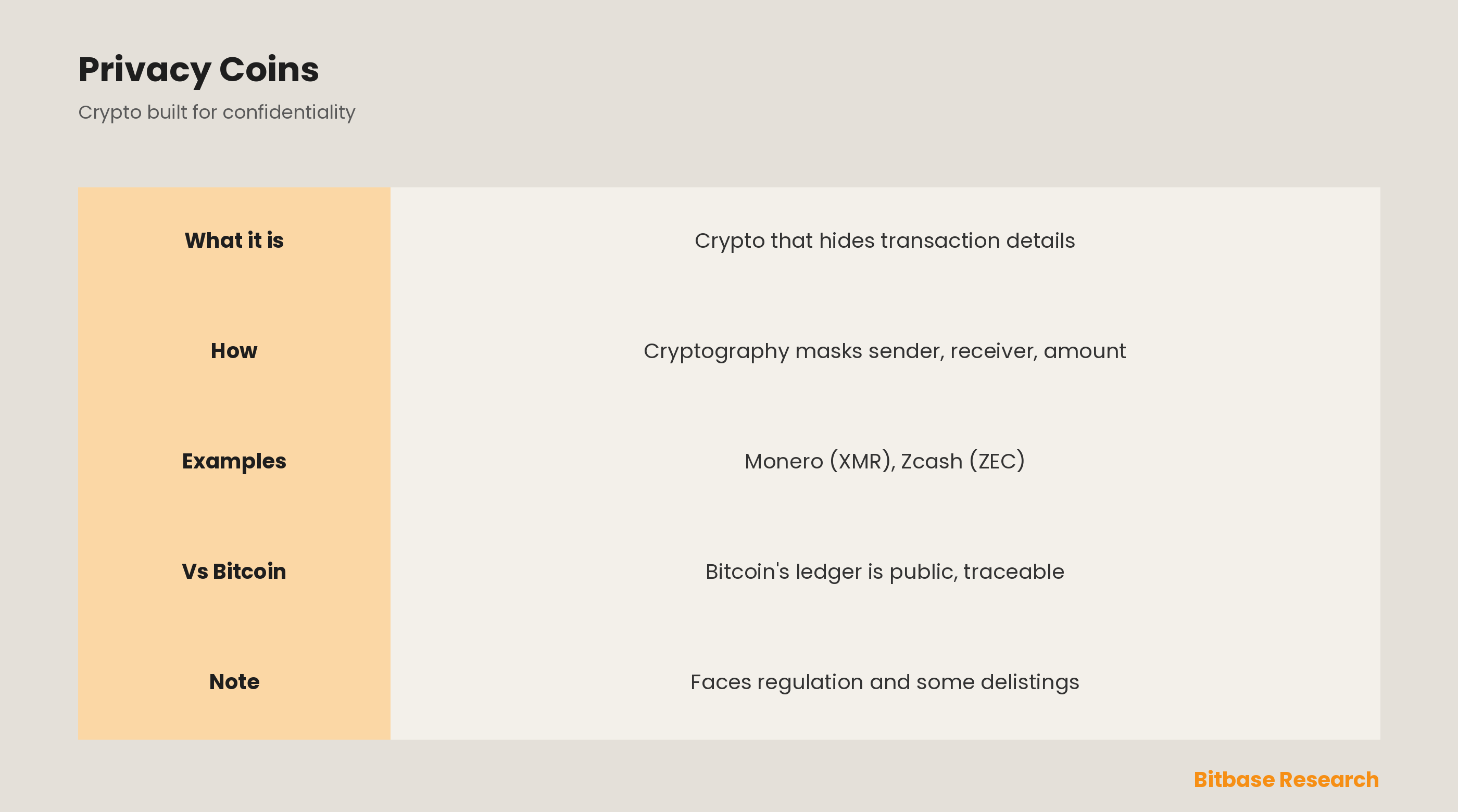
A privacy coin is a cryptocurrency built to hide transaction details — who sent, who received, and how much. It uses cryptography to keep activity confidential, unlike Bitcoin, whose ledger is public. Monero and Zcash are the best-known examples. This guide explains how they work and the debate around them.
How they hide activity
On most blockchains, like Bitcoin's, every transaction is public and traceable on the ledger. Privacy coins add cryptographic techniques — such as ring signatures, stealth addresses, or zero-knowledge proofs — that obscure the sender, receiver, and amount so outsiders can't follow the money [1]. Monero (XMR) makes privacy the default, while Zcash (ZEC) lets users choose shielded, private transactions [2].
Uses and the debate
The bottom line
A privacy coin is simply crypto designed for financial confidentiality, using cryptography to hide details that a normal public blockchain would reveal. People value them for legitimate privacy, but that same feature draws regulatory scrutiny, and some exchanges have delisted them in certain regions. If you explore privacy coins, understand both how the technology works and the rules where you live. To keep learning the fundamentals, follow more from Bitbase Academy.
Disclaimer: This article is educational content from Bitbase Academy, provided for information only. It does not constitute investment, trading, tax, or financial advice. Crypto assets are volatile; assess your own risk. Written as of June 2026; refer to the latest official information.
References
[1] Coinbase, "What is a privacy coin?" coinbase.com
[2] Kraken, "What are privacy coins?" kraken.com