When a market is not trending but bouncing sideways between two levels, range trading is the strategy that fits. Instead of chasing direction, a range trader profits from the market's tendency to reverse at the edges of a band, buying low at support and selling high at resistance. It is a form of mean reversion applied to a clear range. Here is how range trading works, how to manage risk, and when to step aside.
Identifying a range
Range trading starts with spotting a market that is moving sideways, oscillating between a support level below and a resistance level above without a clear trend. The clearer and more established these two boundaries are, the better; a range that has held several times, bouncing off support and turning down at resistance repeatedly, gives a trader confidence that the levels will hold again. Confirming the market is genuinely ranging, not trending, is the essential first step.
Buying support and selling resistance
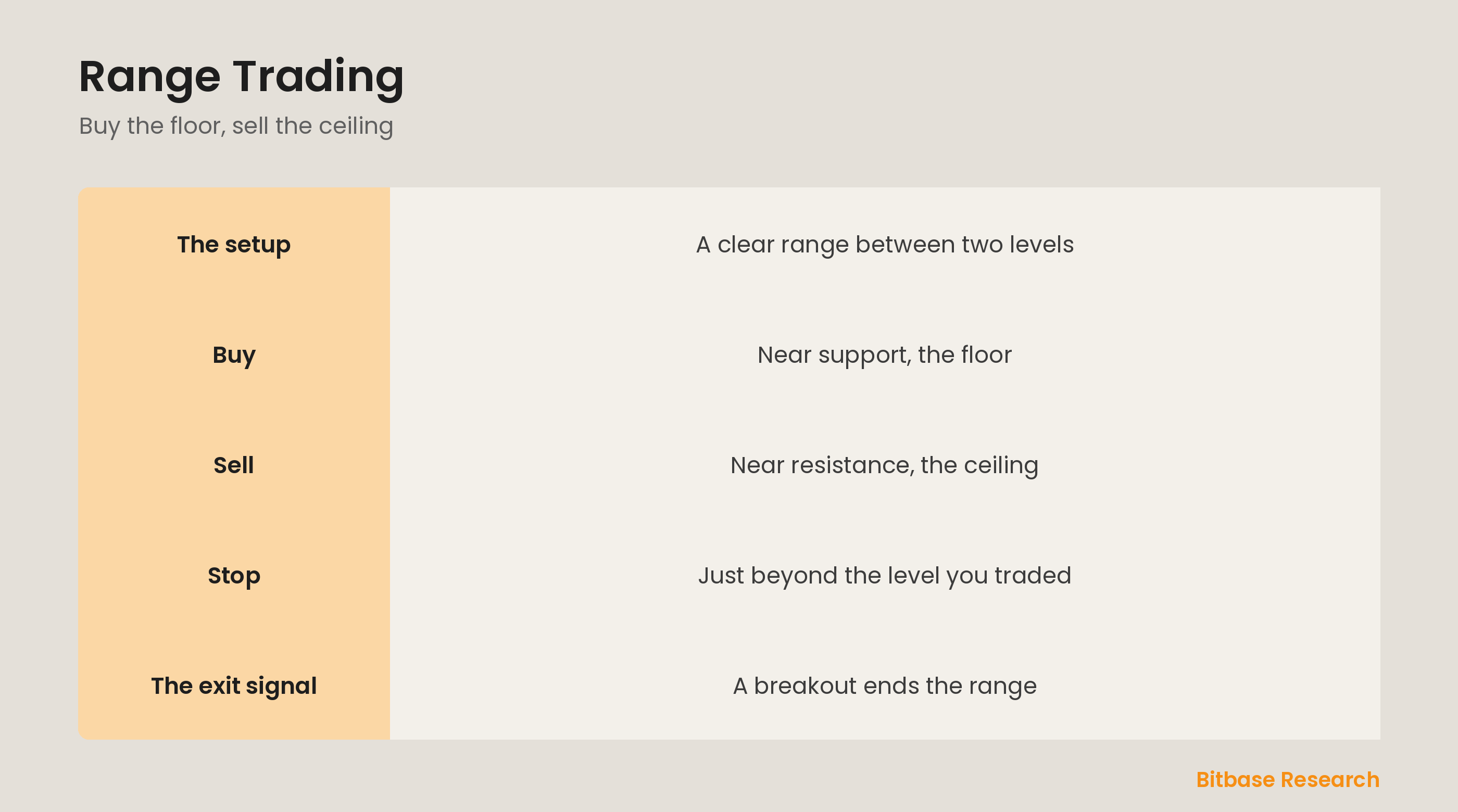
The core of range trading is simple: buy near the bottom of the range, at support, and sell near the top, at resistance. Since price keeps bouncing between these levels, a range trader enters long as price approaches support, expecting a bounce, and exits or goes short near resistance, expecting a turn down. The strategy captures the repeated swings across the band, profiting from the market's balance rather than a directional move.
Managing risk in a range
Risk management in range trading centers on the stop-loss. Because the whole trade rests on a level holding, the stop goes just beyond that level: for a buy at support, the stop sits a little below support, so that if support breaks, you exit with a small loss. This keeps losses tight while the range holds. Position sizing and a favorable risk-reward from the level to the opposite side of the range keep the strategy profitable over many trades.
When the range breaks
Every range eventually ends, and the key risk for a range trader is the breakout. When price finally breaks decisively out of the band, through support or resistance, the range trade fails and a new trend may begin. This is exactly where a range trader must step aside or flip to a breakout mindset. Recognizing that the range has ended, rather than stubbornly fading the breakout, is what separates a disciplined range trader from a trapped one.
The bottom line
Range trading suits a sideways market, buying near support and selling near resistance as price bounces between the two, a form of mean reversion within a clear band. Risk is managed with a stop just beyond the level being traded, keeping losses small while the range holds. The main danger is the breakout that ends the range, so the disciplined range trader steps aside when price decisively leaves the band rather than fighting the new move. To keep learning the fundamentals, follow more from Bitbase Academy.
Disclaimer: This article is educational content from Bitbase Academy, provided for information only. It does not constitute investment, trading, tax, or financial advice. Crypto assets are volatile; assess your own risk. Written as of June 2026; refer to the latest official information.
References
[1] Investopedia, "Range-Bound Trading: Definition and How Strategy Works" investopedia.com
[2] Investopedia, "Support (Support Level): Definition and Trading Strategies" investopedia.com
[3] Investopedia, "Resistance (Resistance Level): Definition, Uses in Trading" investopedia.com