Nearly every crypto exchange charges two different trading fees for the very same trade, and which one you pay comes down to a single question: did your order add liquidity to the market, or take it away? That is the whole idea behind maker and taker fees. Understanding the difference is one of the easiest ways to lower your trading costs, because you often get to choose which side you land on.
What a maker is
A maker is a trader whose order adds liquidity to the order book. When you place a limit order at a price that does not match any order already resting there, it does not fill right away — it sits on the book and waits, giving other traders something to trade against. Because you are supplying liquidity the market can use, the exchange rewards you with the lower maker fee. In effect, you are helping to make the market.
What a taker is
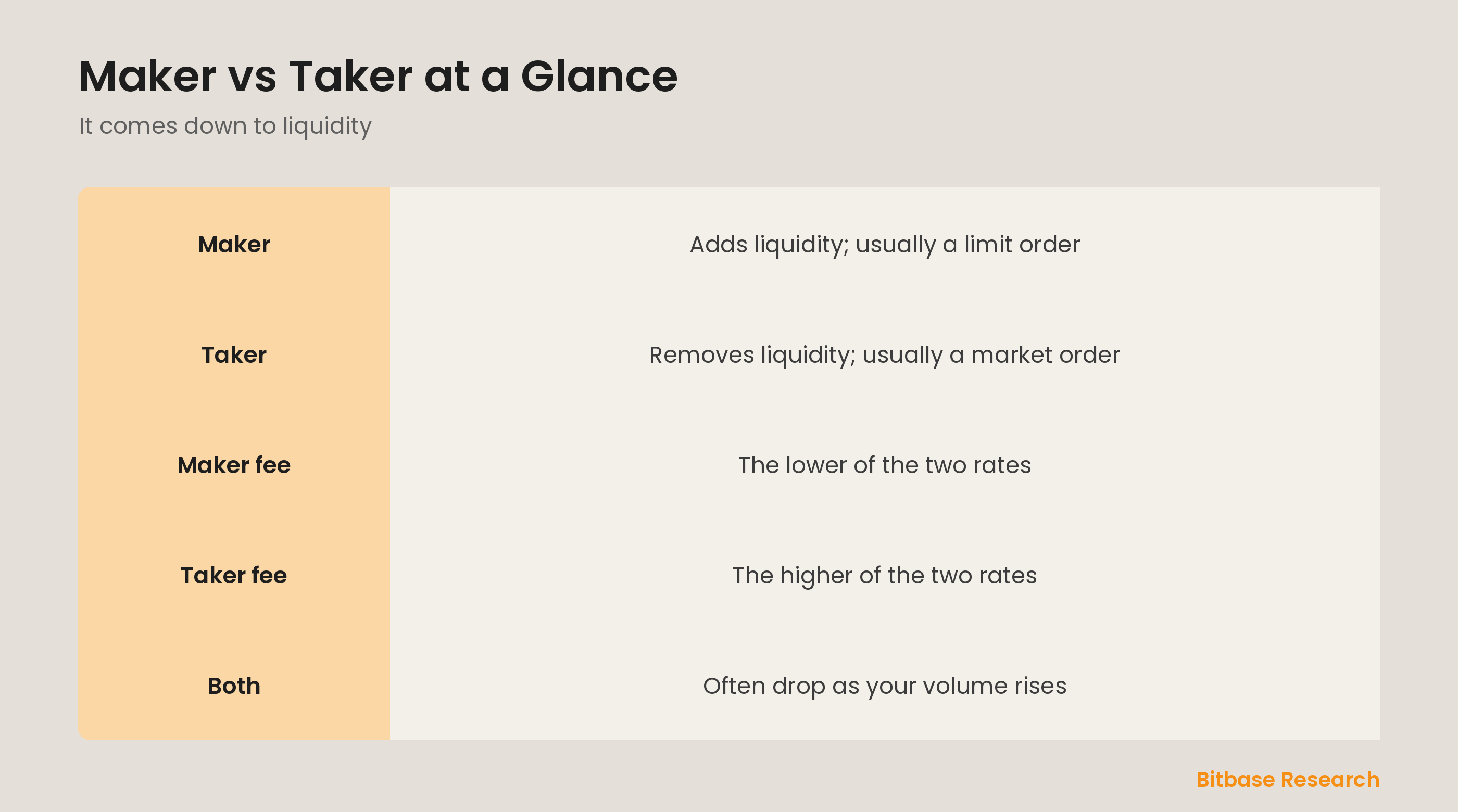
A taker is a trader whose order removes liquidity from the book. A market order is the classic example: it fills instantly against the best orders already resting there. Since you are consuming liquidity someone else provided, you pay the higher taker fee. A limit order can make you a taker too — set a buy limit at or above the current best ask and it executes immediately, taking liquidity, despite being a limit order.
Why exchanges charge them differently
Liquidity is what makes a market usable: the more resting orders there are, the easier it is for everyone to trade at fair prices with little slippage. Makers provide that liquidity, so exchanges reward them with lower fees — sometimes even a rebate that pays them to post orders. Takers consume it, so they pay more. The fee gap is simply an incentive that nudges traders toward adding depth to the book rather than only draining it.
How the fees add up
Maker and taker fees are charged as a small percentage of each trade's value, and both usually fall as your 30-day trading volume rises — higher tiers unlock lower rates. The taker fee is always the higher of the two, so a trader who relies on market orders pays more over time than one who patiently uses limit orders. On a single small trade the difference looks trivial, but across hundreds of trades it compounds into a real cost.
The bottom line
Maker and taker fees come down to one thing: whether your order adds liquidity or removes it. Limit orders that rest on the book make you a maker and earn the lower fee; market orders — and limit orders that fill instantly — make you a taker and cost more. Once you know which side you are on, you can often choose the cheaper one just by changing your order type. To keep learning the fundamentals, follow more from Bitbase Academy.
Disclaimer: This article is educational content from Bitbase Academy, provided for information only. It does not constitute investment, trading, tax, or financial advice. Crypto assets are volatile; assess your own risk. Written as of June 2026; refer to the latest official information.
References
[1] Investopedia, "Market Maker: Definition, How They Make Money, and Key Roles" investopedia.com
[2] Investopedia, "Limit Order: Definition, How It Works, and Types" investopedia.com
[3] Investopedia, "Order Book: Definition, How It Works, and Key Parts" investopedia.com