
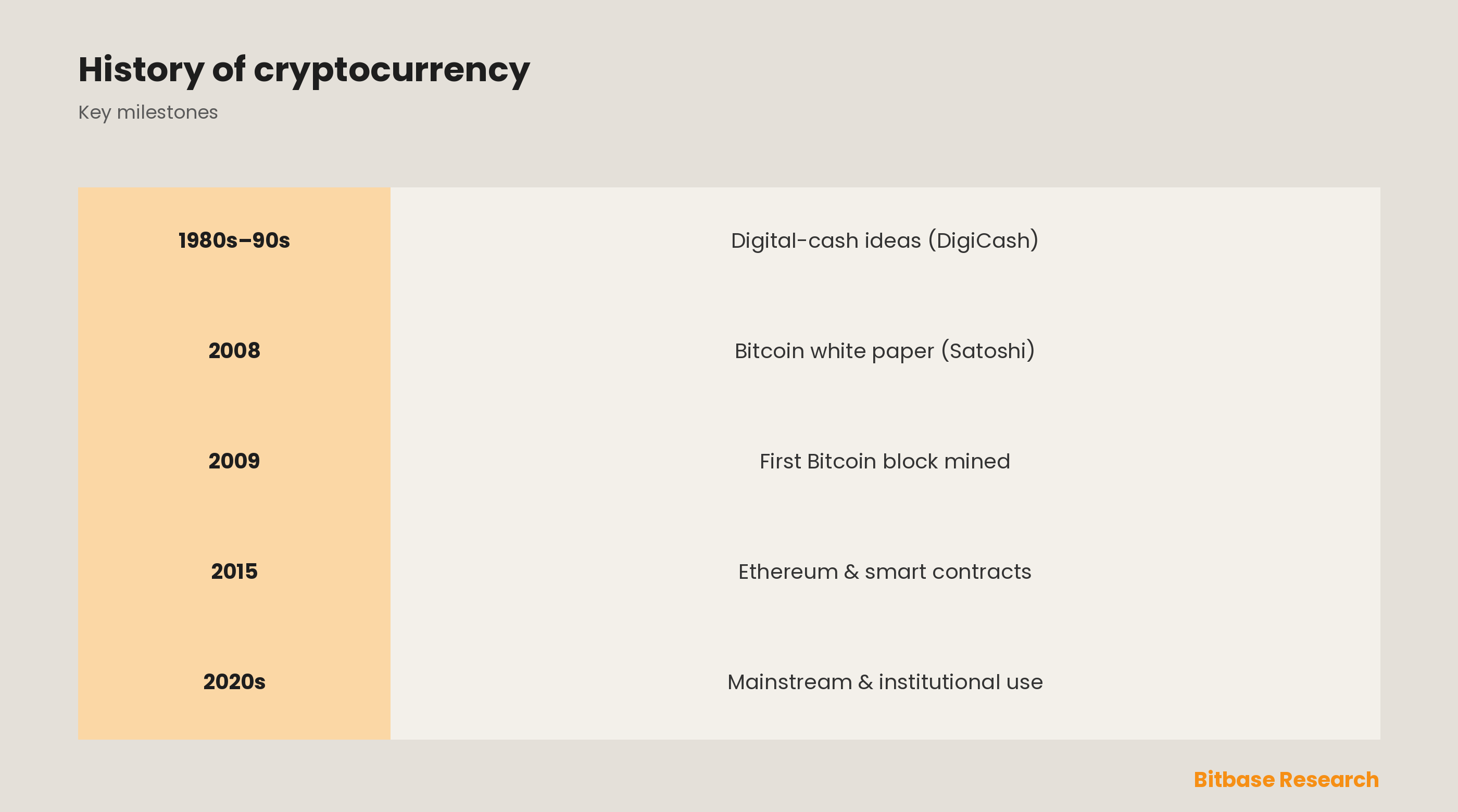
Cryptocurrency didn't appear overnight. It grew from decades of work on digital cash, took shape with Bitcoin in 2009, and expanded with programmable blockchains like Ethereum. This guide walks through the key milestones.
The early ideas (1980s–1990s)
Long before Bitcoin, cryptographers explored digital money. David Chaum's DigiCash introduced private electronic payments in the 1980s–90s, and proposals like b-money and Hashcash laid groundwork for the ideas Bitcoin would later combine [1]. None achieved lasting adoption, but they shaped what came next.
Bitcoin arrives (2008–2009)
In 2008, a person or group using the name Satoshi Nakamoto published the Bitcoin white paper, describing a peer-to-peer electronic cash system without a central authority [1]. The first Bitcoin block was mined in January 2009, launching the first working cryptocurrency [2].
The expansion
The bottom line
Cryptocurrency is the product of a long evolution: early digital-cash experiments, Bitcoin's breakthrough in 2009, programmable blockchains from 2015, and growing mainstream and institutional interest in the 2020s. To keep learning the fundamentals, follow more from Bitbase Academy.
Disclaimer: This article is educational content from Bitbase Academy, provided for information only. It does not constitute investment, trading, tax, or financial advice. Crypto assets are volatile; assess your own risk. Written as of June 2026; refer to the latest official information.
References
[1] Investopedia, "The History of Bitcoin." investopedia.com
[2] Coinbase, "What is Bitcoin?" coinbase.com