
A crypto exchange holds funds for millions of users, which makes it a huge target. To protect that money while still letting people withdraw quickly, exchanges divide their holdings between two kinds of storage: hot wallets and cold storage. The split is a deliberate balance between convenience and security. Here is how each works, why exchanges use both, and what the arrangement means for you as a user.
What a hot wallet is
A hot wallet is connected to the internet. On an exchange, hot wallets hold the working supply of crypto needed to process withdrawals and keep trading flowing smoothly. Because they are online, transactions from them are fast and automatic. That same connection is their weakness: being reachable over the internet makes hot wallets the more exposed part of an exchange's setup and the usual target of remote attacks.
What cold storage is
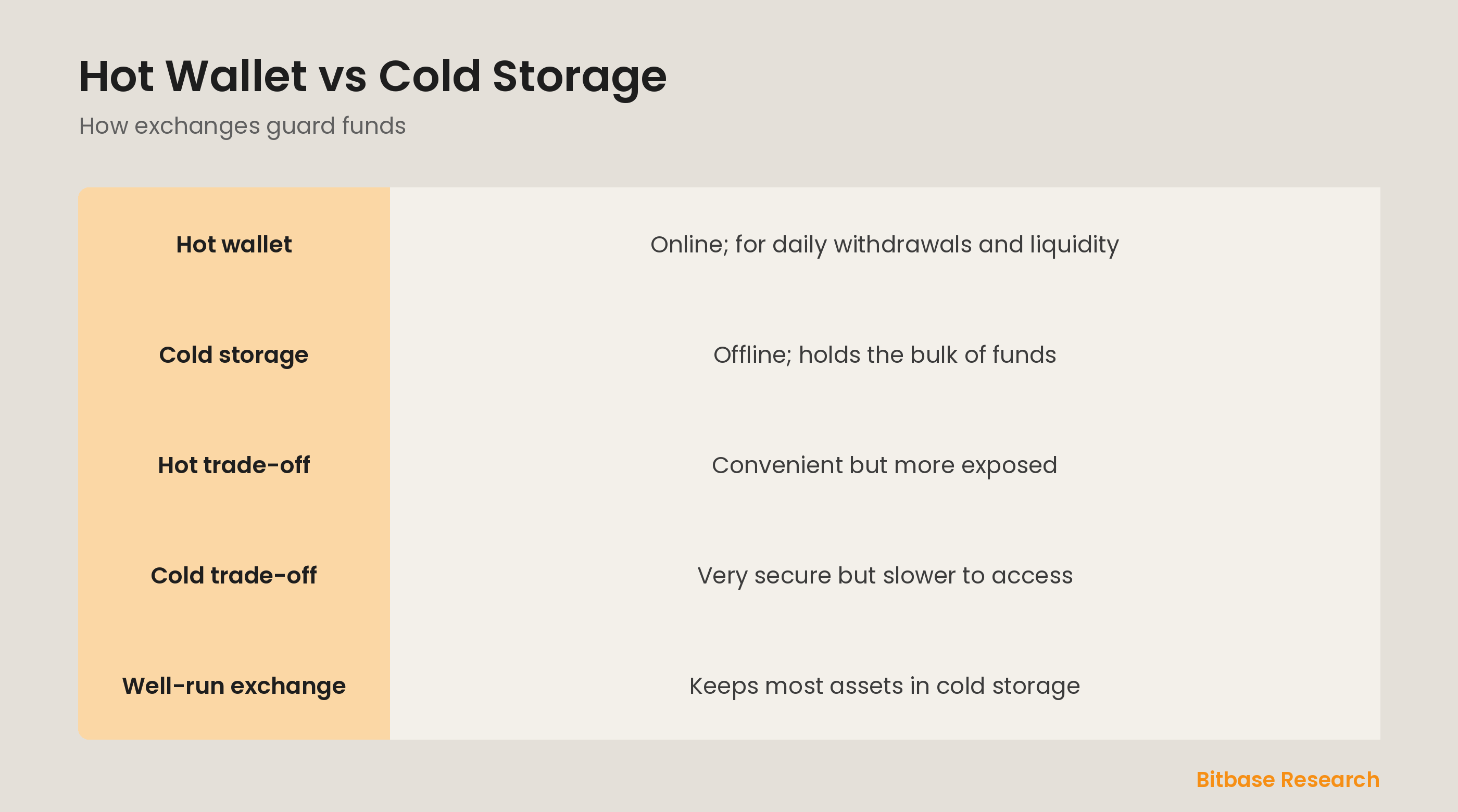
Cold storage keeps crypto offline, with the private keys held on devices that never connect to the internet. An exchange uses it to store the large majority of customer funds — the reserves that do not need to move day to day. Because the keys are air-gapped, cold storage is far harder for a remote attacker to reach. The trade-off is speed: moving funds out of cold storage is deliberate and slower, often requiring manual, multi-person approval.
Why exchanges split funds this way
The two storage types solve opposite problems, so exchanges use both. If everything sat in hot wallets, a single breach could drain the platform; if everything sat in cold storage, withdrawals would be slow and clumsy. The answer is to keep only a small operating amount hot — enough for normal withdrawal demand — and the bulk safely cold. A well-run exchange keeps the hot portion as small as it can while still serving users smoothly.
What it means for you
This design protects you, but it has a limit worth understanding. Even funds in an exchange's cold storage are held by the exchange, not by you — it is custodial, meaning the platform controls the keys. That is convenient and, at a good exchange, well secured, but it is not the same as holding your own keys. For amounts you want full control over, moving them to self-custody puts the security entirely in your hands.
The bottom line
Exchanges split customer funds between hot wallets, which are online for fast day-to-day withdrawals, and cold storage, which is offline and holds the bulk of reserves. The mix balances liquidity against security, and a well-run platform keeps most assets cold. Just remember that either way the exchange holds the keys — so for funds you want to control yourself, self-custody remains the only full answer. To keep learning the fundamentals, follow more from Bitbase Academy.
Disclaimer: This article is educational content from Bitbase Academy, provided for information only. It does not constitute investment, trading, tax, or financial advice. Crypto assets are volatile; assess your own risk. Written as of June 2026; refer to the latest official information.
References
[1] Investopedia, "Hot Wallet: Definition, Types, Examples, and Safety Tips" investopedia.com
[2] Investopedia, "Cold Wallet: What It Is, How It Works, Types, and Examples" investopedia.com
[3] Investopedia, "Custodian: What It Means in Banking and Finance" investopedia.com