When you buy or sell crypto, the fee shown at checkout is rarely the whole story. The real cost of trading is spread across a few different places, and some of them are easy to miss because they are never labeled as a fee. Knowing where your money actually goes is the first step to keeping more of it. Here are the main costs you pay, and what drives each one.
The trading fee
This is the cost most people think of: a small percentage the exchange charges each time you trade, taken from the value of the order. On most order-book platforms it splits into a maker fee and a taker fee, depending on whether your order adds or removes liquidity. The rate usually drops as your 30-day trading volume grows, so active traders pay less per trade than newcomers.
The spread
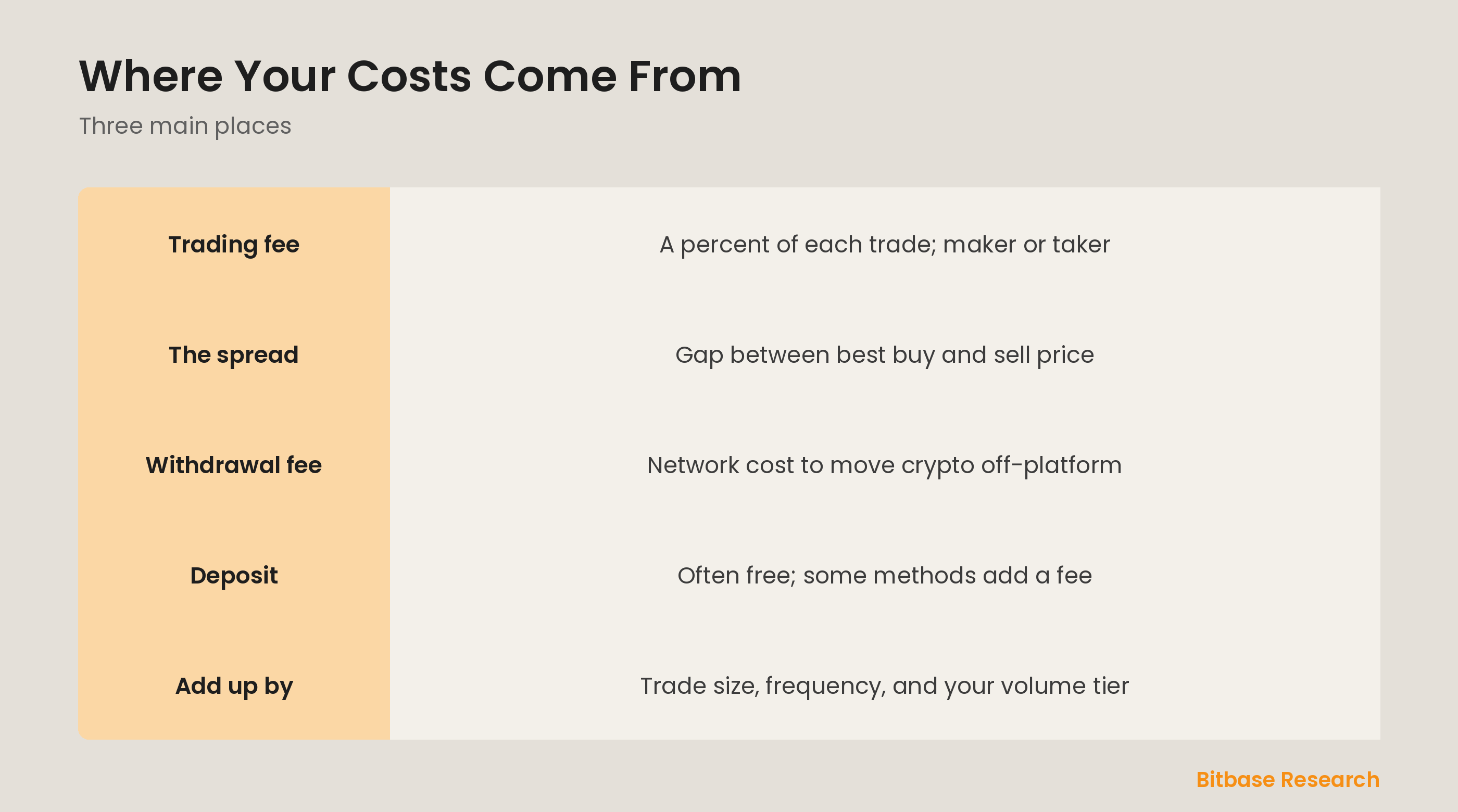
The spread is the gap between the highest price buyers will pay and the lowest price sellers will accept. Every time you trade at market, you buy slightly above the mid-price and sell slightly below it — that difference is a real cost, even though no line item calls it a fee. Liquid markets with lots of orders have tight spreads; thin markets have wide ones, which can cost more than the headline trading fee.
Deposit and withdrawal fees
Moving money on and off a platform has its own costs. Depositing crypto is often free, though funding with a card or certain payment methods can add a fee. Withdrawing crypto almost always costs a network fee — the amount the blockchain itself charges to process the transfer — which varies by network and how busy it is. Choosing a cheaper network for withdrawals can save a surprising amount.
How it all adds up
Your total cost depends on three things: how large your trades are, how often you trade, and which volume tier you sit in. A single round trip might cost a fraction of a percent, but frequent trading multiplies both the trading fee and the spread. The traders who keep the most are not the ones chasing the lowest headline rate — they are the ones who understand every layer and trade in a way that minimizes all of them.
The bottom line
Crypto trading fees are more than the number on the fee schedule. The trading fee, the spread, and withdrawal costs together make up what you actually pay, and each one responds to different choices — your order type, the market's liquidity, and the network you withdraw on. See all three clearly, and you can trade in a way that quietly keeps your costs down. To keep learning the fundamentals, follow more from Bitbase Academy.
Disclaimer: This article is educational content from Bitbase Academy, provided for information only. It does not constitute investment, trading, tax, or financial advice. Crypto assets are volatile; assess your own risk. Written as of June 2026; refer to the latest official information.
References
[1] Investopedia, "Bid-Ask Spread: Definition, Meaning, and How It Works" investopedia.com
[2] Investopedia, "Market Order: Definition, Example, Vs. Limit Order" investopedia.com
[3] CFTC, "Customer Advisory: Understand the Risks of Virtual Currency Trading" cftc.gov