
Swing traders try to enter early in a multi-day move and ride it until it matures. To do that, they rely on a handful of strategies and indicators built around one core idea: trade in the direction of the larger trend. Used well, these tools help you spot good entries and set sensible exits; used blindly, they mislead. Here are the common swing-trading strategies, the indicators behind them, and how to put them together.
Common swing-trading strategies
Most swing strategies share a bias toward the prevailing trend. Trend-following simply trades in the direction the market is already heading. Pullback trading waits for a temporary dip within an uptrend to enter at a better price, rather than chasing. Breakout trading enters as price clears a key level with momentum. Reversal trading, the riskiest, tries to catch a trend as it turns, and demands strong confirmation.
The key indicators
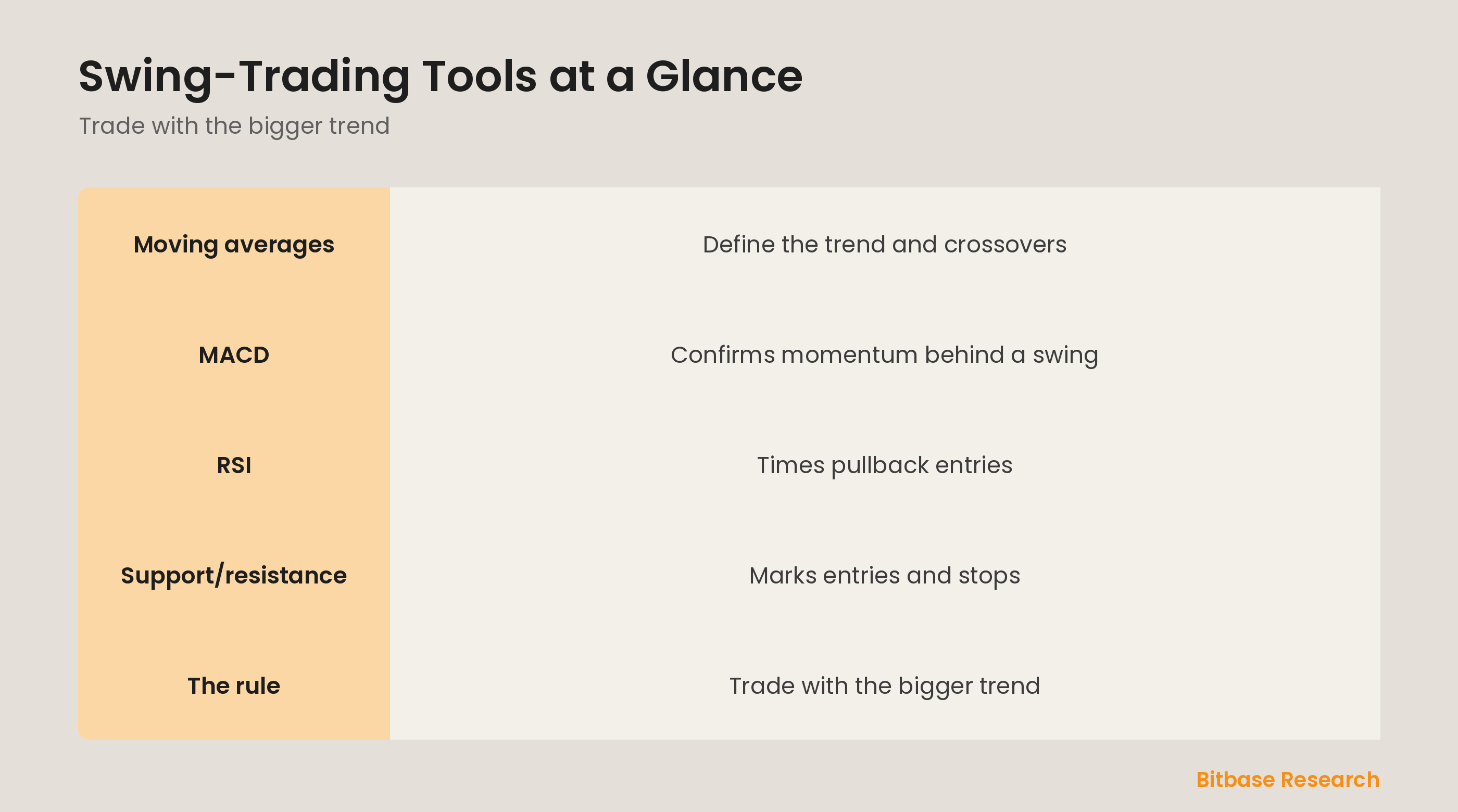
A few indicators do most of the work. Moving averages define the trend and can signal shifts when a faster one crosses a slower one. MACD confirms the momentum behind a swing and hints when it is fading. RSI helps time entries by flagging when a pullback has reached oversold territory. Support and resistance mark the levels where a swing is likely to begin, pause, or end, and where stops belong.
How to combine them
The reliable approach starts with the trend. Identify the larger direction with moving averages, then wait for a pullback and use RSI or support to time an entry in that direction. Confirm the momentum with MACD before committing, and place your stop just beyond the structure that would prove the trade wrong. Layering a few aligned signals like this beats reacting to any one indicator on its own.
Cautions to keep in mind
Even a solid setup can fail. Choppy, trendless markets produce whipsaws that stop out trade after trade, and overnight gaps in 24/7 crypto can jump past your intended exit. Indicators lag and misfire, so never treat a signal as a guarantee. Backtest your strategy, practice it in paper trading, and above all pair every entry with a stop-loss and sensible position size, so no single failed swing does lasting damage.
The bottom line
Crypto swing-trading strategies — trend-following, pullback, breakout, and reversal — are guided by indicators like moving averages, MACD, RSI, and support and resistance. The unifying rule is to trade with the larger trend, enter on pullbacks, and confirm before committing. Combine a few aligned signals rather than trusting one, always trade with stops and sensible sizing, and test any approach before risking real money. To keep learning the fundamentals, follow more from Bitbase Academy.
Disclaimer: This article is educational content from Bitbase Academy, provided for information only. It does not constitute investment, trading, tax, or financial advice. Crypto assets are volatile; assess your own risk. Written as of June 2026; refer to the latest official information.
References
[1] Investopedia, "Technical Analysis: What It Is and How to Use It in Investing" investopedia.com
[2] Investopedia, "Moving Average (MA): Purpose, Uses, Formula, and Examples" investopedia.com
[3] Investopedia, "MACD Indicator Explained, with Formula, Examples, and Limitations" investopedia.com