A stop-loss is a preset order that automatically closes a trade once the price moves against you by a set amount. It is the simplest way to cap a loss before it becomes a disaster, and to take the emotion out of the decision. Here are the main types, where to place one, and the mistakes to avoid.
What a stop-loss actually does
A stop-loss turns “how much am I willing to lose?” into an order the exchange enforces for you. You decide the exit price in advance, and if the market reaches it the position closes automatically — whether you are watching the screen or asleep. Its real value is behavioural: it removes the temptation to wait for a bounce, the habit that turns a small, planned loss into one that threatens the whole account.
The main types
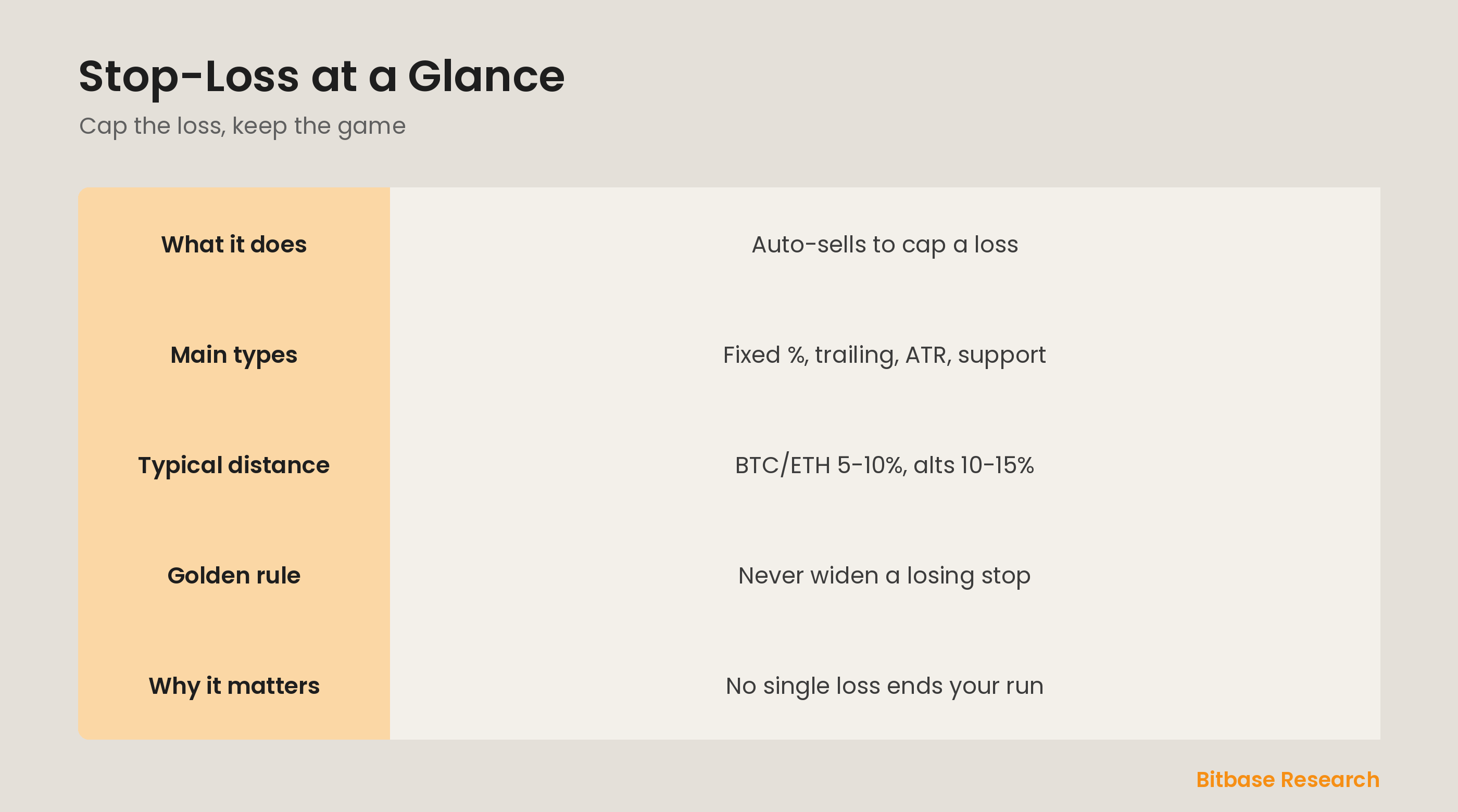
There are a few common ways to set one. A fixed-percentage stop closes the trade after a set drop, say 8% below your entry. A trailing stop follows the price up as the trade works: buy at $50 with a 10% trailing stop and the exit starts at $45, but rises as the price rises, locking in gains. An ATR-based stop uses market volatility to set the distance — wider when the market is choppy, tighter when it is calm. And a support-based stop sits just below a key price level that the chart has repeatedly respected.
Where to place it
Placement is a balance. Too tight and normal volatility knocks you out of a good trade; too wide and the loss is bigger than it needs to be. As a rough guide, majors like BTC and ETH often use 5%–10% and more volatile altcoins 10%–15%, with most strategies capping a single stop around 15%. Better than any fixed number is to place the stop where your trade idea is clearly wrong — below a support level or a swing low — and then size the position around that distance.
Mistakes that undo a stop
The most damaging habit is widening a stop as the price approaches it, which converts your planned risk into an open-ended one. Trading with no stop at all is worse still. Setting a stop exactly on an obvious round number, or right at a well-known support, can get you filled on a brief wick — placing it a little beyond the level helps. And a stop only protects you if the position was sized sensibly in the first place; the two tools work together, not apart.
The bottom line
A stop-loss is the seatbelt of trading: you hope not to need it, but you never trade without one. Choose a placement based on the chart and volatility rather than a comfortable-looking number, never widen it on a losing trade, and let it do its job. The goal is not to avoid every loss — it is to make sure no single loss can take you out of the game. To keep learning the fundamentals, follow more from Bitbase Academy.
Disclaimer: This article is educational content from Bitbase Academy, provided for information only. It does not constitute investment, trading, tax, or financial advice. Crypto assets are volatile; assess your own risk. Written as of June 2026; refer to the latest official information.
References
[1] Investopedia, "Stop-Loss Order: What It Is, How It Works, and Example" investopedia.com
[2] Investopedia, "Trailing Stop: What It Is, How It Works, Example" investopedia.com
[3] Investopedia, "Average True Range (ATR) Formula, What It Means" investopedia.com