Publication date: July 23, 2026 · Bitbase Research
For related Bitbase Research on this subject, see The Crypto Listing Process.
Executive Summary
A catalyst is a scheduled or announced event that moves a token's price, and the crypto market runs on them: exchange listings and delistings, mainnet and testnet launches, protocol upgrades, and governance votes. Traders speak of catalysts constantly and price them badly, because the intuition that "good news lifts price" is exactly the intuition that a rigorous event study exists to discipline. The tool for that discipline is not new. Financial economics has spent half a century measuring how prices react to discrete events through the event study — estimating a token's normal return, subtracting it to isolate the abnormal return, and cumulating those abnormal returns across a window to get the cumulative abnormal return (CAR), the canonical output formalized by MacKinlay (1997) [1][2]. This report imports that machinery wholesale and applies it to the five catalyst types that dominate crypto, then does the one thing casual catalyst-talk never does: it separates a catalyst's magnitude from its durability.
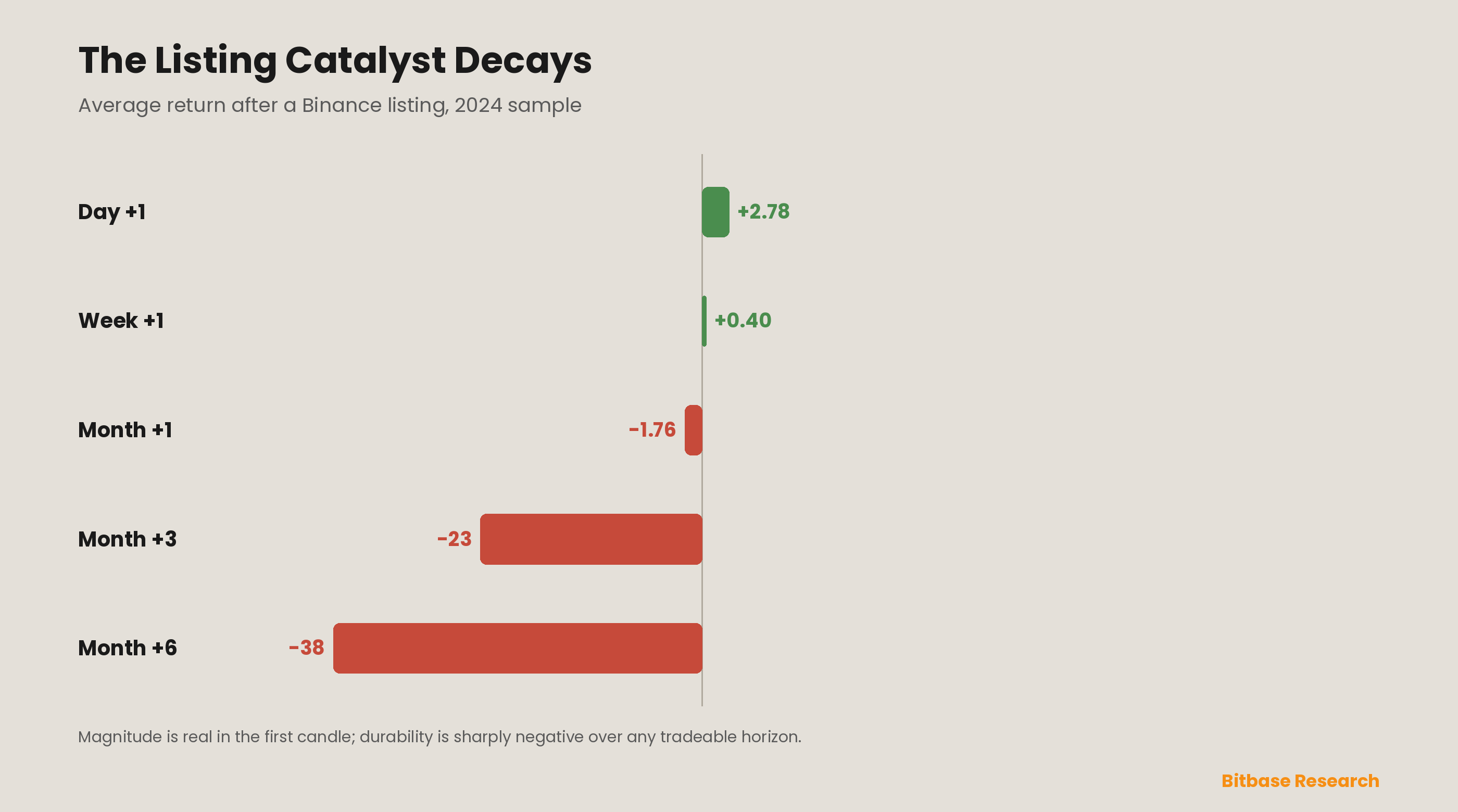
That separation is the whole framework, because the crypto evidence shows the two are almost independent — and often inverted. The exchange listing, long treated as the market's most reliable positive catalyst, is the clearest case. The 2023 "Binance effect" delivered a roughly +41% jump the day after listing and +24% by day three across a sample of coins, and the "Coinbase effect" was measured by Messari at an average +91% within five days of listing [3][4]. But when researchers studied every Binance listing in 2024, the effect had reversed on any horizon longer than the first candle: an average of just +2.78% the day after, +0.40% after a week, −1.76% after a month, −22.66% after three months, and −37.64% after six [5][6]. A catalyst can be huge and entirely transient. Delistings run the other way — a sharp, durable negative, with prices typically falling 25–30% within hours and volume collapsing as much as 90% within a day [7]. And the most counterintuitive class, the mainnet launch, routinely falls on the news it was supposed to celebrate, as SUI did when its long-anticipated mainnet went live and the token sold off to a new all-time low [8]. The framework's job is to rank these events not by how loud they are but by how much abnormal return they produce and how long it survives. Everything here is educational analysis, not investment advice.
Part 1 · The Catalyst as an Event Study
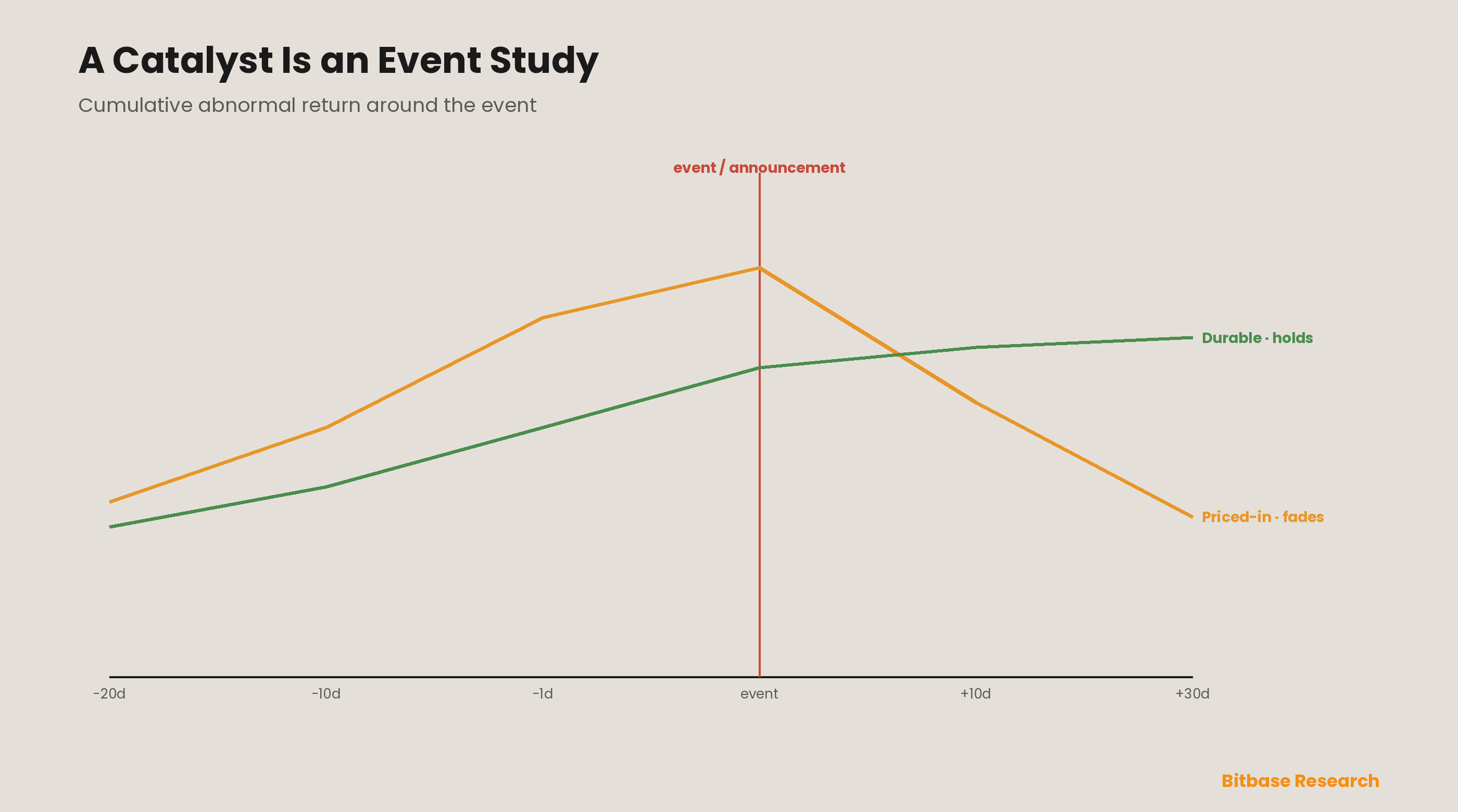
The discipline begins by treating every catalyst as a formal event with three phases, because conflating them is the root of most bad catalyst trades. There is an anticipation phase, in which a scheduled event — a known listing date, a roadmapped upgrade — is partly priced in before it arrives; the event itself, at which new information (or the resolution of uncertainty) hits; and a post-event phase, in which the price either holds the move, drifts further, or reverses [1]. The entire question of whether a catalyst is tradeable lives in the relationship between these three phases, and the event-study framework exists precisely to measure it rather than assume it.
Underlying the method is a claim about market efficiency that crypto tests unusually hard. In an efficient market, a scheduled and publicly known catalyst should be priced in by the time it arrives, so its announcement — not its occurrence — is the information event, and the occurrence is a non-event or even a "sell the news" reversal [2]. The speed and completeness of that adjustment is not something to assume; it is the empirical question the event study answers, and the answer varies enormously by catalyst type and by how liquid and well-covered the token is [1]. A surprise delisting on a thin token adjusts differently from a roadmapped upgrade on a major asset. This is why the framework refuses a single "catalysts are bullish/bearish" rule and instead asks, for each event type, three measured questions: how large is the abnormal return, how much of it survives, and how much was already priced in before the event. The rest of the report is those three questions, answered catalyst by catalyst.
Part 2 · The Methodology: Abnormal Returns, CAR and the Event Window
Precision about the method is what separates an event study from a chart annotation. The core construct is the abnormal return — the token's actual return minus its normal (expected) return over the same period, where the normal return is usually estimated with a market model that regresses the token on a market benchmark over a pre-event estimation window [1]. Summing the abnormal returns across the event window yields the cumulative abnormal return (CAR), the single number that measures a catalyst's total price impact net of what the market was doing anyway [2]. Averaging CAR across many events of the same type — every 2024 Binance listing, say — turns anecdote into a base rate, which is exactly the move that converted "listings pump" into the far more useful finding that listings pump and then bleed [5].
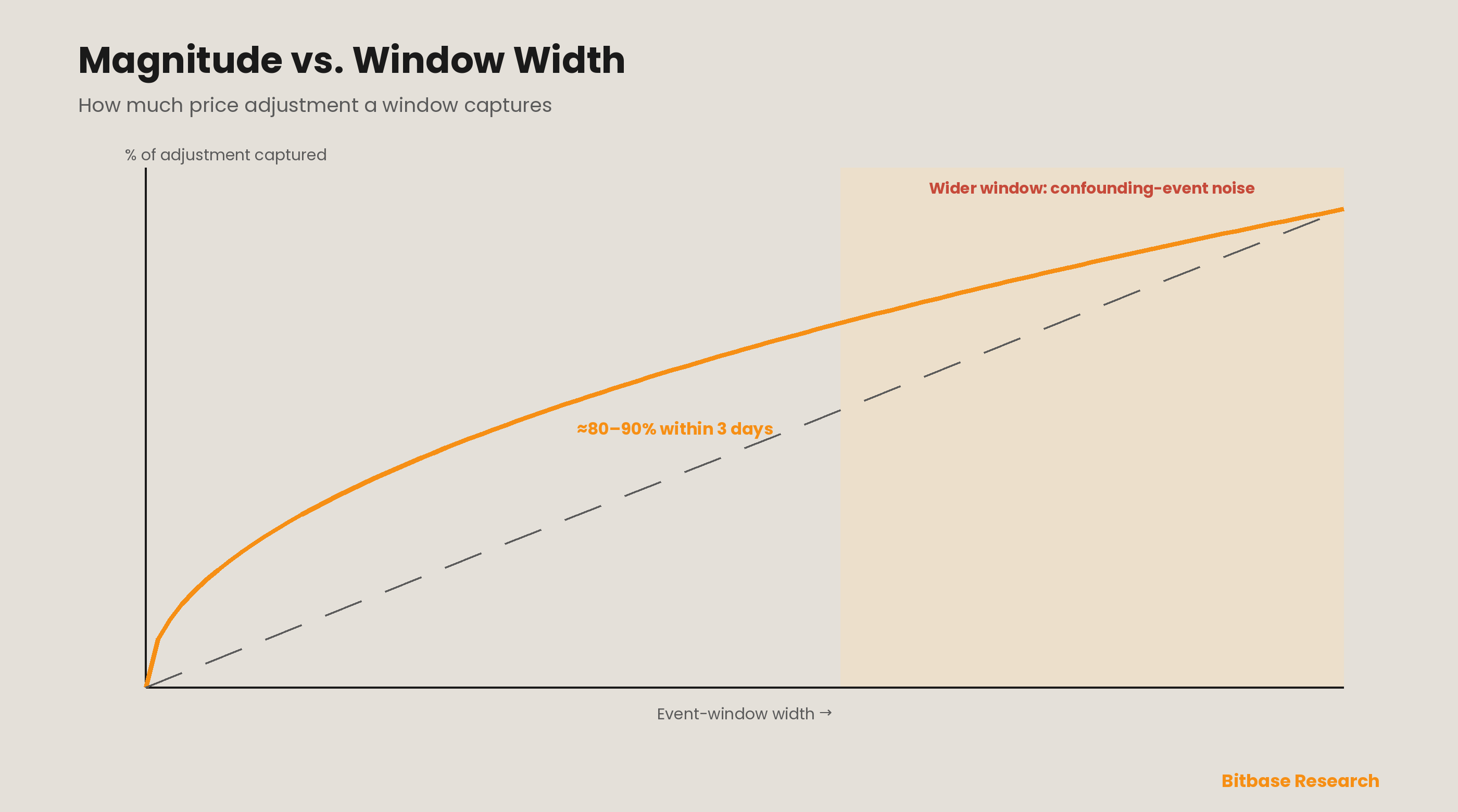
The choice of event window is where most catalyst analysis quietly goes wrong, and it is where the magnitude-versus-durability distinction becomes operational. A narrow three-day window around the event, conventionally written [−1, +1], captures roughly 80–90% of the total price adjustment for a well-defined event in a liquid market — it measures magnitude cleanly [1]. But magnitude is only half the story: widening the window to weeks or months captures information leakage before the event and, more importantly, the post-announcement drift that reveals whether the move was durable or a fade — at the cost of admitting more noise from confounding events [1]. The Binance-effect reversal is invisible in a [−1, +1] window and unmistakable in a six-month one; the delisting death spiral is visible in both. The framework therefore always reports two numbers per catalyst — a short-window magnitude and a long-window durability — and treats a catalyst as tradeable only when both point the same way, or when the divergence between them is itself the trade.
Part 3 · Listings: The Largest Catalyst and Its Decay
The exchange listing is the catalyst traders most trust and the one the event study most thoroughly humbles. Its magnitude is genuine and large: a major-venue listing is a discrete liquidity and legitimacy shock, and the short-window abnormal return has historically been enormous — the +41% day-one and +24% day-three of the 2023 Binance sample, the +91% five-day Coinbase effect measured by Messari [3][4]. Read only through a narrow window, listings look like the market's best catalyst, and the folk strategy of "buy the listing" is built entirely on that short-window magnitude.
The durability tells the opposite story, and it is the single most important catalyst finding of the cycle. Studying every Binance listing across 2024, researchers found the average return collapsing monotonically with horizon: +2.78% the day after, +0.40% after a week, −1.76% after a month, −22.66% after three months, and −37.64% after six, with fewer than one in five listed tokens profitable half a year later [5][6]. The catalyst is real; its durability is negative. Mechanically this is the anticipation phase doing its work — the listing is scheduled and known, so much of the "good news" is bought before the event by insiders and fast traders, leaving the listing candle itself as a liquidity event into which that positioning is sold, followed by the structural drift down that afflicts most newly listed, low-float tokens once the initial attention fades. The framework's verdict on listings is therefore precise in a way the folk wisdom never is: a large positive magnitude with strongly negative durability, which makes the listing itself a distribution event more often than an accumulation one, and turns "buy the listing, hold the token" into one of the most reliably losing catalyst trades in the market.
Part 4 · Delistings: The Asymmetric Negative
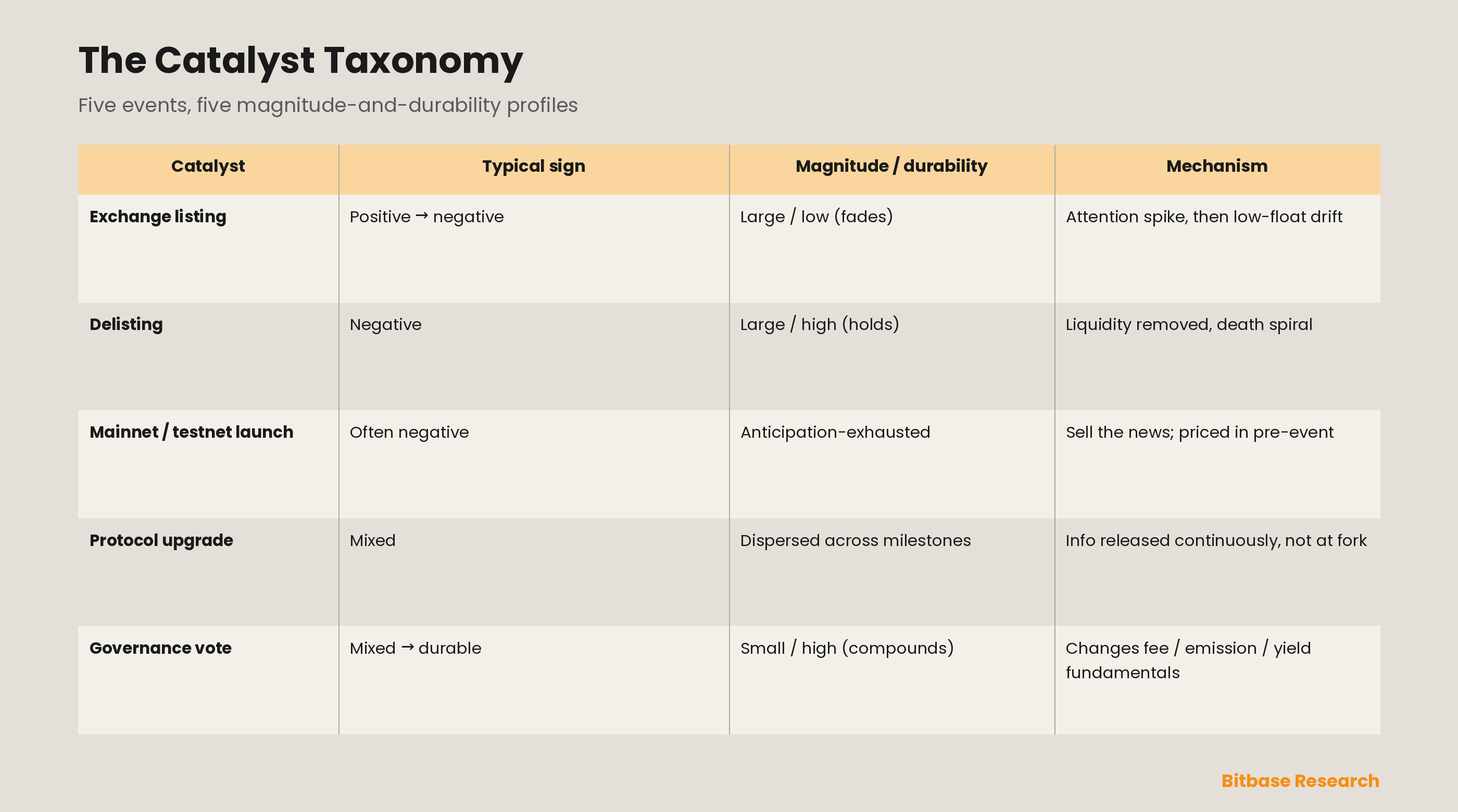
If the listing is a large-magnitude, low-durability positive, the delisting is close to its mirror: a large-magnitude, high-durability negative, and the asymmetry between them is one of the framework's most useful outputs. A delisting announcement removes a token's primary gateway to liquidity and capital, and the price reaction is fast and brutal — typically a 25–30% drop within hours as sell orders overwhelm a thinning order book, accompanied by volume collapses as steep as 90% within twenty-four hours, which is what turns the initial drop into a self-reinforcing death spiral rather than a dip that recovers [7]. A concrete 2026 case fits the pattern cleanly: FUN fell about 28% within a day of its Binance delisting announcement as remaining order-book depth gave way [7].
The durability is what distinguishes the delisting from a mere shock, and it is structural rather than sentimental. A listing's positive magnitude fades because the catalyst added attention that decays; a delisting's negative magnitude holds because the catalyst removed liquidity that does not come back — the token is now harder to trade, harder for new capital to reach, and marked with a signal of distress or non-compliance that suppresses demand indefinitely. The macro backdrop in 2026 sharpened this: exchanges shifted decisively toward liquidity and compliance, with delistings in Korea jumping 258% even as new listings fell 74%, meaning the delisting catalyst became both more common and more consequential [9]. For the framework, the delisting is the cleanest catalyst of all — both magnitude and durability point the same, negative way — which is precisely why it is the one where acting on the announcement, before the death spiral completes, has the clearest logic.
Part 5 · Launches and Upgrades: "Sell the News" and the Priced-In Expectation
Mainnet launches and protocol upgrades are where the efficient-market claim of Part 1 becomes tradeable intuition, because these are the most heavily anticipated catalysts and therefore the most likely to be fully priced in before they occur. The archetype is the mainnet "sell the news" event: SUI's mainnet launch, one of the most telegraphed events of its cycle, resolved not in a rally but in a sell-off to a new all-time low as the uncertainty that had supported the price was replaced by the fact, and holders who had bought the anticipation sold the realization [8]. This is not a market failure; it is the efficient-market prediction working exactly as Part 1 describes — a scheduled, known catalyst is an announcement event, not an occurrence event, so the occurrence can only disappoint a price that already embedded it.
Protocol upgrades follow the same logic with a longer and more legible anticipation phase, because upgrades are roadmapped years ahead and debated in public. Ethereum's Glamsterdam upgrade, targeted for the second half of 2026 and bundling up to 22 improvement proposals — including changes to reduce MEV-boost relay risk for institutional validators and gas-fee reductions expected to lift demand and staking yields — is a catalyst whose informational content is released continuously across testnets, client releases and community debate, not at a single activation block [10][11]. The event-study implication is that the tradeable abnormal return, if any, clusters around the milestones that resolve uncertainty — a contentious EIP being included or dropped, a testnet succeeding or failing — rather than around the hard fork itself, which is typically a non-event by the time it arrives. The framework therefore treats launches and upgrades as anticipation-dominated catalysts: their magnitude is spread across the run-up and often exhausted before the headline date, so the naive trade of buying into a known launch is, like buying the listing, a bet against the market's ability to price a scheduled event — a bet the SUI case shows the market usually wins.
Part 6 · Governance Votes: The Slow, Structural Catalyst
Governance votes are the catalyst the market prices least efficiently and the framework values most, because they are the one class that can durably re-rate a token by changing its fundamental economics rather than its attention. A vote that alters fee capture, emissions, staking rewards or treasury policy is not a sentiment event that fades; it is a change to the cash-flow or supply properties that underpin value, and its abnormal return, when real, should persist the way a durable catalyst does rather than decay the way a listing does. The 2026 debate over redirecting 5–10% of Ethereum's roughly 700,000 ETH in annual staking rewards toward ecosystem public goods is the archetype: a proposal that, if passed, would measurably change validator economics and the effective yield on staked ETH, and whose contested path through governance is itself the information the market must price [12][13].
The structure of on-chain governance shapes how the catalyst plays out. Because protocol changes require broad consensus and are activated by validators through coordinated action rather than imposed unilaterally, a governance catalyst releases its information in stages — proposal, debate, signaling vote, on-chain vote, activation — each of which can carry abnormal return as the probability of passage updates [10][12]. This makes governance the catalyst most amenable to the event-study method's core insight that the announcement (here, the shifting odds of a vote) matters more than the occurrence (the activation), and the one where the anticipation phase is longest and most legible. It is also the catalyst where confounding is most dangerous, because governance debates unfold over weeks during which market-wide moves easily swamp the vote-specific signal — a caveat Part 8 takes up. But when the framework isolates it, the governance vote is the rare catalyst whose durability can exceed its magnitude: a quiet re-rating that compounds, rather than a loud candle that fades.
Part 7 · The Ranking: Magnitude × Durability
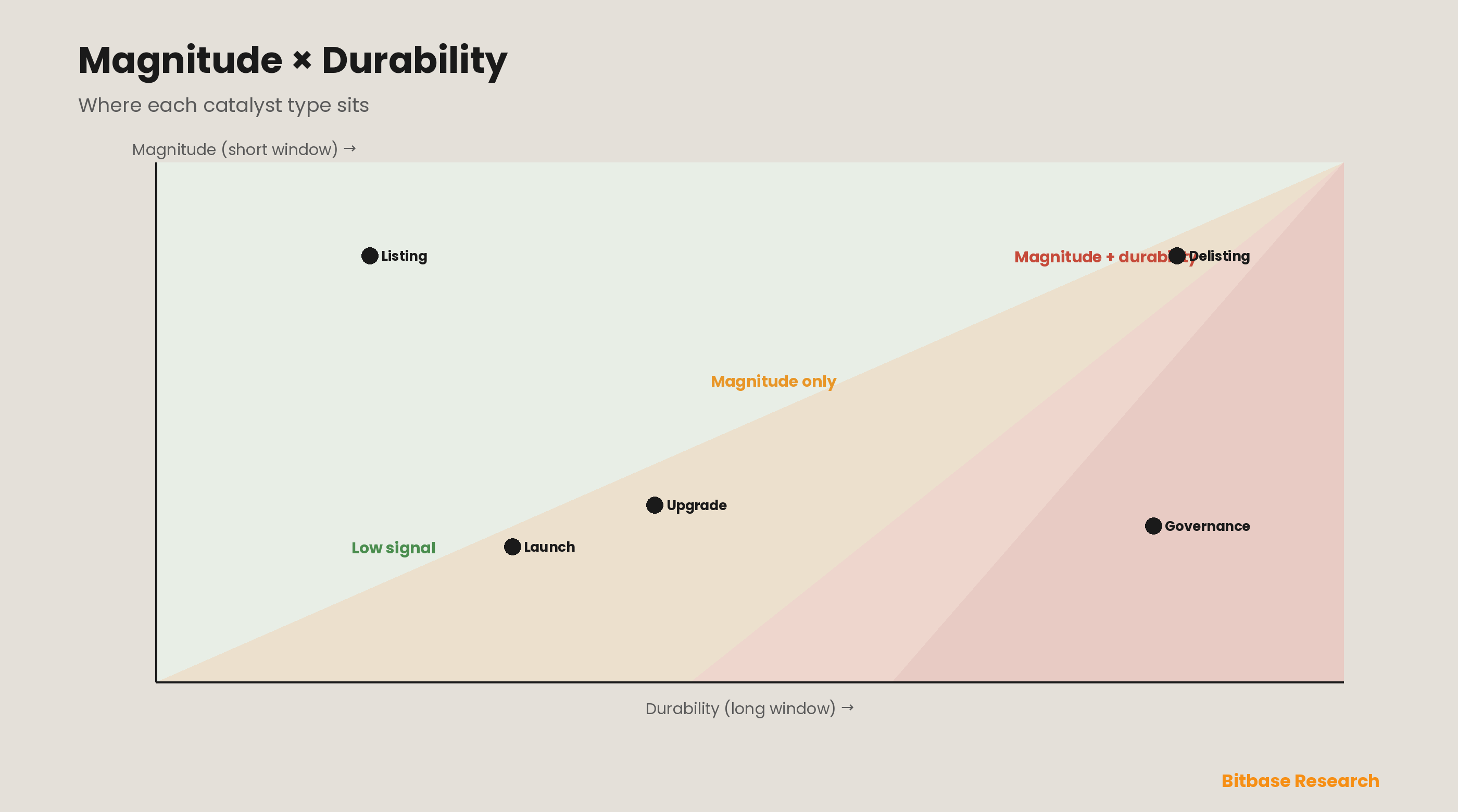
The framework's payoff is a two-dimensional ranking that a one-dimensional "bullish/bearish" label can never produce, because the catalysts separate cleanly only when magnitude and durability are read together. Plotting each catalyst type on magnitude against durability sorts them into quadrants that map directly to how they should be traded. The listing sits in the high-magnitude, low-durability corner — a large first-candle move that a longer window reveals as a fade, tradeable only as a short-term liquidity event and dangerous to hold. The delisting sits in the high-magnitude, high-durability negative corner — both dimensions aligned, the cleanest and most actionable catalyst. The mainnet launch sits in the anticipation-dominated zone where realized magnitude is often small or negative because the move happened before the event. The upgrade sits nearby, its abnormal return dispersed across milestones rather than concentrated at activation. The governance vote sits in the low-magnitude, high-durability corner — easy to miss because no single candle is dramatic, but capable of a persistent re-rating that outlasts every louder catalyst.
Read this way, the ranking inverts folk intuition on exactly the points where folk intuition is most confident. The catalyst that feels most reliable — the listing — is the least durable and the most treacherous to hold; the catalyst that feels most bearish — the delisting — is the cleanest to act on precisely because its magnitude and durability agree; and the catalyst that feels least dramatic — the governance vote — is the one most likely to reward patience because it changes fundamentals rather than attention. The specific placements matter less than the discipline: two numbers per catalyst, always, and a trade thesis that names which number it is relying on.
Part 8 · Limits and Honest Failure Modes
An event-study framework earns trust by naming the ways it can mislead, and the method's own literature is unusually candid about them. The first and largest is confounding: an event study attributes the abnormal return in its window to the catalyst, but crypto's catalysts rarely occur in isolation — a listing during a market-wide rally, a governance vote during a macro sell-off — and the wider the window needed to measure durability, the more foreign events contaminate the estimate [1]. The market model's benchmark subtraction mitigates but does not eliminate this, because crypto betas are unstable and a token's relationship to "the market" shifts exactly when catalysts cluster. A durability number measured over six months is therefore always part catalyst and part everything else that happened in those six months.
Four further limits deserve to be as visible as the framework itself. Base-rate drift and reflexivity: the listing reversal is now widely known and tooled, so the more efficiently the market anticipates a catalyst, the more its abnormal return migrates into the anticipation phase and, for the most-watched events, toward zero — a base rate that partly self-destructs as it becomes common knowledge [5][6]. Event-window sensitivity: because magnitude and durability can point opposite ways, the same catalyst can be presented as bullish or bearish purely by choosing the window, which makes disclosure of the window non-negotiable and cherry-picking it the most common abuse of the method [1]. Survivorship and selection: samples of listings or launches skew toward tokens that survived long enough to be studied, and catalysts are not randomly assigned — weaker projects time announcements to prop up price, entangling the catalyst with project quality [5]. Anticipation is unobservable: the framework's central quantity — how much was priced in before the event — cannot be measured directly, only inferred from the gap between announcement and occurrence returns, so any single event's decomposition is an estimate, not a fact [2]. As a checklist for ranking event types, the framework is sharp; as a predictor of any single catalyst's outcome, it is a probability, not a promise.
Conclusion · Two Numbers, Not One
Crypto catalysts reward the analyst who refuses the single adjective. Every listing, delisting, launch, upgrade and vote is a formal event with an anticipation phase, an event, and a drift, and the event-study method exists to measure the abnormal return across all three rather than to assume it from the headline [1][2]. Measured that way, the catalysts separate on two axes that folk intuition collapses into one: magnitude, cleanest in a narrow window, and durability, visible only in a wider one. The listing is large and fleeting; the delisting is large and lasting; the launch and upgrade are usually exhausted by anticipation before they arrive; and the governance vote is quiet but capable of a durable re-rating [5][7][8][12]. Report both numbers, name which one a trade relies on, disclose the window, and treat the divergence between magnitude and durability not as a nuisance but as the signal.
The deeper primitives these events act upon — how a token's float and unlock schedule shape the supply a listing meets, how fee capture and emissions govern whether a governance change actually accrues value, and how liquidity depth determines the severity of a delisting spiral — are each worth understanding in their own right, because a catalyst's abnormal return is always a reaction against those underlying conditions. Treat the framework as a discipline for ranking event types by magnitude and durability, never as a guarantee for any single event, and always alongside the market context that no event study can fully hold constant.
References
[1] A. C. MacKinlay, "Event Studies in Economics and Finance," Journal of Economic Literature 35(1), 1997, 13–39 (market model, abnormal returns, CAR, event windows). studocu.com
[2] EventStudy.de, Understanding Cumulative Abnormal Return (CAR) in Finance. eventstudy.de
[3] CoinDesk, "'Binance Effect' Means 41% Price Spike for Newly Listed Tokens," January 6, 2023. coindesk.com
[4] Messari, The Coinbase Effect (average +91% within five days of Coinbase listing), summarized in CoinLaunch, Upcoming Coinbase Listings to Watch. coinlaunch.space
[5] Empirica / Our Crypto Talk, How the Crypto's Biggest Listing Signal Reversed (every Binance 2024 listing; +2.78% day, +0.40% week, −1.76% month, −22.66% 3-month, −37.64% 6-month). web.ourcryptotalk.com
[6] FXStreet, "Binance Effect Fades: Less Than 20% of Tokens Are Profitable Six Months After Listing," May 2024. fxstreet.com
[7] Volity, Delisting (Crypto) 2026: Master the Causes (25–30% drop within hours, ~90% volume collapse); FinanceFeeds, List of Delisted Crypto Coins (FUN −28%). volity.io
[8] FXStreet, "SUI Mainnet Is Live, Token Drops to All-Time Low of $1.15 in Sell-the-News Event," May 2023. fxstreet.com
[9] The Coin Republic, "Crypto News: South Korea Listings Fall as Delistings Jump 258%," July 6, 2026. thecoinrepublic.com
[10] Bitcoin Foundation, Ethereum Main Updates 2026: Glamsterdam and Upcoming Changes (up to 22 EIPs, EIP-7732, EIP-7928, H2 2026 activation). bitcoinfoundation.org
[11] CryptoRank, Ethereum Foundation Unveils 2026 Protocol Roadmap: Scaling, Security, and Quantum Readiness. cryptorank.io
[12] Luganodes, Governance Roundup Q1 2026 (on-chain governance process and votes). luganodes.com
[13] TechTimes, "Ethereum Staking Rewards Face Mandatory 10% Cut: Protocol Proposal Ignites Governance Debate," June 23, 2026 (redirect of 5–10% of ~700,000 ETH annual staking rewards). techtimes.com
[14] R. Alkhabbaz et al., Market Reaction to Exchange Listings of Cryptocurrencies (event-study evidence on listing abnormal returns). researchgate.net
[15] Shockwaves in Cryptocurrency Markets: Return and Variation Responses to Global Events, ScienceDirect (2026) (sentiment-driven events produce sharp but short-lived reactions). sciencedirect.com
[16] E. F. Fama, "Efficient Capital Markets: A Review of Theory and Empirical Work," Journal of Finance 25(2), 1970 (efficient-market hypothesis; information adjustment).
[17] E. F. Fama, L. Fisher, M. Jensen & R. Roll, "The Adjustment of Stock Prices to New Information," International Economic Review 10(1), 1969 (the original event-study design).
[18] S. J. Brown & J. B. Warner, "Using Daily Stock Returns: The Case of Event Studies," Journal of Financial Economics 14(1), 1985 (daily-return event-study practice and specification).
[19] Crypto.news, Delisting news tag (2026 delisting cases and exchange compliance shift). crypto.news
[20] FXStreet, Ethereum's Upcoming Updates: Will Prices Finally Respond to Record Network Usage?, March 2026 (upgrade anticipation vs price response). fxstreet.com
[21] CryptoDaily, Ethereum's Government Pitch: Why Public-Sector Blockchains Need Governance Before Hype, July 2026. cryptodaily.co.uk
[22] CoinMarketCap, Token Unlocks and Vesting Schedules (float and supply context that a listing catalyst meets). coinmarketcap.com
Methodology and disclosure: This report applies the standard event-study method (the market model, abnormal returns, cumulative abnormal return, and event-window choice as formalized by MacKinlay [1] and the foundational event-study literature [16][17][18]) to five crypto catalyst types, using published data as of mid-2026: exchange-listing abnormal returns and their reversal (the 2023 Binance and Coinbase effects [3][4] and the 2024 Binance-listing study [5][6][14]); delisting price and volume impact [7][9][19]; mainnet "sell the news" behaviour [8]; protocol-upgrade anticipation (Ethereum Glamsterdam [10][11][20]); and governance-vote dynamics [12][13][21]. The magnitude-versus-durability ranking and the catalyst taxonomy are educational, ordinal analytical constructs for comparing event types; the figures cited (the +41% / +24% and +91% short-window listing effects; the +2.78% / +0.40% / −1.76% / −22.66% / −37.64% listing-decay series; the 25–30% delisting drop and ~90% volume collapse; the 258% rise in Korean delistings; the ~80–90% adjustment captured in a three-day window; the ~700,000 ETH staking-reward figure) are drawn from the cited sources and illustrate the framework rather than forecast any specific event. Nothing here is a rating, a recommendation, or a price target.
Disclaimer: This is educational content from Bitbase Research, provided for informational purposes only. It is not investment, trading, tax, or financial advice. Written as of July 2026; exchange policies, upgrade schedules, governance proposals and market conditions change continuously, so always rely on the latest primary data and do your own research before making any decision.