Publication date: July 23, 2026 · Bitbase Research
For related Bitbase Research on this subject, see When Momentum Breaks: A Structural Framework for Reading Meme Markets.
Executive Summary
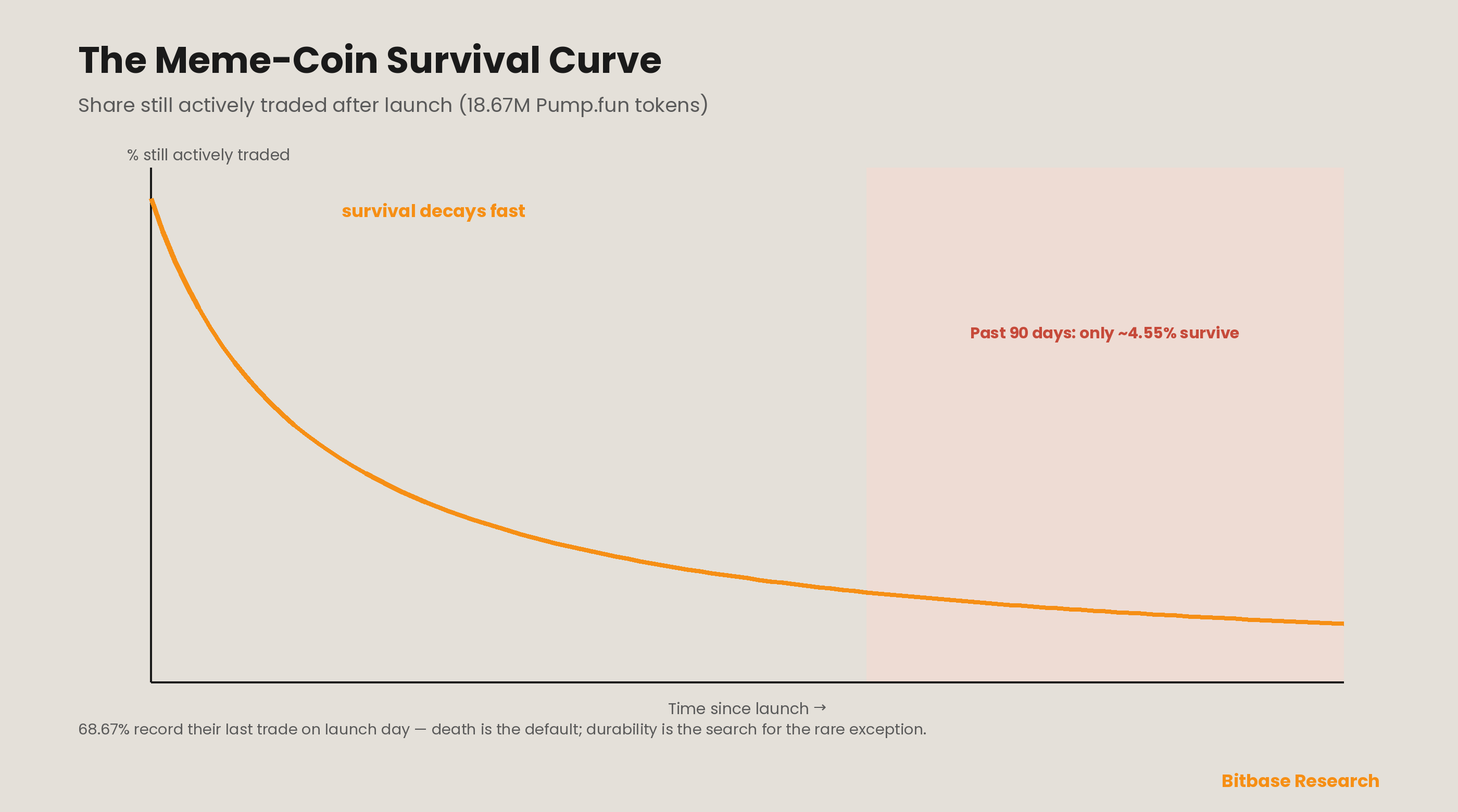
Meme coins are the market's clearest natural experiment in survival, because almost none survive. A sweeping on-chain study of the 18.67 million tokens launched on Pump.fun between January 2024 and June 2026 found that just 4.55% remained actively traded beyond 90 days; the other 95.45% effectively ceased to exist as tradable assets before the three-month mark, and 68.67% recorded their last trade on the very same day they launched — nearly seven of every ten tokens born, briefly traded, and never traded again within 24 hours [2][3]. Against that base rate, the analytical question is not "will this meme coin go up" but "does this one have the structural properties of the roughly one-in-twenty that live" — and the survivors are not random. They share measurable traits: deep liquidity across multiple venues, decentralized holder distribution, and community engagement that persists through drawdowns rather than only pumps [9].
This report turns those traits into a structural durability and rug-risk framework built on four observable components, deliberately privileging on-chain structure over social buzz because, as the data repeatedly shows, holder distribution, trading volume and wallet concentration measure a meme token's strength far more reliably than social-media interest alone [8]. The first component is holder-distribution health — whether the holder base is broad and decentralized or thin and clustered. The second is whale concentration, read against hard red-lines the market has converged on: a top-5 wallet share above roughly 20%, or a top-10 share above roughly 30%, of supply leaves the token one coordinated selloff from collapse [4]. The third is the liquidity-to-market-cap ratio, the antidote to the "MCAP illusion" in which a large headline capitalization sits atop liquidity too thin to exit, with unlocked liquidity the single clearest rug-pull setup [6][7]. The fourth is social momentum, treated not as the signal but as the accelerant — the thing that creates the short-term move that the first three decide whether the token can survive [11].
The stakes are large and the losses concrete. The memecoin category carried a roughly US$30.6 billion market capitalization in 2026, and rug pulls alone cost investors more than US$2.8 billion in 2025, with the average rug taking roughly US$510,000 — most now executed through a DEX liquidity-pool launch pattern that the framework is built to flag before it fires [1][6]. Resolved together, the four components produce a durability-versus-rug reading: a way to separate the handful of structurally sound communities from the overwhelming majority engineered, or simply doomed, to disappear. Everything here is educational analysis, not investment advice, and meme coins carry an extreme risk of total loss.
Part 1 · The Base Rate: 95% Die, and Structure Predicts Which
Every meme-coin analysis has to begin with the survival base rate, because it is so extreme that it reframes the entire exercise. The Pump.fun dataset is the definitive sample: 18.67 million tokens over roughly two and a half years, of which only 4.55% were still actively traded past 90 days [2][3]. The mortality is not gradual but immediate — 68.67% of all tokens recorded their final trade on their launch day, meaning the typical outcome is not a slow bleed but instant death, a token that is minted, trades for minutes to hours, and is abandoned [2]. A separate CoinGecko analysis reached the same conclusion from a different angle: roughly 5% survive past 90 days [3]. When 95% of a population dies, the correct default assumption for any new specimen is death, and the analyst's job is to find the specific, structural reasons to override that default.
This is what makes meme coins amenable to a structural framework rather than pure speculation. If survival were random, no analysis could help; but it is not random, and the survivors share identifiable traits — deep liquidity across multiple exchanges, decentralized distribution, and community engagement that holds during price drawdowns, not merely during pumps [9]. Those traits are exactly the four components this framework measures, which means the framework is, at heart, a survival filter: it does not predict which of the doomed 95% will pump hardest before dying (that is momentum's domain and is close to noise), but it identifies which tokens carry the structural signatures of the surviving ~5%. The distinction matters because the two questions have opposite time horizons and opposite risk profiles: momentum is a short-term, high-turnover bet against the base rate, while structural durability is the slower question of whether a community can outlast the mortality curve. This report is about the second question.
Part 2 · Holder-Distribution Health
The first component is the shape of the holder base, because a community is, structurally, its distribution of holders, and that distribution is visible on-chain before any price action confirms or denies it. A healthy meme coin has a broad, growing, decentralized holder base — many independent wallets each holding a modest share — which is both a sign of genuine adoption and a structural buffer, because no single holder or small coordinated group can collapse the price by exiting. Pepe's roughly 550,000 holder addresses at a US$1.23 billion capitalization is the profile of a token whose distribution has broadened enough to be difficult to rug, precisely because value is spread across a base too large to coordinate [1]. An unhealthy one has the opposite shape: a small number of wallets, often connected, holding the bulk of supply, so the "community" is a facade over a concentrated position.
The distinction the framework insists on is that holder count and holder distribution are different measurements, and the second matters more. A token can post an impressive holder count that is mostly dust wallets — tiny balances that inflate the number without adding real ownership — while the meaningful supply sits in a handful of large wallets. The healthy read is therefore not "many holders" but "many holders who each hold a meaningful and comparable share," a base that is broad and flat rather than broad and top-heavy. Practitioners have formalized this intuition into metrics like Token Holder Count and community-engagement indices, but the underlying signal is simpler than the acronyms: does the distribution look like a real crowd, or like a few insiders wearing a crowd as a costume [8]? A real crowd is a structural asset that dampens volatility and resists coordinated exit; a costume is the setup Part 3 measures directly.
Part 3 · Whale Concentration
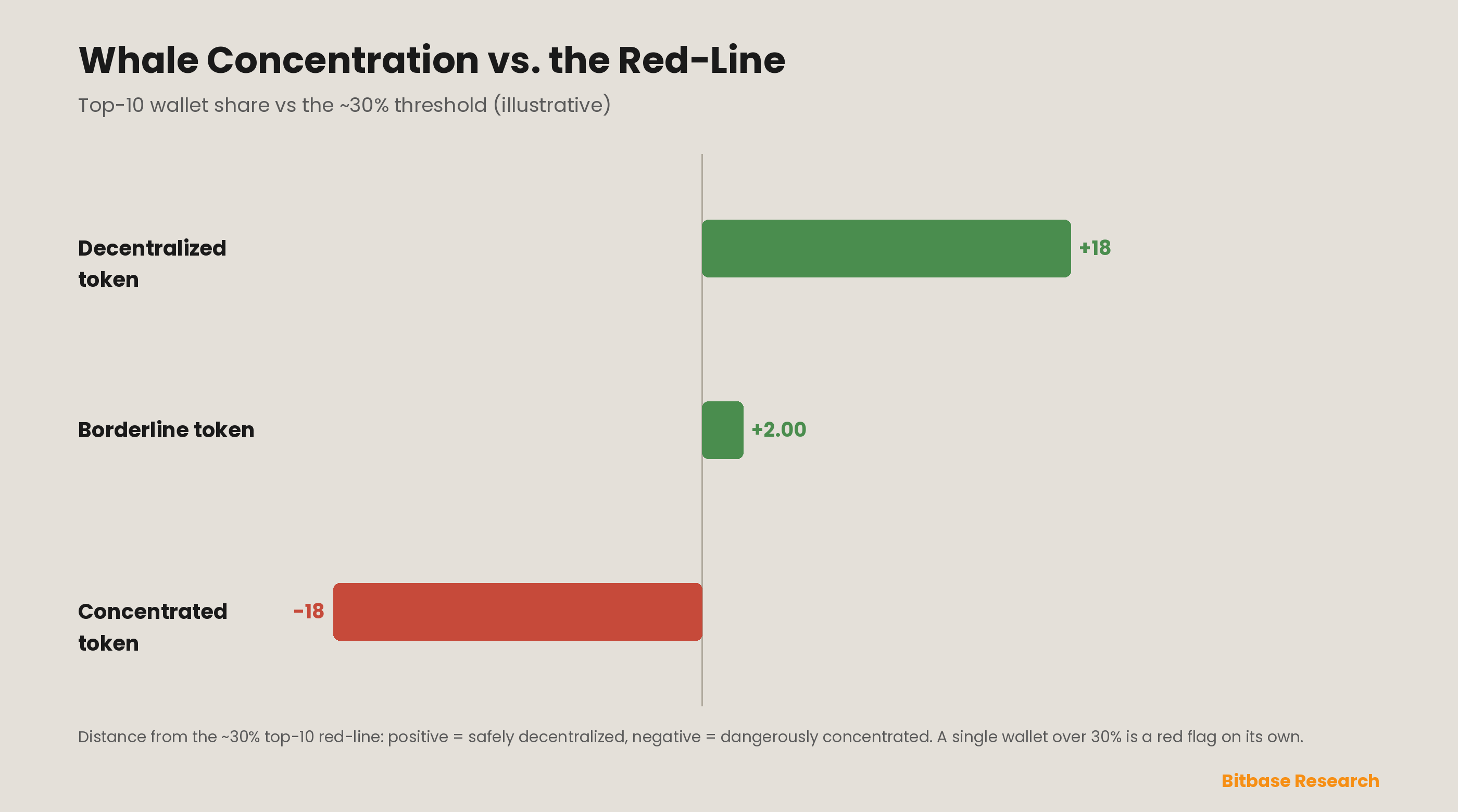
Whale concentration is the sharpest single rug-risk signal, and it is the one the market has converged on hard red-lines for. The widely used thresholds are concrete: if the top 5 wallets hold more than roughly 20% of circulating supply, or the top 10 hold more than roughly 30%, the token is dangerously concentrated, and a single wallet holding more than 30% is treated as a massive red flag on its own [4]. The logic is mechanical rather than moral: a token where a few connected wallets control a large share of supply is, in the framework's phrasing, one large selloff away from collapse — the concentrated holders can dump at any time, and because meme-coin liquidity is thin, even one of them exiting can crater the price and trigger the panic that empties the rest [4].
The reason concentration is so predictive of rug risk is that it is the precondition for the most common rug mechanics. A team or insider cluster that holds the majority of supply does not need any elaborate exploit to rug — they simply sell into whatever liquidity the community provides, and the "community" is left holding a token whose price reflects the exit of its largest holders. This is why concentration must be read against the specific red-lines rather than in the abstract: a top-10 share of 25% is a different asset from one of 45%, and the framework's discipline is to check the actual wallet distribution — ideally identifying whether the top wallets are connected, freshly funded, or tied to the deployer — rather than trusting a holder count or a market cap that says nothing about who can exit. Concentration is where the "community" narrative meets the on-chain reality of who actually owns the token, and the gap between the two is often the whole story.
Part 4 · Liquidity-to-Market-Cap and the MCAP Illusion
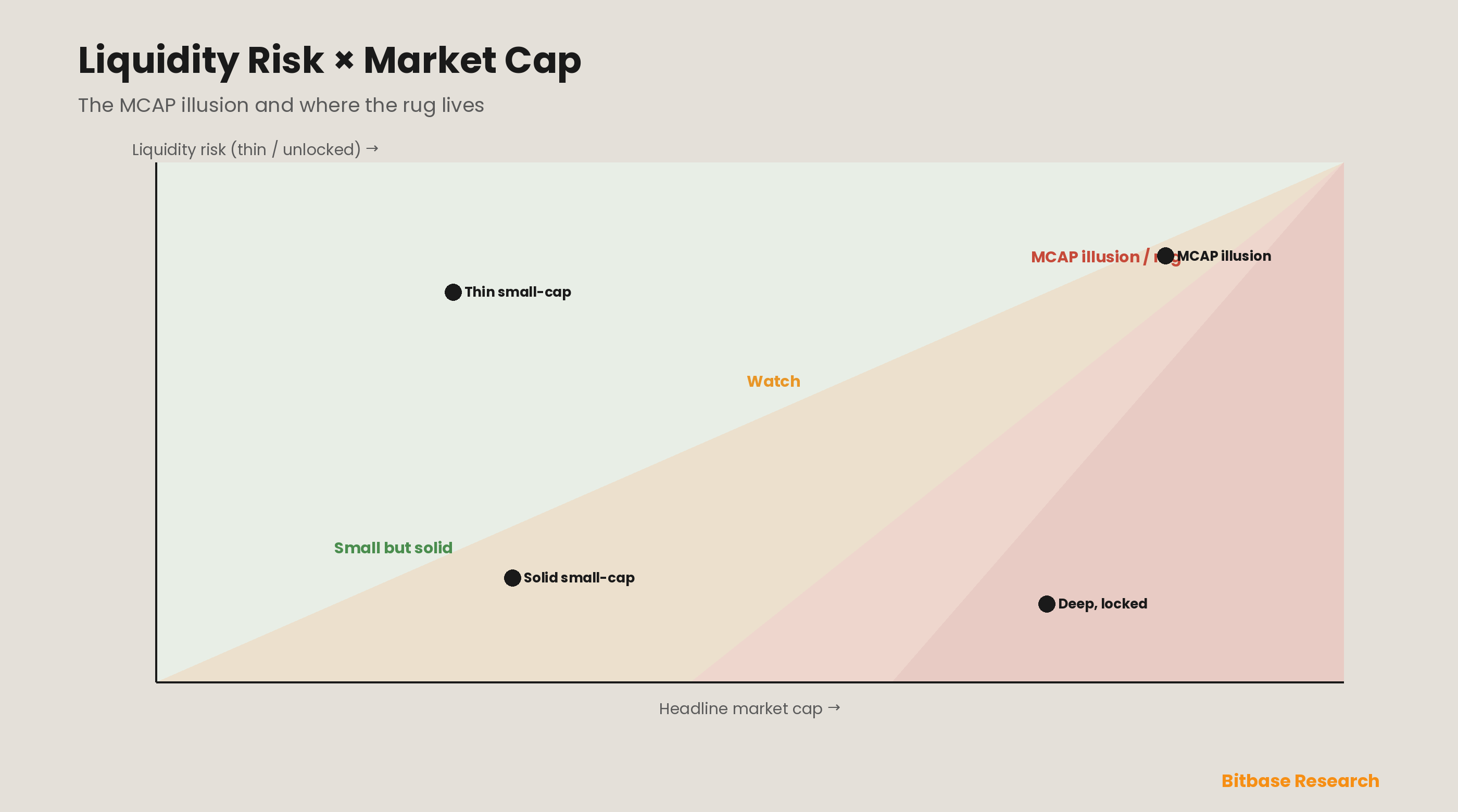
The third component is the ratio of liquidity to market capitalization, and it exists to defeat the single most seductive error in meme-coin analysis: taking the market cap at face value. A meme coin's headline capitalization is price multiplied by supply, but that number is only real to the extent the token can actually be sold near it, and in thin markets it cannot — the "MCAP illusion" is a large capitalization sitting atop liquidity far too shallow to exit, so the paper value evaporates the moment holders try to realize it [7]. The framework therefore treats the liquidity-to-market-cap ratio, not the market cap, as the measure of a token's real substance: a high capitalization on deep, multi-venue liquidity is a genuinely large asset, while the same capitalization on a single thin pool is a number waiting to collapse. The practical floors the market uses are blunt but useful — avoid tokens trading under roughly US$1 million per day, and be wary of any capitalization whose supporting liquidity is a small fraction of it [5].
Liquidity is also where the rug pull lives most directly, which is why this component doubles as the framework's fraud detector. The dominant rug mechanic in 2026 is a DEX liquidity-pool launch in which the team controls the pool, and unlocked liquidity is a rug pull waiting to happen — the deployer can withdraw the pooled liquidity at any moment, leaving holders with a token that cannot be sold at all [6]. Rug pulls executed this way cost investors more than US$2.8 billion in 2025, at an average of roughly US$510,000 per incident, and the pattern has converged toward the liquidity-pool launch precisely because it is fast and deniable [6][12]. The framework's liquidity check is therefore two questions at once: is the liquidity deep enough to make the market cap real, and is it locked so it cannot be pulled? A token can pass the first and fail the second — deep liquidity that is unlocked is deep liquidity that can vanish — so both must be verified, and a token whose liquidity is thin, unlocked, or controlled by the deployer fails the component regardless of how large its market cap or how loud its community.
Part 5 · Social Momentum vs. Durability
The fourth component is social momentum, and the framework's most important claim about it is that it is the accelerant, not the signal. Momentum — the velocity of a meme's propagation across social platforms, the surge of attention that drives a token vertical — genuinely creates the short-term move, and it is the reason meme coins can deliver the explosive returns nothing else offers, as when a Solana token exploded more than 600× in a single day [14]. But momentum is close to unpredictable and close to survivorless: it determines which of the doomed 95% pumps hardest before dying, not which token lives, and treating it as the durability signal is the error that keeps investors buying tops in tokens that structurally cannot last. The evidence is explicit that momentum creates short-term gains while community engagement determines long-term survival, and that the metrics of structure — distribution, volume, concentration — measure a token's strength far more reliably than social interest alone [8][11].
What distinguishes durable social momentum from the disposable kind is whether the engagement holds through drawdowns. The surviving ~5% share a community that stays engaged when the price falls, not only when it pumps — a base that treats the token as an identity or a bet it is committed to rather than a lottery ticket to be discarded on the first red candle [9]. This is why the framework reads social signals structurally rather than by volume: a token with a smaller but drawdown-resilient community is more durable than one with a larger community that evaporates the moment momentum fades. Practitioners quantify this with propagation-velocity and engagement indices, but the framework's use of them is conditional: high momentum is a reason to look, never a reason to hold, and it only counts toward durability when paired with the structural health the first three components measure. Social momentum, in short, tells you a token is moving; only holder distribution, whale concentration and liquidity tell you whether it can survive the move.
Part 6 · The Durability / Rug Score
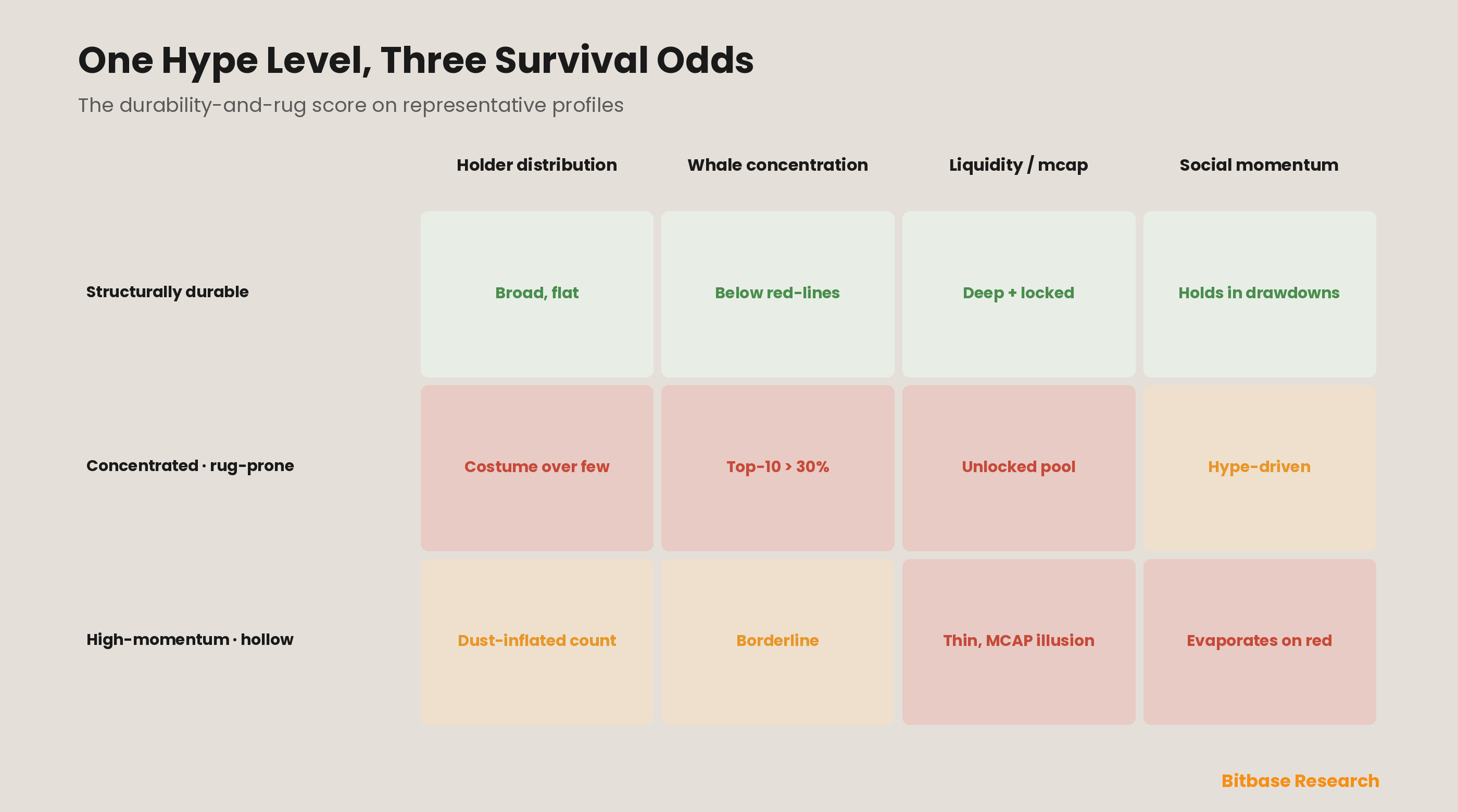
The four components combine into a single reading because each covers what the others miss, and a meme coin's durability is their alignment rather than any one signal. Holder distribution asks whether there is a real, broad community or a costume over a concentrated position; whale concentration asks whether a few wallets can collapse the price and reads it against the 20%/30% red-lines; the liquidity-to-market-cap ratio asks whether the market cap is real and the liquidity locked; and social momentum asks whether the attention driving the move is backed by a community that holds through drawdowns. A durable token is one that passes all four — decentralized distribution, concentration below the red-lines, deep and locked liquidity, and drawdown-resilient engagement — which is precisely the profile of the surviving ~5% [9]. A rug-prone one fails the structural components regardless of how strong its momentum looks, because momentum without structure is the signature of the 95%.
The composition matters because each component alone is defeatable. A broad holder count can be dust wallets hiding a concentrated position; deep liquidity can be unlocked and pullable; low concentration can coexist with liquidity too thin to matter; and strong momentum can ride atop all three failing at once. Only the composite catches the token that looks healthy on one axis and is fatal on another — the one with 500,000 holders but unlocked liquidity, or the one with locked liquidity but a top wallet holding 40%. The score is therefore ordinal and structural, not a price target: it ranks a token's durability — its odds of being in the surviving minority — and flags the specific rug-risk conditions that place it in the doomed majority. Applied across a set of tokens, the same four questions separate the rare structurally sound community from the many that a holder count and a market cap would make look identical.
Part 7 · Limits and Honest Failure Modes
A structural framework earns trust by naming what it cannot do, and this one has hard limits precisely because meme coins are, at bottom, reflexive social objects. The largest limit is that structure sets the odds, not the outcome: a token can pass all four components and still die because a meme is only ever worth what its community collectively decides, and that decision can reverse for reasons no on-chain metric captures — a lost narrative, a founder's silence, a rival token stealing the attention. The framework moves the base rate; it does not repeal it. It identifies the tokens with the structural signatures of survivors, but a large fraction of even the structurally sound will still fail, because the base rate is 95% and structure improves the odds without guaranteeing them.
Four further limits deserve to be as visible as the framework. Data quality and obfuscation: holder distributions can be disguised — a deployer can split a concentrated position across many wallets to fake decentralization, or use dust wallets to inflate holder count — so the concentration read requires clustering the wallets, not trusting the raw count, and a sophisticated rug will look decentralized [4][8]. Liquidity can be un-locked after the fact: a lock is only as good as its term and its contract, and "locked" liquidity that unlocks in a week, or is locked by a contract the team controls, is not locked in any meaningful sense [6]. Momentum is genuinely unpredictable: the framework deliberately downgrades momentum because it cannot be forecast, which means the framework will systematically miss the explosive pumps in structurally doomed tokens — it is a survival filter, not a momentum tool, and it will underperform in a raging meme mania where structure is temporarily irrelevant [11][14]. Reflexivity and speed: meme coins move faster than any due diligence, and by the time a structural read is complete the token may have already lived and died, so the framework is better suited to filtering a watchlist than to timing an entry. As a discipline for reading which communities are structurally built to last, the framework is sharp; as a predictor of any single token's price, it is a probability against a brutal base rate.
Conclusion · Structure Against the Mortality Curve
Meme coins reward the analyst who starts from the base rate and reads structure against it. Ninety-five percent die, most on the day they are born, so the question is never whether a token will pump but whether it carries the structural signatures of the rare survivors — and those signatures are measurable [2][9]. Holder distribution reveals whether there is a real community or a costume; whale concentration, read against the 20% and 30% red-lines, reveals whether a few wallets can collapse it; the liquidity-to-market-cap ratio reveals whether the capitalization is real and the liquidity locked, defeating both the MCAP illusion and the rug; and social momentum, treated as accelerant rather than signal, reveals whether the attention is backed by a community that holds through drawdowns [4][6][7][11]. Composed into a durability-and-rug score, they separate the structurally sound minority from the doomed majority that a holder count and a market cap make look the same.
The deeper primitives these judgments rest on — how liquidity pools and locks actually work, how a token's circulating supply and holder distribution are engineered, and how the rug-pull mechanics of unlocked liquidity and concentrated supply actually execute — are each worth understanding in their own right, because a durability read is only as good as the reader's grasp of the on-chain mechanics that make a meme coin survivable or fatal. Treat the framework as a discipline for ranking structural durability and rug risk against a 95% mortality curve, never as a forecast of which token will pump, and always with the humility that a meme is ultimately worth only what its community decides it is.
References
[1] CoinLaw, Memecoin Statistics 2026: The $30.6B Category (category market cap; Dogecoin ~US$14.28B; Pepe ~US$1.23B and ~550,000 holders). coinlaw.io
[2] CoinLaw / on-chain study, Pump.fun survival: 18.67M tokens, 4.55% traded past 90 days, 68.67% last trade on launch day. coinlaw.io
[3] Crypto Briefing, "Only 5% of Pump.fun Tokens Survive Past 90 Days, CoinGecko Study Finds." cryptobriefing.com
[4] Crypto Start Now, How to Analyze Meme Coins and Avoid Rug Pulls (2026) (top-5 > ~20% and top-10 > ~30% concentration red-lines; a single wallet > 30% as a red flag); DEXTools News, How to Invest in Meme Coins. cryptostartnow.com
[5] CryptoNews, Best Meme Coins to Invest in 2026; WEEX, Meme Coin Guide: Opportunities, Risks, and Strategy 2026 (liquidity vs cap; avoid < ~US$1M daily volume). cryptonews.com
[6] DEXTools News, How to Invest in Meme Coins (Risk and Rules) (unlocked liquidity = rug setup; rug pulls > US$2.8B in 2025, average ~US$510,000; DEX liquidity-pool launch pattern). dextools.io
[7] Crypto Times, The MCAP Illusion: How ANSEM Exposes the Fatal Flaws in Meme Coin Metrics, July 1, 2026. cryptotimes.io
[8] AInvest, Meme Coins: The New Speculative Wave Driven by Community and Momentum (Token Holder Count, Community Engagement Index, Meme Propagation Velocity; distribution/volume/concentration over social interest). ainvest.com
[9] ChainPeak, Why Some Meme Coins Go Viral While Others Die in 72 Hours (survivor traits: deep multi-venue liquidity, decentralized distribution, drawdown-resilient community). medium.com
[10] CoinLaw, Pump.fun April 2026 trader profitability (73.3% of traders in gains; ~169,000 wallets > US$1,000). coinlaw.io
[11] XT Exchange, Top Eight Meme Coins to Follow in 2026: Understanding Community-Driven Crypto Assets (community engagement vs momentum). medium.com
[12] Chainalysis (via CoinLaw / DEXTools), 2026 scam-methodology convergence (scammers adopting multiple tactics simultaneously). coinlaw.io
[13] FXM Brand, Inside the Meme Coin "Pump Room": How to Spot a Rug Pull Before It Happens Using AI Volume Analysis. medium.com
[14] CoinEdition, How a Solana Meme Coin Called ANSEM Exploded More Than 600x in a Day (momentum-driven explosive move). coinedition.com
[15] DEXTools News, What Is Pump.fun: Complete Solana Memecoin Launchpad Guide (2026). dextools.io
[16] Analytics Insight, Why Meme Coins Are Highly Volatile and Risky for Investors. analyticsinsight.net
[17] Tangem, Top 10 Meme Coins to Monitor in April 2026 (large-cap vs small-cap liquidity and volatility). tangem.com
[18] Bitcoin Foundation, Best Memecoins to Buy in June 2026: A Data-Driven Look at the Most Traded Tokens. bitcoinfoundation.org
[19] CoinMarketCap, Token Holder and Distribution Data (holder-distribution metrics context). coinmarketcap.com
[20] Chainalysis, The 2026 Crypto Crime Report (rug-pull losses and methodology, sector context).
Methodology and disclosure: This report synthesizes public meme-coin data as of mid-2026 (the memecoin category's ~US$30.6B market cap and project figures [1]; the Pump.fun survival statistics of 18.67M tokens, 4.55% surviving past 90 days and 68.67% dying on launch day [2][3]; the top-5 ~20% and top-10 ~30% concentration red-lines [4]; the ~US$1M daily-volume floor [5]; unlocked-liquidity rug mechanics and the ~US$2.8B / ~US$510,000 rug figures [6][12]; the MCAP-illusion critique [7]; and survivor-trait and metric literature [8][9][11]). The four-component durability-and-rug framework (holder-distribution health, whale concentration, liquidity-to-market-cap, social momentum) is an educational, ordinal analytical construct for ranking structural durability and rug risk within the meme-coin sector; the token positions shown in the figures are illustrative of the framework rather than live assessments, and the cited numbers illustrate the framework rather than forecast any token. Nothing here is a rating, a recommendation, or a price target, and meme coins carry an extreme risk of total loss.
Disclaimer: This is educational content from Bitbase Research, provided for informational purposes only. It is not investment, trading, tax, or financial advice. Meme coins are highly speculative and carry a very high risk of total loss. Written as of July 2026; holder distributions, liquidity, market conditions and scam methodologies change continuously, so always rely on the latest primary on-chain data and do your own research before making any decision.