Publication date: July 23, 2026 · Bitbase Research
For related Bitbase Research on this subject, see Herding Effects and Incentive Misalignment in Cryptocurrency Markets.
Executive Summary
On-chain data is pseudonymous, not anonymous, and that single distinction is the foundation of every whale-tracking and smart-money strategy. Every transaction is public and permanent, so the challenge was never seeing what moved but knowing who moved it — and by 2026 that gap has largely closed. Platforms like Arkham Intelligence and Nansen apply real-world entity labels to millions of addresses, with Arkham's AI-driven engine specializing in de-anonymizing addresses into named venture funds, market makers and individual whales, and Nansen labeling wallets and surfacing a "Smart Money" dashboard that tracks the addresses with historically profitable trading patterns [1][2]. The blockchain-analytics market that powers this reached roughly US$1.76 billion in 2026, and the AI now does automatically what no human analyst could two years ago: cluster related wallets into single entities at scale [3][4]. The raw ledger has become a labeled map of who is doing what.
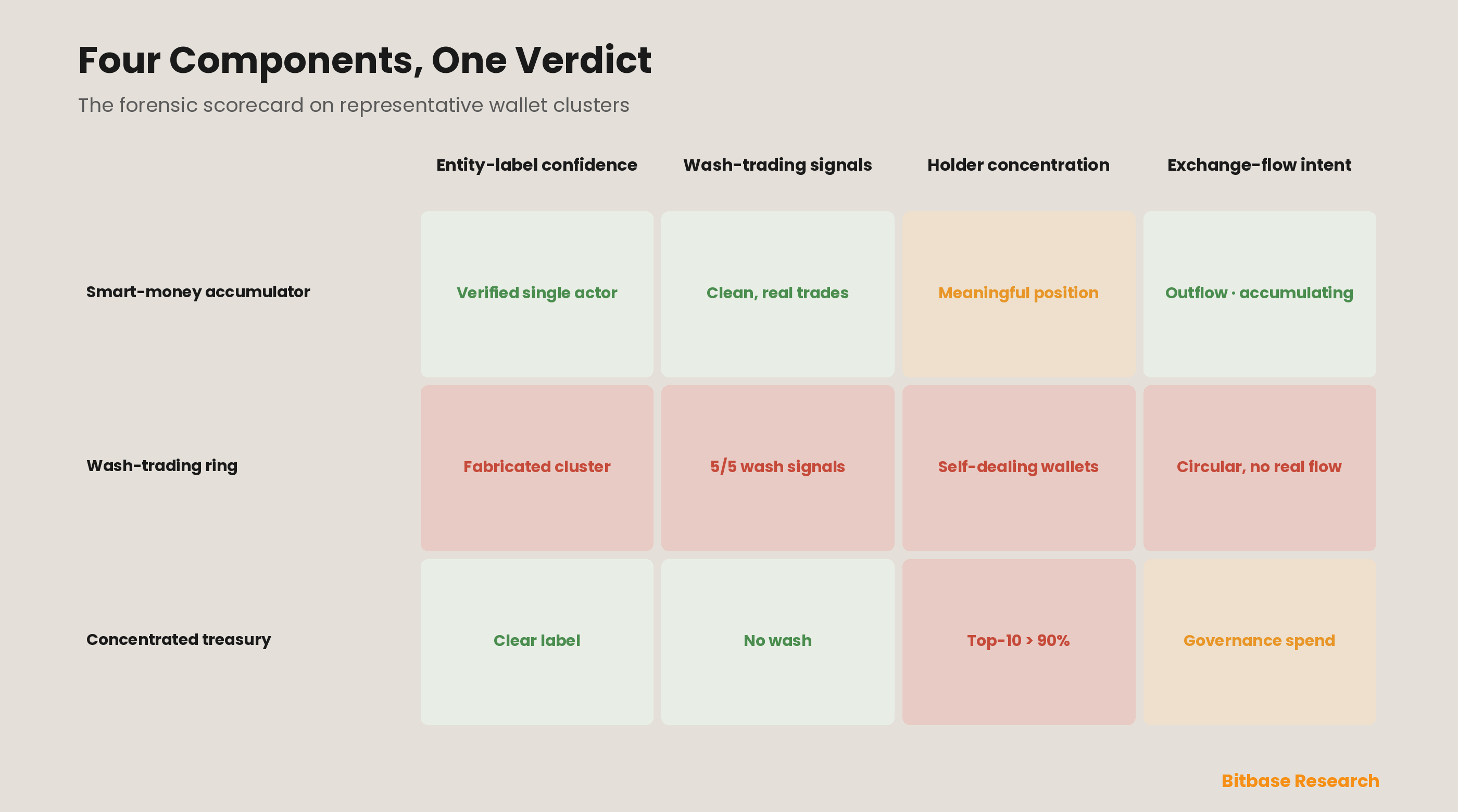
But a labeled map is only useful with a discipline for reading it, because the same transparency that reveals a whale also lets manipulators fabricate the signals analysts follow. This report builds that discipline as a wallet-entity taxonomy and forensic detection framework in four parts. The first is the taxonomy itself — classifying an address into the entity type that determines what its behavior means, because a large transfer from an exchange, a venture fund, a protocol treasury, a smart-money wallet and a wash-trader are five completely different signals wearing the same on-chain clothing. The second is clustering — the heuristics that connect many addresses to one controlling actor, without which a single entity moving across ten wallets looks like ten independent decisions. The third is a wash-trading detection scorecard built on the forensic heuristics that separate real activity from manufactured volume. The fourth is a holder-concentration and exchange-flow read that turns the distribution of a token and the direction of its exchange flows into a statement of intent.
The stakes are not academic. Chainalysis identified roughly US$2.57 billion in suspected wash trading across major chains in its 2025 analysis, and its forensic methods are relied on by an estimated 85% of US law enforcement agencies — which means the same techniques that catch criminals are the ones a serious analyst must use to avoid being deceived by fabricated on-chain signals [6][11]. Read together, the four components turn the public ledger from a stream of anonymous-looking transfers into an intelligible map of entities, intentions and manipulations. Everything here is educational analysis, not investment advice.
Part 1 · Pseudonymous, Not Anonymous: Labeling as the Foundation
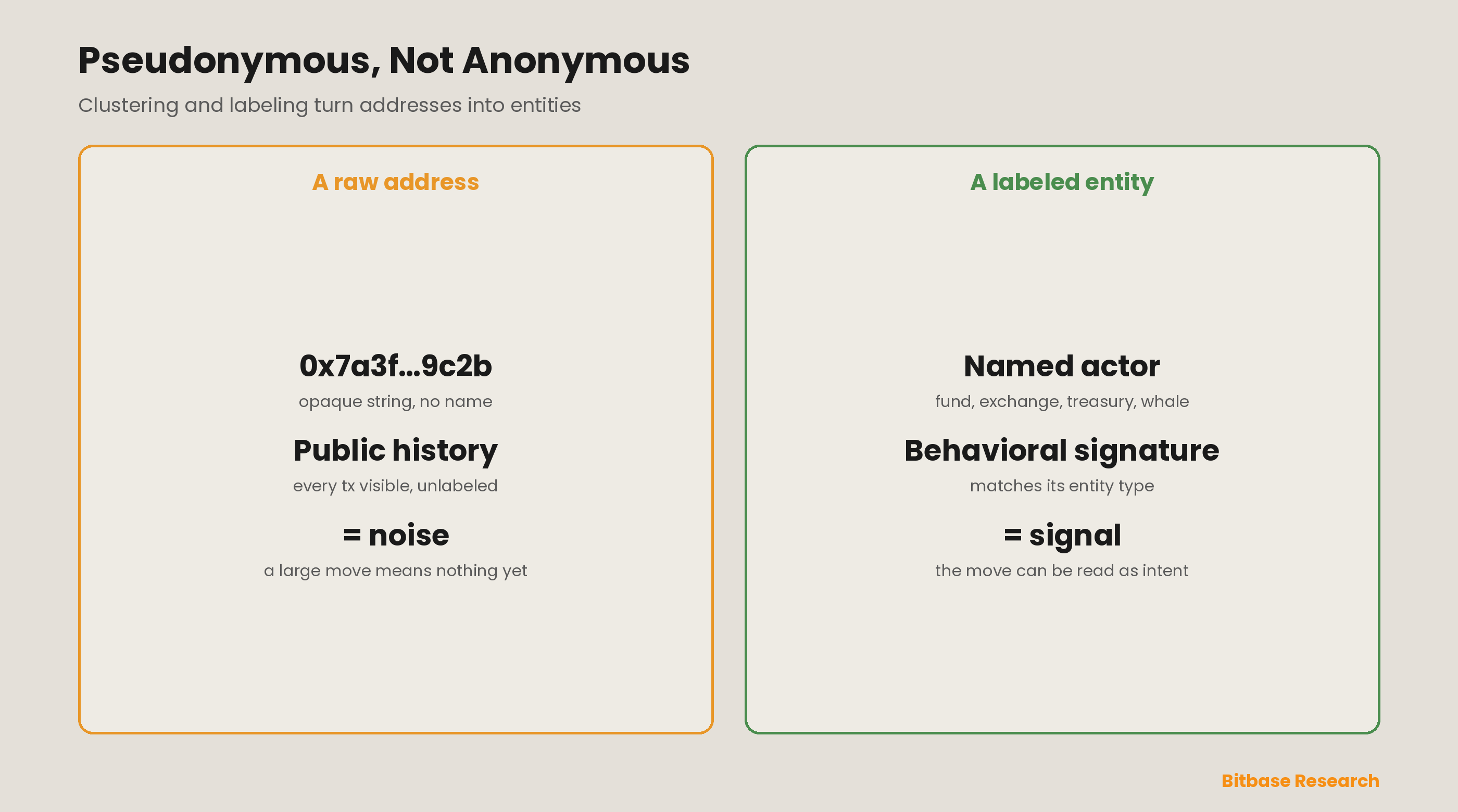
Precision about what the blockchain actually reveals is the foundation for everything else. A blockchain address is not a name, but it is not a secret either: every transaction it has ever made is public and permanent, and enough public behavior eventually identifies the actor behind the address as surely as a fingerprint. This is the property the entire tracking industry is built on — the chain is pseudonymous, and pseudonyms can be de-anonymized by cross-referencing on-chain patterns with off-chain information (a labeled exchange deposit, a publicized VC investment, a doxxed founder wallet). Arkham's core product is exactly this: an AI-powered algorithmic engine that applies real-world entity labels to addresses, letting an analyst inspect the portfolio of a named venture firm or market maker directly, while Nansen maintains labels on millions of wallets so that a large transaction reads not as "an unknown address moved funds" but as "this specific fund, protocol, or exchange did" [1][2].
The consequence is that raw address-watching has been replaced by entity-watching, and the two are not the same skill. Following an unlabeled whale address tells you a large holder is doing something; following a labeled entity tells you which kind of holder is doing it, which is the difference between noise and signal. The automation matters here as much as the labeling: platforms now cluster related wallets and surface relationships and transactional patterns at a scale that was impossible for human analysts even two years ago, so an analyst's job has shifted from manually piecing together wallet clusters to interpreting the entity map the tools produce [4]. But that shift creates its own trap — the labels are only as good as the inference behind them, and both the labels and the behaviors they attach to can be gamed, which is why the rest of the framework is as much about detecting deception as about following conviction. The foundation is simple to state and easy to forget: on-chain is a public record of pseudonymous entities, and the whole game is turning the pseudonyms into entities and the entities into intent.
Part 2 · The Wallet-Entity Taxonomy
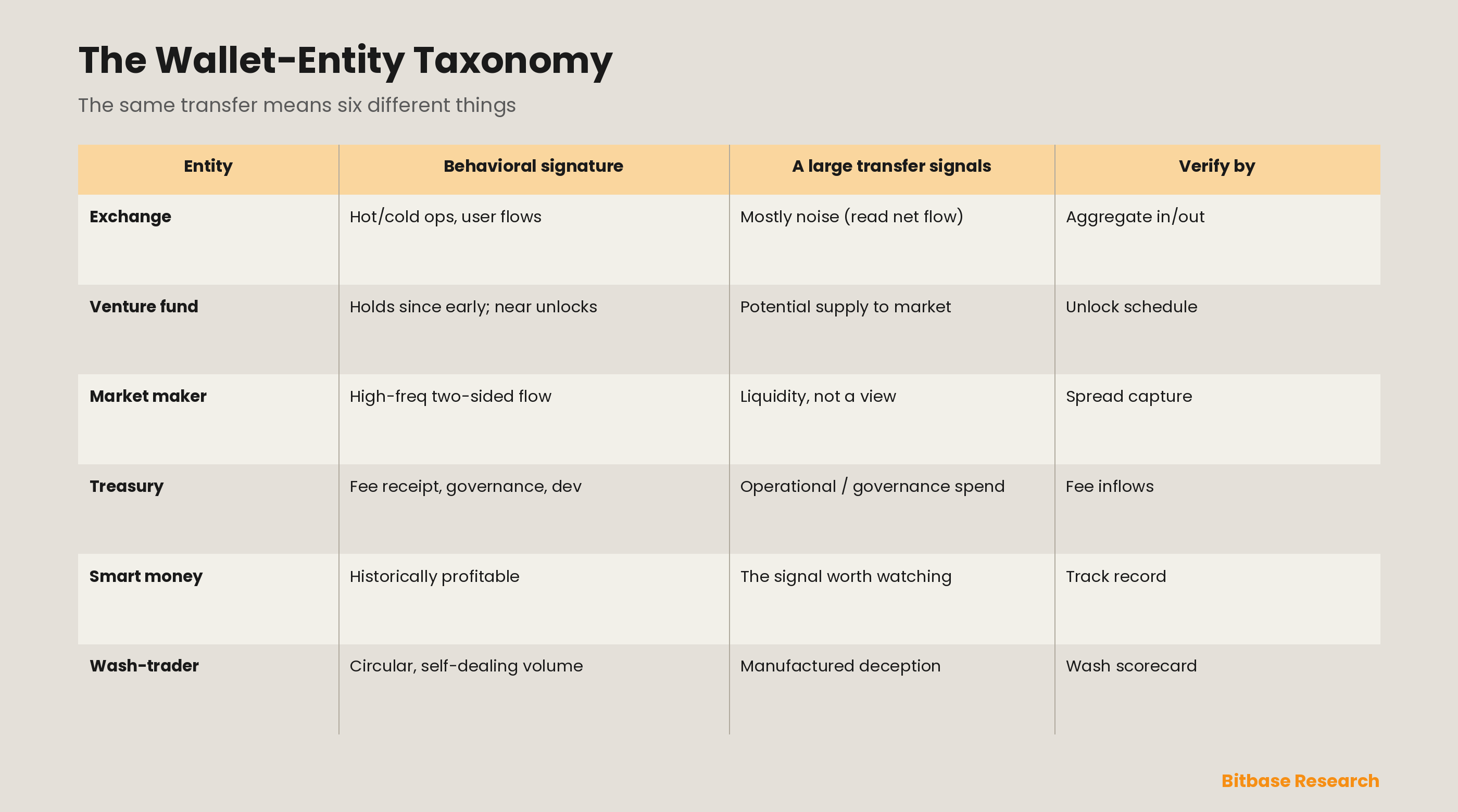
The first analytical component is a taxonomy, because the same on-chain action means opposite things depending on which entity performs it, and misclassifying the actor is the most common and most expensive tracking error. A large token transfer is not a signal until you know whether it came from an exchange, a venture fund, a market maker, a protocol treasury, a smart-money wallet or a wash-trader — six entity types with six different meanings for the identical transaction. An exchange wallet moving tokens is usually operational (hot-wallet management, user flows), so its transfers are mostly noise unless read as aggregate inflow or outflow. A venture fund or early investor moving tokens near an unlock is potential supply hitting the market. A market maker cycling inventory is providing liquidity, not expressing a view. A protocol treasury — identifiable because it receives protocol fees, holds governance tokens, funds development and often runs diversified, yield-farming holdings — moving funds may be operational spending or a governance-directed action, not a market call [9]. A smart-money wallet, defined by a track record of historically profitable trades, moving into a position is the signal traders actually want to follow [2][15]. And a wash-trader generating volume is a signal designed to deceive, which Part 4 is built to catch.
The discipline the taxonomy enforces is that classification precedes interpretation, always. The single most useful habit in on-chain analysis is to refuse to read any large transaction until the entity behind it is identified, because the identical flow — say, ten million tokens leaving a wallet — is bullish, bearish, or meaningless depending entirely on whether the wallet is a smart-money accumulator taking profit, a treasury funding a grant, an exchange rebalancing, or a market maker cycling inventory. Labeling platforms do much of this classification automatically, but the analyst must still verify the label and, crucially, understand the behavioral signature of each entity type, because that signature is what makes a label trustworthy: exchanges show characteristic hot/cold patterns, treasuries show fee-receipt and governance activity, market makers show high-frequency two-sided flow, and smart money shows a profitable historical record. When a wallet's behavior matches its label's signature, the label is trustworthy; when it does not, the label — or the analyst's reading of it — is the thing to question.
Part 3 · Clustering: From Addresses to Entities
The taxonomy assumes you can tell which entity owns an address, and that assumption rests on the framework's most technical component: address clustering. A single actor almost never operates from one wallet — a fund, an exchange, or a whale spreads activity across many addresses, whether for operational security, to obscure its footprint, or simply as a byproduct of using many services — so treating each address as an independent actor systematically miscounts the number of real participants and their true position sizes. Clustering is the set of heuristics that connect multiple wallets to a single controlling entity, and it is what turns "ten addresses each bought a little" into the far more meaningful "one entity accumulated a large position across ten wallets" [1][4][10]. Address clustering connects wallets to a controlling entity, and transaction-graph analysis visualizes the fund flows between them, which is the same technique used to trace circular flows in fraud [10].
The clustering heuristics are inferential, and understanding them is what lets an analyst judge how much to trust a cluster. Wallets that are repeatedly funded from a common source, that move in coordinated timing, that interact only with each other, or that share behavioral fingerprints are inferred to belong to one actor — and the same signals that cluster a legitimate fund's wallets also cluster a manipulator's, which is why clustering is the bridge between entity-tracking and fraud-detection. This is precisely why the automation is double-edged: AI clustering surfaces relationships at a scale impossible for humans, but it also produces false positives — two independent wallets that happen to share a funding exchange or a common counterparty can be clustered together incorrectly, inflating an entity's apparent size or fabricating a connection that is not real [4]. The framework's discipline is therefore to treat a cluster as a hypothesis with a confidence level, not a fact: a cluster built on many strong, independent signals (shared funding, coordinated timing, exclusive interaction) is high-confidence, while one built on a single weak signal (a shared exchange used by millions) is low-confidence and must not be read as a single actor. Clustering is what makes the taxonomy operable, but only if its inferential nature is respected.
Part 4 · The Wash-Trading Detection Scorecard
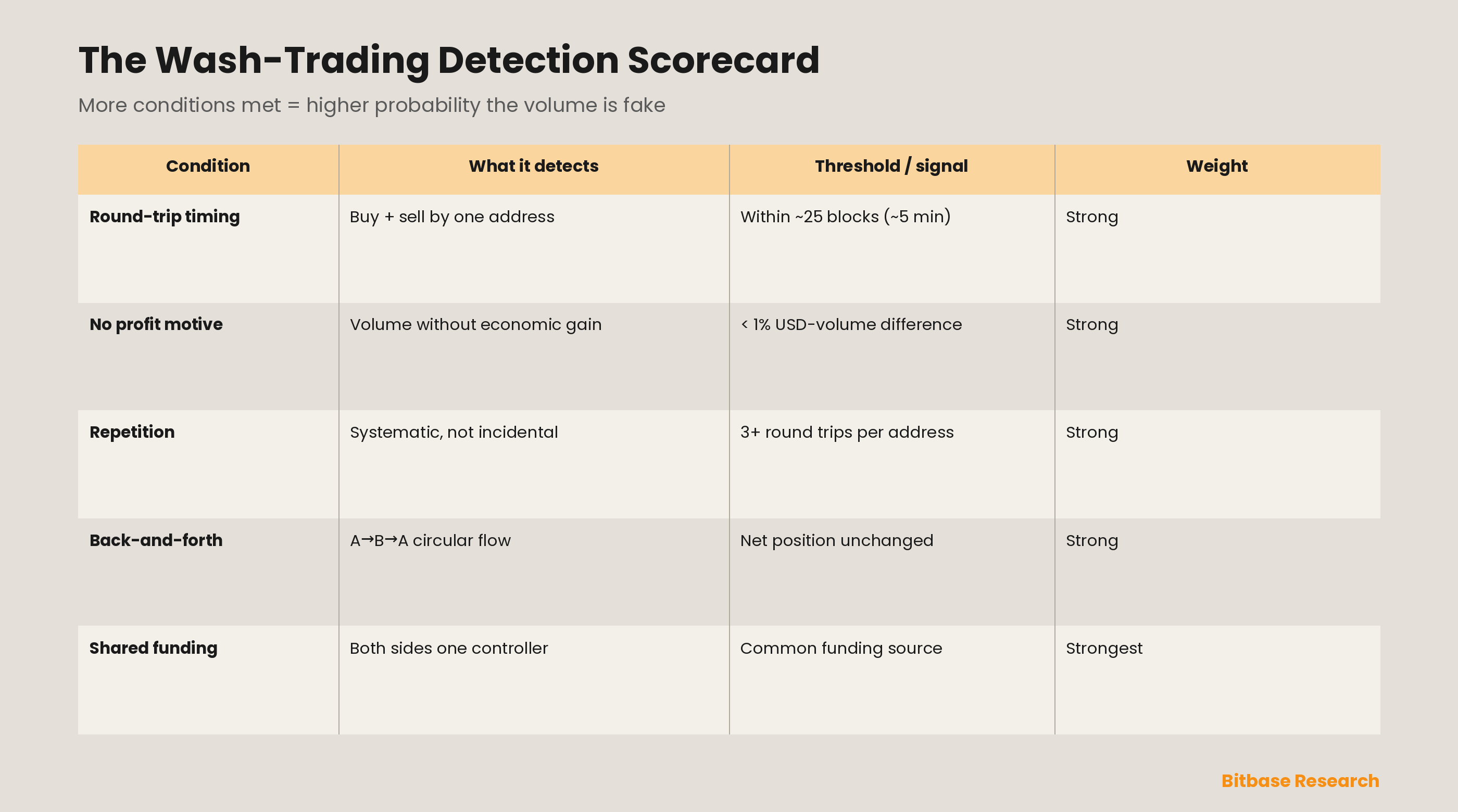
The third component turns the same clustering and behavioral analysis toward its most important defensive use: detecting manufactured volume, because a whale-tracking framework that cannot tell real activity from fake is worse than useless — it follows the very signals a manipulator planted. Wash trading, in which the same actor is on both sides of a trade to create artificial volume without real economic transfer, is not rare: Chainalysis identified roughly US$2.57 billion in suspected wash trading across major chains in its 2025 analysis, and the on-chain forensics to detect it have matured into a concrete scorecard [6]. The canonical heuristics, formalized by Chainalysis, are specific and checkable: an address executing one buy and one sell within about 25 blocks (roughly five minutes), with less than 1% difference in USD volume between the two (indicating no meaningful profit motive), and a single address performing three or more such round-trip trades over the study period [5]. Each condition alone is weak; together they describe activity that has the shape of trading but none of its economic substance.
Beyond the timing-and-size heuristic, the framework layers the structural tells that forensic investigators use, because sophisticated wash trading spreads across wallets to evade the single-address test. Back-and-forth trades — wallet A sells to wallet B, then B sells back to A — create volume with no net position change and are visible in transaction-graph analysis as circular flows [7][10]. Shared funding sources — the "buyer" and "seller" wallets both funded from the same origin — are one of the strongest tells that a single actor controls both sides [7]. And the most-active-wallet check — identifying the wallets generating the most volume and testing whether they are the same addresses repeatedly trading with each other — catches the coordinated wash-trading rings that a per-address test misses [7]. Academic work such as on-chain wash-trade detection systems for ERC-20 tokens has quantified these patterns at scale, and the practical output is a scorecard: for any token or wallet cluster, how many of these conditions are met tells you how much of the "volume" is real [14]. The framework treats a high wash-trading score not as a minor caveat but as a disqualifier, because a token whose volume is manufactured has no reliable signal in any of the other three components — the concentration, the flows, and the smart-money activity are all distorted by the fake trades.
Part 5 · Holder Concentration and Exchange Flows
The fourth component reads two aggregate signals that the entity map makes legible: how concentrated a token's ownership is, and which way it is flowing relative to exchanges. Concentration is the structural risk read — analysts examine the distribution among holders because a token where the top wallets control most of the supply is manipulable and fragile, with the rough industry line that if the top 10 wallets hold more than 90% of supply the manipulation potential is high, since those holders can move the price at will [8]. But concentration is only meaningful after clustering, because ten wallets that look independent may be one entity, and the true concentration is what the clustered distribution shows, not the raw address list — a token that looks decentralized across 10,000 addresses can be dangerously concentrated if clustering reveals that a handful of entities control most of those addresses [8][10]. Concentration read on unclustered addresses systematically understates the real risk.
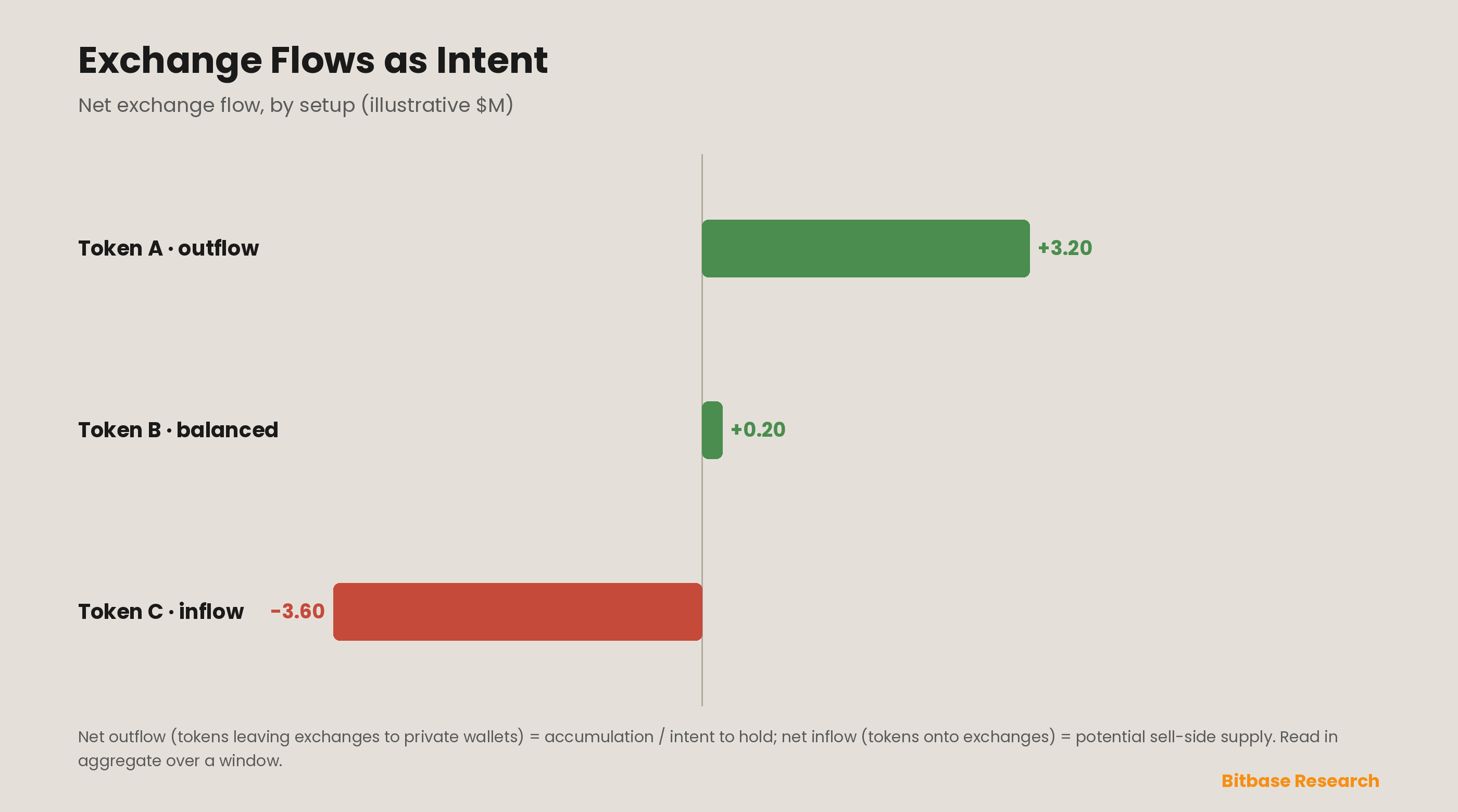
Exchange flows are the intent read, the aggregate signal that turns operational exchange transfers from noise into information. Tokens flowing into exchanges are positioning to be sold — accumulating on order books as potential supply — while tokens flowing out of exchanges into private wallets suggest accumulation and an intent to hold, removing supply from the immediately sellable pool [13][16]. Read at the level of a single transfer this is noise, but read in aggregate — net exchange inflow versus outflow over a window — it is one of the cleaner directional signals in on-chain analysis, because it captures the collective decision of holders to move toward or away from the ability to sell. The two reads combine: a token that is highly concentrated (after clustering) and showing large net inflows to exchanges is a token whose few large holders are positioning to sell into whatever demand exists — the on-chain configuration that most often precedes a large holder exit. Concentration tells you who could move the price; exchange flows tell you which way they are leaning; and only the clustered, labeled entity map makes either read trustworthy.
Part 6 · Reading Smart Money vs. Noise
The framework's most sought-after use is following smart money — the wallets with a track record of historically profitable trades that platforms like Nansen surface — but the discipline here is knowing what that signal can and cannot do. A smart-money label is a statement about the past: this wallet has been profitable, which is genuine information because skill and access persist to some degree, and a wallet that has consistently entered good positions early is more worth watching than a random address [2][15]. The framework's four components make the smart-money read trustworthy rather than naive: clustering confirms the smart-money wallet is a single real actor and not a fabricated track record spread across coordinated wallets; the wash-trading scorecard confirms its profits came from real trades rather than manufactured ones; the entity taxonomy confirms it is an independent trader and not a market maker whose "profits" are spreads; and the concentration read confirms its position is meaningful relative to the token. A smart-money signal that survives all four checks is worth far more than a raw "profitable wallet" label.
But the framework is equally clear about the signal's limits, because following smart money is inherently reflexive. The moment a wallet is publicly labeled smart money, its moves are watched and front-run, so the edge that made it profitable erodes as it becomes known — the most-followed smart-money wallets are the least likely to still have an edge, precisely because everyone is copying them [2]. Worse, a sophisticated actor who knows its wallet is labeled can exploit the followers, accumulating quietly in an unlabeled wallet while making visible moves in the labeled one to induce a crowd. The framework's discipline is therefore to treat smart-money labels as a starting point for investigation, not a trade signal to copy: the value is in understanding why a skilled entity is positioning a certain way — what it may know that the market has not priced — not in mechanically mirroring its transactions after they are already public and already being front-run by thousands. Smart money is a lead to investigate, verified by the other three components; it is never a signal to follow blindly.
Part 7 · Limits and Honest Failure Modes
A forensic framework earns trust by naming what it cannot do, and on-chain intelligence has sharp limits precisely because it is inferential at every step. The largest is that labels and clusters are hypotheses, not facts: an entity label is an inference from public behavior and off-chain data that can be wrong, stale, or deliberately spoofed, and a wallet cluster is a probabilistic grouping that can incorrectly merge independent actors or split a single one. Building a thesis on a mislabeled wallet or a false cluster is the most common way sophisticated on-chain analysis goes wrong, and the automation that makes labeling scalable also makes its errors scalable — a wrong label propagates to every analyst using the platform.
Four further limits deserve to be as visible as the framework. Adversarial gaming: every signal the framework reads can be manufactured — wash trading fakes volume, coordinated wallets fake decentralization, a labeled wallet can be used to bait followers, and an actor who understands the heuristics can construct on-chain behavior specifically to deceive them, so the analyst is always in a contest with counterparties who know they are being watched [5][7]. Privacy tools and cross-chain gaps: mixers, privacy protocols, bridges and centralized-exchange internal transfers break the transaction graph, so an entity can deliberately sever the trail, and clustering across chains or through an exchange's omnibus wallet is often impossible [10]. Reflexivity: the most valuable signals — a smart-money entry, a whale accumulation — lose their edge the moment they are public and followed, so the framework's best outputs are self-defeating in proportion to their fame [2]. The "why" is invisible: on-chain data shows what an entity did, never why, so an analyst always supplies the interpretation, and the gap between the observed transaction and its true motive is where most incorrect theses live. As a discipline for turning the public ledger into a map of entities and detecting the manipulations planted in it, the framework is sharp; as a source of certainty about any single actor's intent, it is an inference against an adversary.
Conclusion · From Addresses to Intent
On-chain analysis rewards the analyst who treats the ledger as pseudonymous rather than anonymous, and builds a discipline for turning addresses into entities and entities into intent. The chain shows everything and hides who; labeling and clustering close that gap, turning a stream of transfers into a map of named actors, but only if the labels are verified and the clusters treated as confident hypotheses rather than facts [1][4][10]. On that map, the wallet-entity taxonomy determines what each action means, the wash-trading scorecard separates real activity from the roughly US$2.57 billion of manufactured volume that would otherwise corrupt every read, the concentration-and-flow analysis turns ownership and exchange direction into a statement of who could move the price and which way they lean, and the smart-money read — verified by the other three — points to the entities worth investigating [6][8][13]. Composed, the four components turn the public ledger from an opaque stream into an intelligible, and defensible, map of who is doing what.
The deeper primitives these judgments rest on — how address clustering actually infers common control, how exchange hot- and cold-wallet architecture shapes the flow signals, and how the mechanics of wash trading and coordinated wallets actually manufacture the patterns the framework must detect — are each worth understanding in their own right, because an on-chain read is only as good as the analyst's grasp of the mechanics being observed and gamed. Treat the framework as a discipline for classifying entities, detecting manipulation, and reading intent from the public ledger, never as a source of certainty about motive, and always with the awareness that every signal worth following is also a signal an adversary can plant.
References
[1] Startupik, Arkham Intelligence vs Nansen: Which Wallet Tracking Tool Is Better? (Arkham AI-driven entity labeling and de-anonymization; Nansen wallet labels). startupik.com
[2] Nansen, Smart Money dashboard and wallet labeling (labels on millions of wallets; tracking historically profitable wallets); KuCoin, Top 5 Free Tools to Track Smart Money in Real-Time in 2026. nansen.ai
[3] Blockchain-analytics market valued at ~US$1.76 billion in 2026 (sector-size context, cited in tracking-tool analyses). startupik.com
[4] Cryptowisser, Advanced On-Chain Analysis: Wallet Tracking & Smart Money Flows, March 2026 (automated AI wallet clustering surfacing relationships at scale). cryptowisser.com
[5] Chainalysis, Crypto Market Manipulation 2025: Suspected Wash Trading, Pump and Dump (wash-trade heuristic: buy+sell within ~25 blocks, <1% USD-volume difference, 3+ round trips per address). chainalysis.com
[6] Chainalysis, 2025 analysis: ~US$2.57 billion in suspected wash trading across major chains. chainalysis.com
[7] FinanceFeeds, Detecting Crypto Wash-Trading Patterns Using On-Chain Signals; Crypto Trace Labs, What Are Wash Trading Patterns and How Do Investigators Detect Them? (back-and-forth A↔B trades, shared funding source, most-active-wallet check). financefeeds.com
[8] DEXTools News, How to Use Bubblemaps to Spot Token Manipulation (2026) (holder-concentration read; top-10 > 90% of supply as high manipulation potential). dextools.io
[9] Cryptowisser, Advanced On-Chain Analysis (treasury identification: protocol-fee receipt, governance-token holdings, development funding, diversified yield-farming). cryptowisser.com
[10] Chainalysis, Address clustering and transaction-graph analysis (connecting wallets to a controlling entity; visualizing circular fund flows). chainalysis.com
[11] Chainalysis, Blockchain forensic capabilities (used by an estimated 85% of US law-enforcement agencies). chainalysis.com
[12] DEXTools News, How to Use Bubblemaps to Spot Token Manipulation (2026) (visual wallet-cluster bubble maps). dextools.io
[13] Ledger Academy, How to Track Crypto Whale Movements (exchange inflow/outflow as accumulation/distribution signal); Mintarex, On-Chain Whale Activity 2026. ledger.com
[14] WTEYE: On-Chain Wash-Trade Detection and Quantification for ERC-20 Cryptocurrencies, ResearchGate (academic wash-trade detection at scale). researchgate.net
[15] Altrady, How to Track Crypto Whale Wallets & Smart Money (2026) (smart-money definition as historically profitable wallets; tracking methodology). altrady.com
[16] Mintarex, On-Chain Whale Activity 2026: Reading Large Holder Moves (interpreting whale accumulation and exchange flows). mintarex.com
[17] Gate, How to Use On-Chain Data Analysis Tools to Track Active Addresses, Whale Movements, and Transaction Volumes in 2026. web3.gate.com
[18] West Africa Trade Hub, Crypto Whale Tracker Guide 2026: Tools, Alerts & Strategies. westafricatradehub.com
[19] AXE TAX, Whale Wallet Activity: Your Key to Smart Money Tracking in Crypto. axe-tax.com
[20] Nadcab, How to Prevent NFT Wash Trading (wash-trading mechanics and detection strategies). nadcab.com
Methodology and disclosure: This report synthesizes public on-chain-intelligence data and practitioner literature as of mid-2026 (entity-labeling and clustering platforms Arkham and Nansen [1][2][4]; the ~US$1.76B blockchain-analytics market [3]; Chainalysis wash-trading heuristics and the ~US$2.57B suspected-wash-trading figure [5][6][10][11]; structural wash-trade tells [7][14]; holder-concentration and Bubblemaps manipulation reads [8][12]; treasury-identification signals [9]; and exchange-flow interpretation [13][16][17]). The wallet-entity taxonomy, clustering discipline, wash-trading detection scorecard, and concentration-and-flow read are educational, ordinal analytical constructs for classifying on-chain entities and detecting manipulation; the wallet profiles shown in the figures are illustrative of the framework rather than real entities, and the cited numbers illustrate the framework rather than identify any specific actor. Nothing here is a rating, a recommendation, or a price target.
Disclaimer: This is educational content from Bitbase Research, provided for informational purposes only. It is not investment, trading, tax, or financial advice. On-chain labels and clusters are probabilistic inferences that may be wrong. Written as of July 2026; labeling data, clustering methods, and on-chain conditions change continuously, so always rely on the latest primary data and do your own research before making any decision.