
BIP-44 is the standard that organises a modern wallet's keys into a predictable tree, all grown from a single seed. It is the reason your wallet can hold many coins and accounts from one backup — and the source of those cryptic paths like m/44'/0'/0'/0/0. Here is what BIP-44 does and how to read a derivation path.
From one seed to many keys
The foundation is an earlier standard, BIP-32, which introduced hierarchical deterministic (HD) wallets in 2012. Its key idea is that a single seed can mathematically derive an unlimited number of private keys, in a fixed order, so you never have to back up each key separately. Back up the one seed and every key — past and future — can always be regenerated from it. Almost all wallets today are HD wallets built on this idea.
Why BIP-44 exists
BIP-32 says how to derive keys but not how to organise them, and it allows so much freedom that two wallets using the same seed could produce completely different addresses. That would break recovery: restoring your seed into a different app might show none of your funds. BIP-44 fixes this by defining one agreed structure for the tree, so any compatible wallet lays out the same accounts and addresses from the same seed.
The derivation path
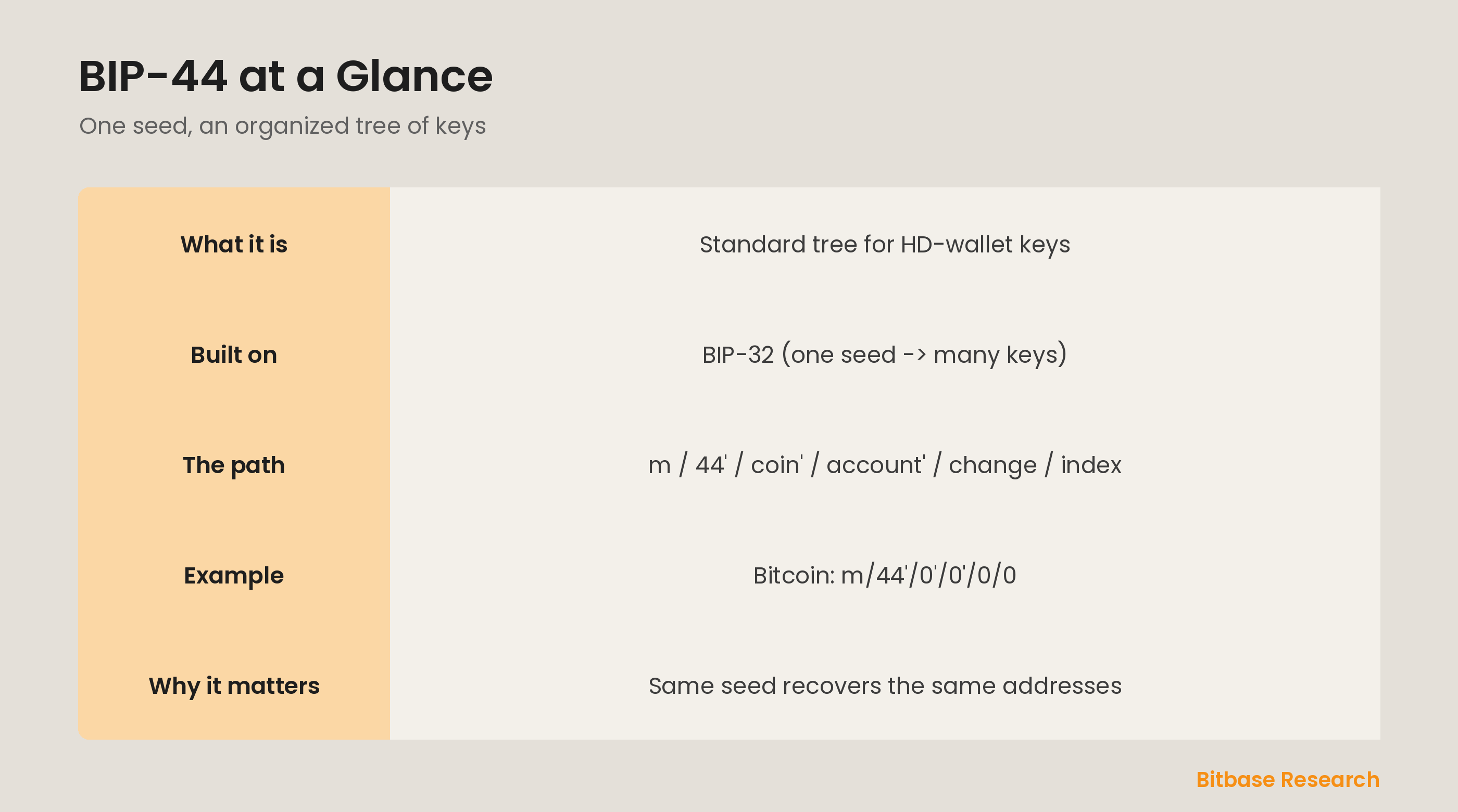
A BIP-44 path has five levels after the master key, written m / purpose' / coin_type' / account' / change / index. purpose' is always 44' (marking BIP-44); coin_type' selects the cryptocurrency; account' lets you keep separate sub-wallets; change is 0 for receiving addresses and 1 for internal change addresses; and index is the specific address number. Your wallet walks this path to generate each address in a repeatable order.
Hardened levels and coin types
The apostrophe in a path — as in 44' or 0' — marks hardened derivation, a stricter method that stops someone who has a public key from working out the related private keys. The coin_type value identifies the network: Bitcoin is 0' and Ethereum is 60', so a typical Bitcoin address sits at m/44'/0'/0'/0/0 and an Ethereum one at m/44'/60'/0'/0/0. Different coins simply take different branches of the same tree.
The bottom line
BIP-44 turns the freedom of HD wallets into a shared map, so one seed reliably produces the same accounts and addresses everywhere. You rarely need to type a path by hand — the wallet handles it — but knowing the m/44'/coin'/account'/change/index shape explains how a single backup can hold Bitcoin, Ethereum, and more. It is the quiet standard that makes cross-wallet recovery actually work. To keep learning the fundamentals, follow more from Bitbase Academy.
Disclaimer: This article is educational content from Bitbase Academy, provided for information only. It does not constitute investment, trading, tax, or financial advice. Crypto assets are volatile; assess your own risk. Written as of June 2026; refer to the latest official information.
References
[1] Bitcoin Improvement Proposals, "BIP-44: Multi-Account Hierarchy for Deterministic Wallets" github.com
[2] Bitcoin Improvement Proposals, "BIP-32: Hierarchical Deterministic Wallets" github.com
[3] Investopedia, "Hierarchical Deterministic (HD) Wallet: Definition" investopedia.com