Before you risk money on a trading idea, it helps to know whether it has ever actually worked. Backtesting answers that by running your strategy's rules over historical price data and measuring how it would have performed. Done well, it turns a hunch into evidence; done carelessly, it produces confident nonsense. Here is what backtesting is, what it measures, the traps that fool most people, and how to test a crypto strategy honestly.
What backtesting is
Backtesting means taking a set of trading rules and applying them to past market data to see what the results would have been. You define exactly when the strategy buys and sells, then run it across historical prices as if you had traded it back then. The output is a simulated track record — a way to check whether an idea has an edge before you ever put real money behind it.
What it measures
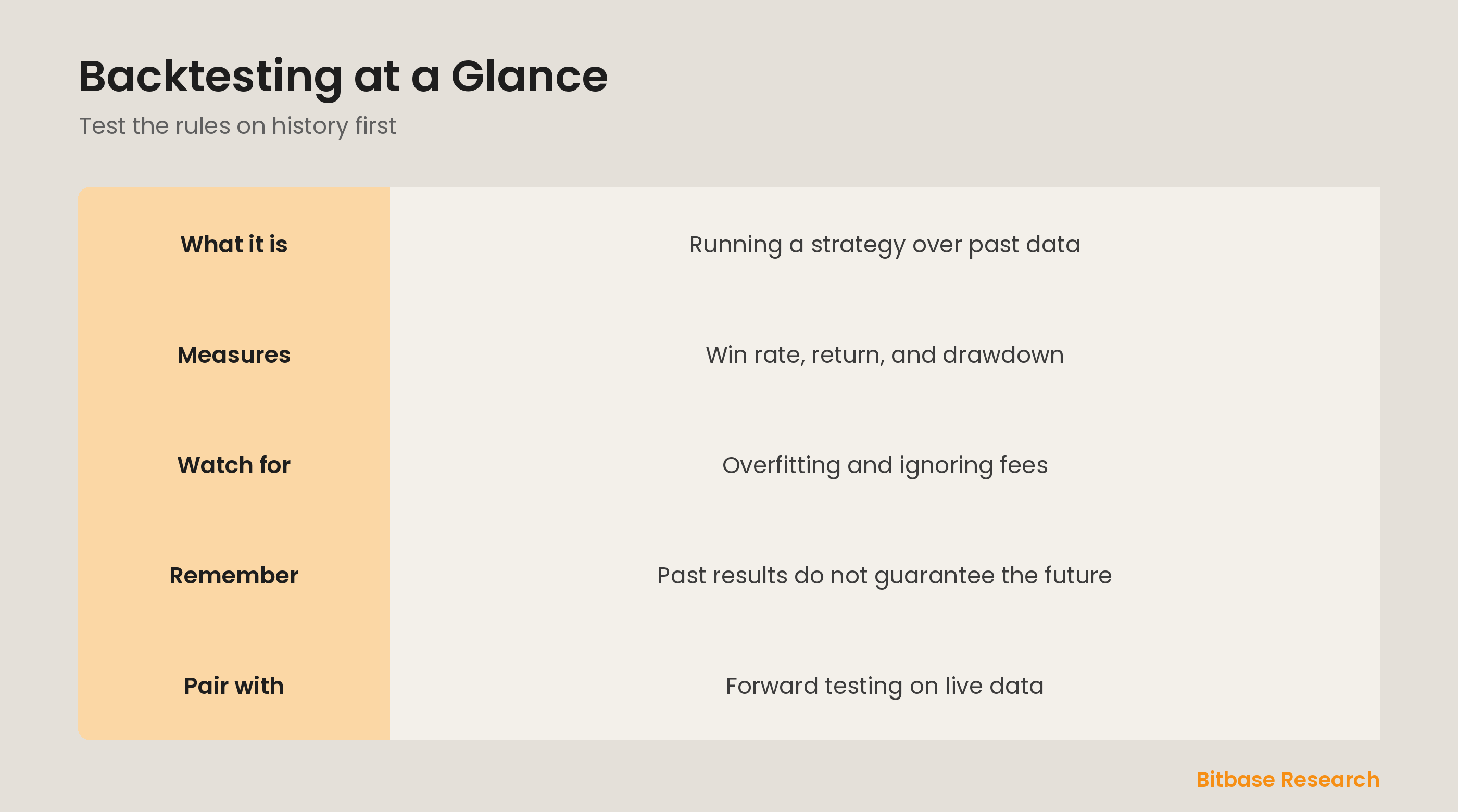
A useful backtest reports more than a single profit number. It shows the win rate, the total and average return, and crucially the drawdown — the worst peak-to-trough loss the strategy would have suffered. Drawdown matters because a strategy that made money but would have dropped your account by 60 percent along the way may be one you could never actually stick with in real life.
The common pitfalls
The results can lie if you are not careful. Overfitting is the biggest trap: tuning a strategy so tightly to past data that it looks brilliant on history but fails on anything new. Ignoring trading fees and slippage inflates results that would shrink in reality. And no matter how good a backtest looks, the past does not guarantee the future — market conditions change, and crypto changes fast.
How to test honestly
Keep strategies simple, since fewer rules are harder to overfit. Always include realistic fees and slippage so the numbers reflect real trading. Test on data your strategy was not designed around — an out-of-sample period — to check it was not just tuned to the past. Finally, follow a promising backtest with forward testing on live data, ideally in paper trading, before committing real funds.
The bottom line
Backtesting runs a crypto strategy over historical data to estimate how it would have performed, reporting win rate, return, and drawdown. Its value depends entirely on honesty: avoid overfitting, include costs, and remember that past results never guarantee future ones. Treat a good backtest as a green light to test further, not proof — then confirm it with forward testing before risking real money. To keep learning the fundamentals, follow more from Bitbase Academy.
Disclaimer: This article is educational content from Bitbase Academy, provided for information only. It does not constitute investment, trading, tax, or financial advice. Crypto assets are volatile; assess your own risk. Written as of June 2026; refer to the latest official information.
References
[1] Investopedia, "Backtesting: Definition, How It Works, and Downsides" investopedia.com
[2] Investopedia, "Paper Trade: Definition, Meaning, How It Works, and Benefits" investopedia.com
[3] Investopedia, "Risk Management in Finance: Definition and Common Strategies" investopedia.com