Macro regime change overruns crypto catalysts. The Monday-Wednesday accumulation, Thursday-Friday reversal pattern that defined Issues 4 and 5 broke this week into a uniformly negative print—US spot BTC ETFs registered –$1.0 billion in weekly outflows, the largest single-week outflow since late January and the conclusive end of a six-week net-positive streak. The trigger was not within crypto. Kevin Warsh's 54-45 Senate confirmation Wednesday—the slimmest margin ever for a Fed Chair—coincided with a hot April PPI print of +1.4% (the largest since March 2022) and the Trump-Xi state visit that produced no joint communiqué and zero mention of cryptocurrency, stablecoins, or CBDCs. The 10-year Treasury yield rose 24 basis points to 4.59%, a one-year high. Two genuine crypto-positive catalysts arrived in the same week—Senate Banking Committee's 15-9 passage of the Clarity Act and Bitwise's BHYP launch on NYSE as the first US spot Hyperliquid ETF—and were both fully overrun by Friday's macro selloff.
Week of May 11 to May 17, 2026
Bitbase Research · May 18, 2026
Market Insights is Bitbase Research's short-wave companion to our Deep Dive flagship series. Each edition reviews the most structurally meaningful developments of the preceding week in compliant crypto derivatives and on-chain native infrastructure, mapped against the long-wave framework set out in our flagship reports. The previous issue documented that the recommitment did not repair but consolidated into a higher-frequency two-sided regime ahead of three converging unknowns—Powell's term ending May 15, Warsh's Senate confirmation, and the CFTC framework. This issue records the collapse of that two-sided regime: under sustained macro shock—Fed transition completed, hot inflation print, pageantry-without-policy summit diplomacy—the intra-week pattern dissolved into uniform outflows, while the most consequential crypto-positive structural events of 2026 to date arrived and were drowned out within 24 hours.
1. The one chart that matters
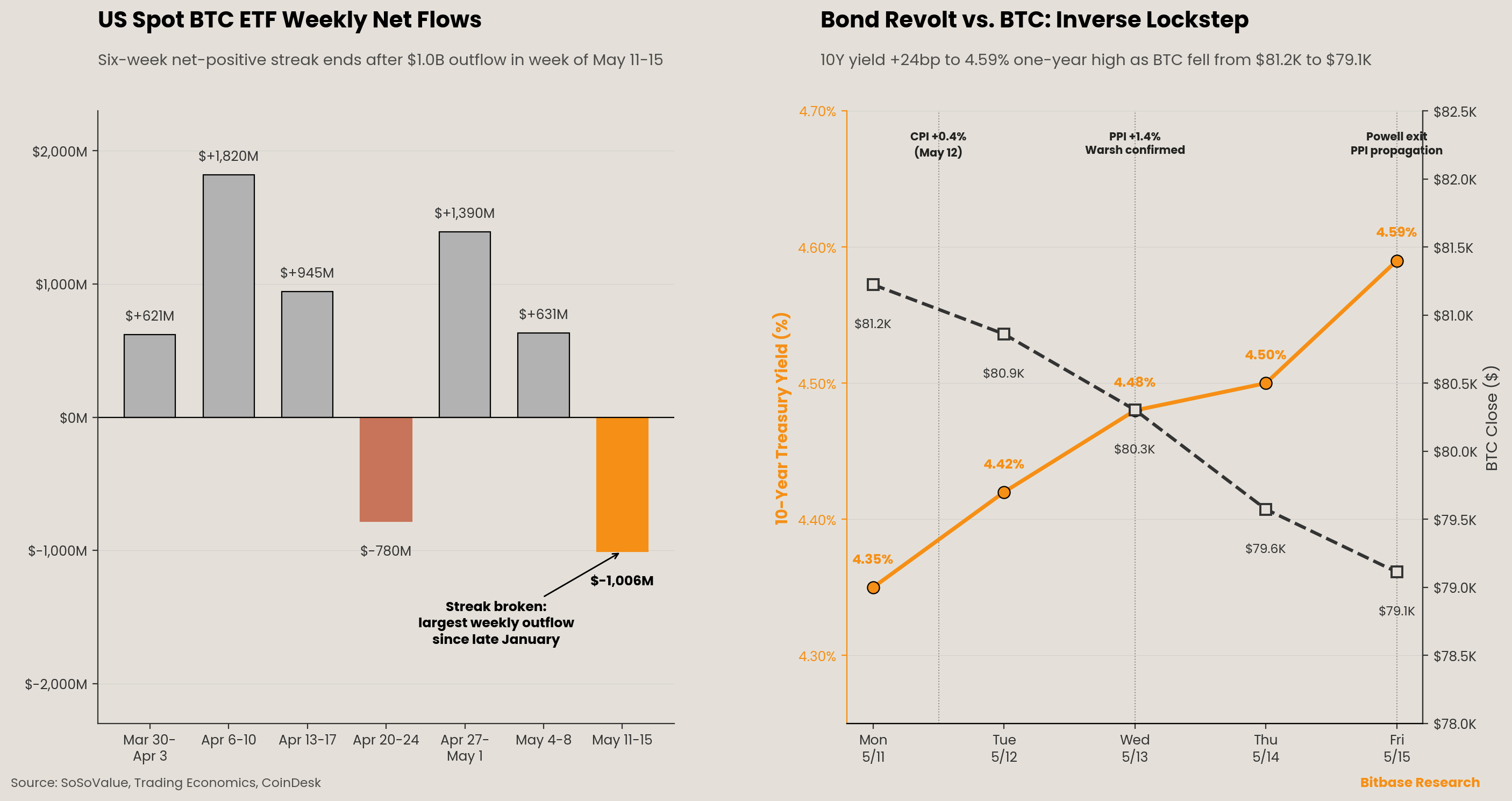
The two panels capture what the macro-overruled week actually was. On the left, seven weeks of BTC ETF flows are tracked through the late-April reversal, the May 4-8 recommitment, and this week's break. Issue 4 documented the unusual reversal week-of-April-27; Issue 5 documented the second-consecutive reversal pattern that suggested a regime shift to higher-frequency two-sided flows. This week broke the pattern entirely. For the week ended May 15, US spot Bitcoin ETFs registered –$1.0 billion in net outflows [1]—the largest weekly outflow since late January and the conclusive end of the six-week net-positive streak that ran +$621M, +$1,820M, +$945M, –$780M, +$1,390M, +$631M before this week's break. The intra-week composition matters: Monday May 11 saw a brief +$27.25M with MSBT contributing +$26.3M, Tuesday alone produced –$233.2M, Wednesday was modestly flat, Thursday rebounded to +$131M on the Clarity Act vote, and Friday May 15 alone saw –$290.4 million with zero positive flows across any of the eleven listed funds [1]. The hypothesis from Issue 5—that institutional positioning had migrated to high-frequency two-sided flows around catalysts—proved fragile when the catalyst was sustained inflation-driven bond repricing rather than discrete event risk. Cumulative net inflows since January 2024 stand at approximately $58.34 billion with category AUM at $104.29 billion [1]. A separately significant data point: Jane Street's Q1 2026 13F filing, made public May 13, disclosed a 71% cut in its IBIT position—from 20.3 million shares to 5.9 million shares—and roughly 60% reduction in FBTC [2], a flow signal regardless of whether it reflects fundamental rotation or routine market-maker rebalancing.
On the right, the underlying mechanism. The 10-year Treasury yield's climb from 4.35% on Monday to 4.59% by Friday [3] was almost perfectly inverted by BTC's path from $81,224 to $79,113 [4][5]. The 10Y at 4.59% is the highest since February 2025; the 2Y reached 4.09% (also highest since February 2025); the 30Y tagged 5.121%, highest since May 2025 [6]. Fed funds futures shifted from a 28% rate-cut probability one week earlier to roughly 50% odds of at least one rate hike before year-end, with a March 2027 hike now fully priced [6]. The dollar index closed at 99.27, up 1% on the week to a one-month high [7]. The framework from our Deep Dive 1 thesis on monetary regime change requires updating: the MMF reflux to $7.745 trillion we classified as "weakened by geopolitical reflux" in Issue 5 has now fixed into a plateau (ICI's May 14 release reported +$436M, near-flat [8]); the avoidance-driven cash is not reverting. The broader interpretation is that rates-driven repricing of risk assets is now overwhelming what would otherwise have been a confirmatory week for the long-wave thesis. Macro regime change is the dominant variable, and it has compressed the crypto signal stack within itself.
2. This week's structural signal
The structural signal of the week is convergence overload. Four events arrived in a five-day window. Any one independently would have moved markets; all four together produced a week in which the structural shelf for crypto continued to build while the macro tape decisively overrode it.
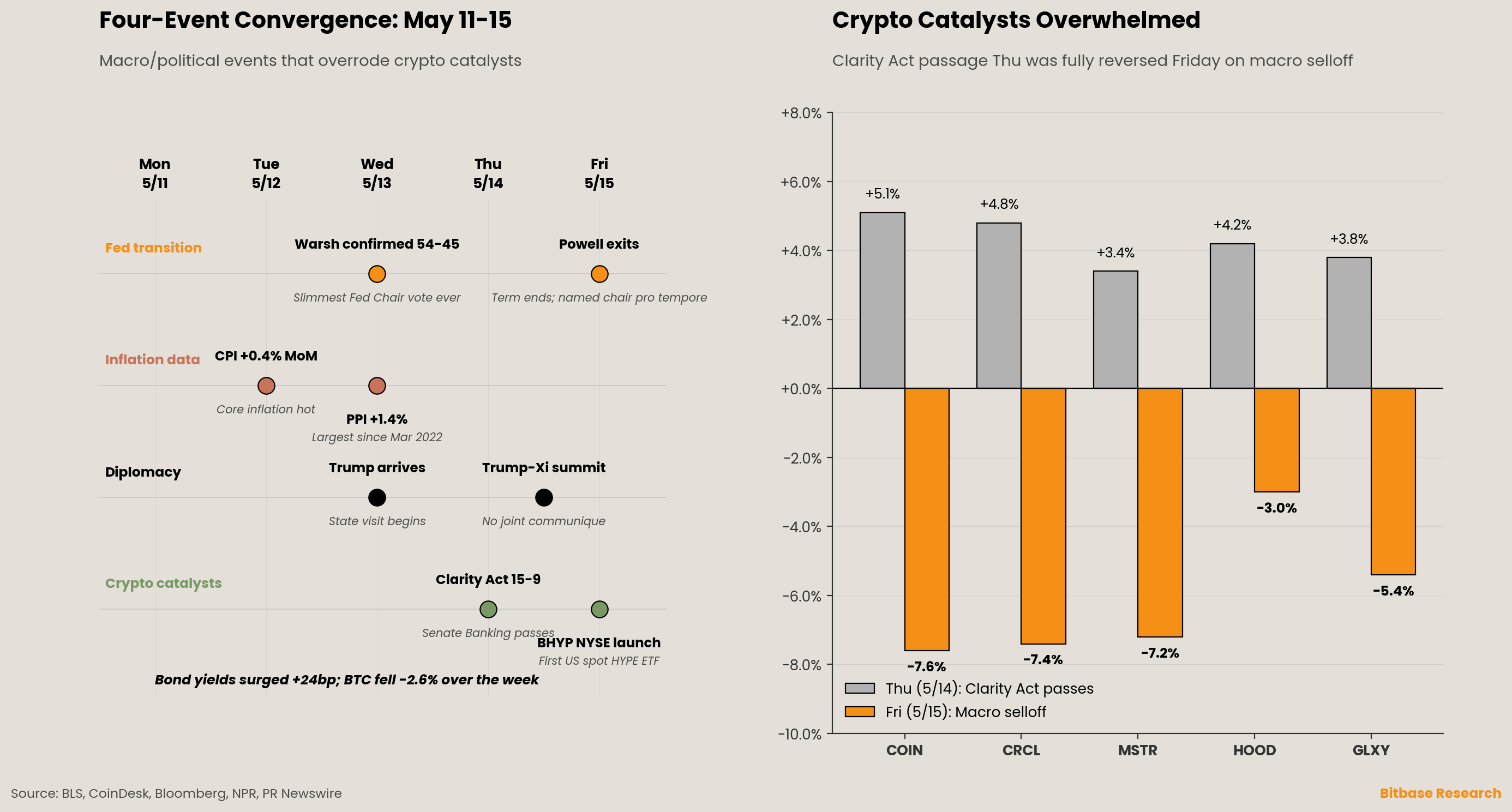
First, the Fed transition completed. Kevin Warsh was confirmed as the 17th Chair of the Federal Reserve on Wednesday May 13, 2026 by a Senate vote of 54-45—the slimmest margin ever for a Fed Chair confirmation [9][10]. Pennsylvania Democrat John Fetterman was the only Democrat to cross the aisle [9]; the procedural cloture vote had carried 51-45 on Tuesday May 12 [11]. Senator Thom Tillis dropped his earlier blockade after the DOJ closed its probe into Powell's renovation of the Eccles building [9]. Warsh's first FOMC meeting is scheduled June 16-17, 2026 [10]. Senate disclosure forms had previously established Warsh's personal holdings at $135M to $226M, with his wife Jane Lauder adding $192M, making him the wealthiest Fed Chair in U.S. history; disclosures also revealed personal cryptocurrency positions including Solana, dYdX, and a stake in Bitcoin Lightning's Flashnet [12][13]. Jerome Powell's term as Chair ended Friday May 15; the Federal Reserve Board named Powell "chair pro tempore" pending Warsh's swearing-in [14]. Powell remains on the Board of Governors with a term running through January 2028—the first ex-Chair to do so since Marriner Eccles in 1948 [15]. His advice to Warsh, per a May 15 CNN exit profile: "Stay out of elected politics. If you want democratic legitimacy, you earn it by your interactions with our elected overseers, and so it's something you need to work hard at." [15].
Second, the inflation print broke the rally. The April CPI released Monday May 12 showed core inflation up 0.4% month-over-month [16]. The April PPI released Tuesday May 13 showed final demand prices up 1.4%—"the largest advance since rising 1.7 percent in March 2022", with final demand services up 1.2%, also "the largest increase since moving up 1.3 percent in March 2022" [17][18]. This was the actual trigger for the bond selloff that followed; the Fed transition was the political backdrop, but the inflation print was the physical cause. Markets repriced rapidly. BTC opened the week at $81,224, briefly tested $82,800 mid-week on the Clarity Act news, and closed at $79,113 by Friday with intraday lows touching $78,600 [4][5]. The 200-day moving average at $82,228 was approached but not reclaimed. Tom Lee's $76,000 threshold held; Strategy's average cost basis of $75,540 was not tested. Bitcoin open interest fell from approximately $27 billion to $25.5 billion as leverage built during Wednesday's Clarity Act rally was flushed. The Mon-Wed/Thu-Fri reversal pattern characteristic of Issues 4-5 dissolved entirely; this week skewed bearish across all five trading days, with the macro/CPI/PPI catalyst overwhelming the discrete event risk that had defined the prior month's positioning.
Third, and most consequentially for our framework: the Trump-Xi state visit produced no joint communiqué, no tariff adjustment, and zero mention of cryptocurrency, stablecoins, or digital assets—a striking null result given the parallel rollout of Hong Kong stablecoin licensing. President Trump's visit ran May 13-15 [19]. The bilateral meeting at the Great Hall of the People on May 14 lasted two hours and fifteen minutes; on May 15 the leaders met at the Zhongnanhai leadership compound [19]. Headline deliverables: a reported Chinese commitment to purchase 200 Boeing jets (U.S.-side claim, not confirmed by Beijing), vague agricultural and energy commitments, an AI nonproliferation protocol, and a planned Xi state visit to Washington on September 24 [19][20]. Trump told reporters explicitly that the two sides "did not discuss tariffs" [21]. No joint communiqué was issued—U.S. and Chinese readouts differed materially on what had been agreed [20]. Four absences register as signal: zero mention of cryptocurrency, zero mention of stablecoins, zero mention of CBDCs or e-CNY, zero mention of dollar reserve status across all official readouts. The simultaneous tracking of Hong Kong stablecoin licensing—where the HKMA issued its first two licenses to HSBC and Anchorpoint in April [22]—did not produce any summit-level coordination. Bilateral U.S.-China digital asset dialogue is not yet on the table. Capital Economics' assessment, quoted by CBS News on May 15, captured the consensus: "Beyond the warm words, though, little has been said about any concrete agreements. And what has been reported so far has been modest in scale." [21]. This is consequential for the Deep Dive 1 framework specifically: the long-wave thesis presumes monetary regime change drives crypto adoption through dollar-system stress, but the absence of any U.S.-China digital asset coordination signal suggests that the bilateral channel is not yet a transmission mechanism for that adoption. Meanwhile, two genuine crypto-positive catalysts arrived in the same week: the Senate Banking Committee passed the Clarity Act 15-9 Thursday after a behind-the-scenes deal flipped Ruben Gallego and Angela Alsobrooks to support [23], and Bitwise launched BHYP on NYSE Friday as the first U.S. spot Hyperliquid ETF [24][25]. Both were fully overrun by Friday's macro selloff—Coinbase –7.6%, Circle –7.4%, Strategy –7.2%, Galaxy Digital –5.4%, Robinhood –3.0% [5][26]—the most direct illustration this year of macro variables drowning crypto-internal catalysts within a 24-hour window.
3. Dual-track scoreboard, expanded
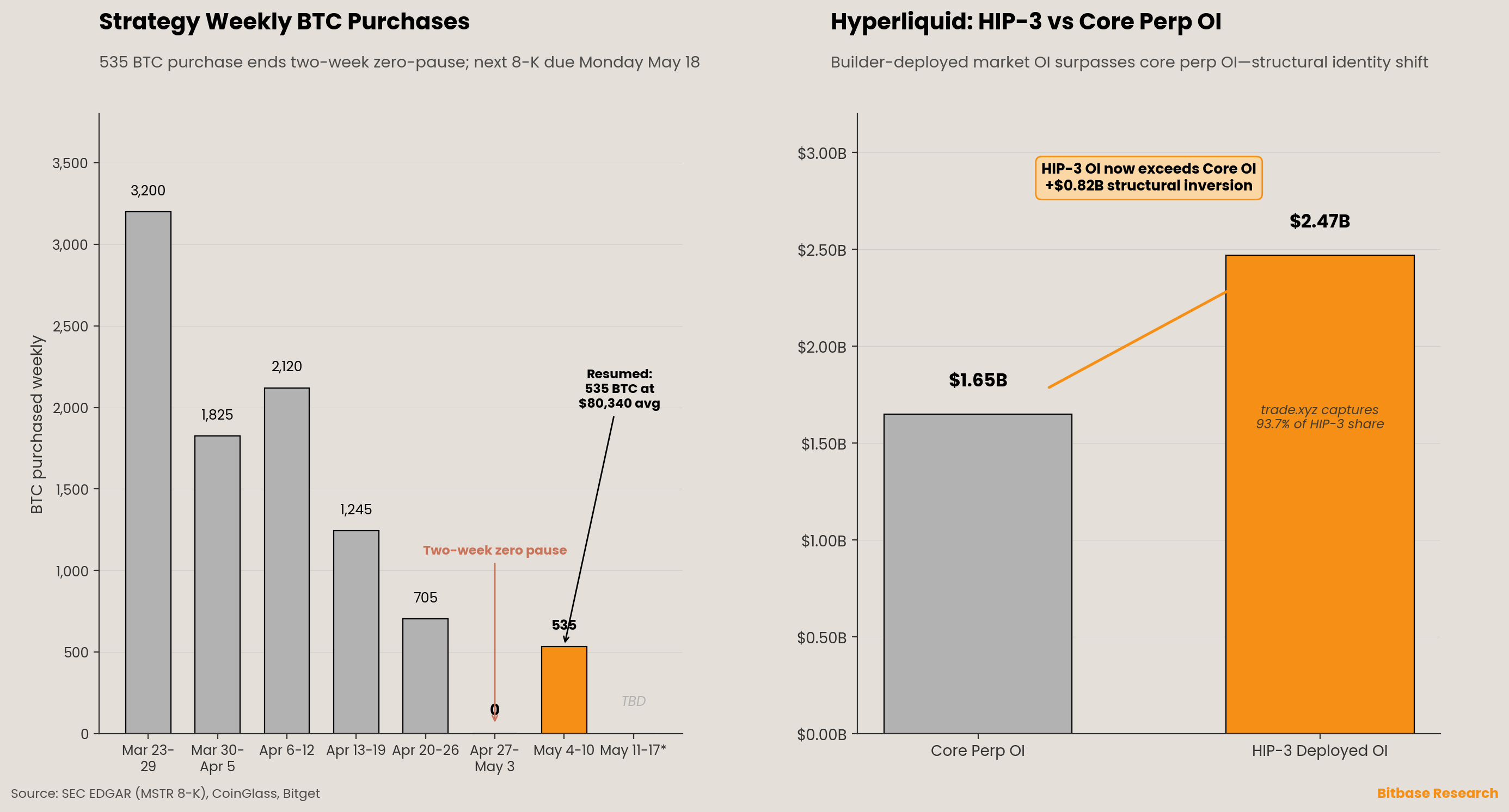
Compliant-centralized track. Strategy ended its two-week zero-purchase streak: an 8-K filed Monday May 11 disclosed the purchase of 535 BTC for $43 million at an average price of $80,340 during the week of May 4-10 [27]. Total holdings stand at 818,869 BTC at an aggregate cost of $61.86 billion, average $75,540 per BTC; BTC Yield YTD 9.4%, down from 9.5% mid-April due to ATM dilution [27][28]. The acquisition was funded by 231,324 MSTR shares and 1,412 STRC preferred shares sold through Strategy's ATM program—a 1:1 funding ratio analysts noted as unusually small versus prior weeks [28]. Saylor had floated the possibility of selling BTC to fund dividends on the May 5 Q1 call, then reframed it in a May 11 CoinDesk Q&A as "a big nothing burger from an economic point of view. If we were to fund all of our dividends exclusively by selling bitcoin over the next year, we would buy 20 bitcoin for every one we sold." [29]. President Phong Le added: "I believe in math over ideology." [28]. Coinbase's Thursday-Friday round trip—+5.1% then –7.6%—encapsulated the dual-track narrative. The New York Attorney General's $2.2 billion lawsuit over prediction-market operations continues in federal court [30]. CLO Paul Grewal had previously stated: "Coinbase will continue to fight for the federal oversight of these markets that Congress intended." [31]. The Jane Street IBIT reduction noted in Section 1 (71% cut from 20.3M to 5.9M shares, 60% FBTC reduction) is meaningful as a flow signal regardless of intent [2]; the firm simultaneously added approximately $82M in ETH ETF exposure.
On-chain native track. The week's most consequential structural event for the on-chain native model was the launch of Bitwise's BHYP on NYSE Friday May 15—the first U.S. spot Hyperliquid ETF, with a 0.34% sponsor fee waived to 0% for the first 30 days on the first $500M of AUM, and in-house staking via Bitwise Onchain Solutions [24][25]. Bitwise CIO Matt Hougan: "Hyperliquid has emerged as one of the most compelling investment opportunities in crypto today. When geopolitical tensions spiked on a Sunday morning in February, and traditional markets were closed, the world turned to Hyperliquid for price discovery." [24]. The launch came three days after 21Shares' THYP went live on Nasdaq with Day-1 volume of $1.8 million and cumulative $8.1 million through Thursday [32], and four days after Grayscale's S-1/A Amendment No. 2 added staking functionality to its planned GHYP product [33]. HYPE traded above $46 mid-week, settling at approximately $45.55 by Sunday May 17 [34]. HIP-3 open interest reached $2.47 billion aggregate at mid-month peak, with trade.xyz capturing 93.7% of HIP-3 market share [35]; by comparison, Hyperliquid's core perp open interest stood at approximately $1.65 billion per CoinGlass on May 18 [36]. HIP-3 deployed markets now likely exceed Hyperliquid's core OI—a structural inversion that materially changes the platform's identity from "centralized-perp-DEX" to "perpetual-issuance-marketplace." This is the data point most consequential for the Deep Dive 3 Model 5 thesis: BHYP's NYSE listing combined with HIP-3's OI inversion further weakens our Reverse Signal C (Model 5 regulatory failure) and confirms the Model 5 convergence rail. HIP-4 outcome-contract activity remained nascent (approximately 6 million contracts in early days versus Kalshi's $14.8 billion April monthly volume), and Native Markets' USDH product is being sunset with settlement migrating to USDC on Hyperliquid [37].
TradFi-perpetual & tokenized-RWA layer. No new third-party report covering the May 11-17 week was published; BitMEX's Q1 2026 baseline ($30.7 billion weekly TradFi-perpetual volume) remains the reference standard. Tokenized real-world assets sustained the $20 billion threshold first crossed in early May; CoinGecko's 2026 RWA Report placed tokenized U.S. Treasuries at approximately $12.88 billion by early April [38]. No major new cross-border tokenized Treasury settlement followed the May 6 Ondo-JPMorgan-Mastercard-Ripple atomic event noted in Issue 5; the structural integration appears to be in an evaluation period. Stablecoin total market cap stood at approximately $322.74 billion at week's end [39], with USDT near $189.6 billion (~59% share), USDC at $77.9 billion, USDG at $2.66 billion (+11.89% W/W—the fastest-growing top-10 stablecoin) [39]. The GENIUS Act compliance rules take effect July 18, 2026, requiring 100% reserves and audits [40]. Circle (CRCL) stock fell 2.1% Thursday, then 5.3-7.4% Friday—the Clarity Act's stablecoin yield compromise (banning rewards on passive holdings while allowing them on trading/transactions/staking) was read as a constraint on Circle's reserve-yield business model [23]. Macro context bears on this layer specifically: the Strait of Hormuz remained effectively closed through the week, with the IEA's April 2026 Oil Market Report noting that "crude and oil product flows through the Strait of Hormuz plunged from around 20 million barrels per day (mb/d) before the war to just over 2 mb/d in March" [41]; Brent crude closed above $109 per barrel Friday (+8.1% W/W), WTI in the $103.50-$106+ range (+8 to 11% W/W) [42]; EIA's May 2026 STEO projected Brent at ~$106 in May-June, falling to $89 by Q4 2026 [43]. The MMF plateau cannot unwind until this geopolitical premium drains.
4. On the radar—week of May 18 to May 24
-
Warsh's first FOMC meeting, June 16-17. The April 29 8-4 dissent meeting under Powell and Warsh's disclosed personal crypto holdings produce two competing scenarios: continuation of the hawkish hold path, or recalibration toward Trump administration alignment. The first speech as Chair, expected within two weeks of swearing-in, will preview direction. Any dovish surprise likely produces rapid BTC rebound toward $82,228—the 200-day moving average not reclaimed this week.
-
Next Strategy 8-K disclosure, expected Monday May 18. The 535 BTC purchase ended a two-week zero-purchase streak. If the next filing shows resumption of programmatic accumulation, the "Saylor sells bitcoin" framing collapses; if another zero, the dilution-funding cycle moves into 2026's longest pause. A purchase exceeding 1,000 BTC funded primarily through preferred-share ATM (rather than common-share dilution) would be the most bullish configuration.
-
NYSE Rule 7.50 SEC action window expires June 16. Comment letters from FIA, BlackRock/Securitize, Citi, BNY, Coinbase, and major buy-side participants closed May 13. The 60-day suspension window expires June 16. Companion filings published this week extend the framework across NYSE-affiliated exchanges: SR-NYSETEX-2026-14 (May 14), SR-NYSEARCA-2026-47 (May 15), SR-NYSEAMER-2026-35 (May 15), SR-NYSENAT-2026-09 (May 15) [44]. SEC approval before June 16 would unlock Phase 1 of mainstream tokenized-equity infrastructure.
-
CFTC perpetual framework—eleven weeks overdue. Selig's March 3 commitment is now approximately eleven weeks past with no staff letter, no-action position, or rulemaking. The Clarity Act's 15-9 committee passage establishes a parallel legislative track that may render the CFTC framework redundant. Continued silence through Q2 close would shift Signal D from "overdue" to "abandoned."
-
Hyperliquid HIP-3 vs core OI inversion sustainability. HIP-3 deployed-market OI ($2.47 billion) now likely exceeds core perp OI ($1.65 billion) [35][36]. Watch for either consolidation of trade.xyz's 93.7% HIP-3 share or fragmentation across additional builders. A sustained four-week inversion would justify a Pillar 2 framework update in the next Deep Dive cycle. BHYP and THYP weekly flows are the most direct indicator of institutional uptake.
-
Coinbase prediction-market litigation status. The NY AG case continues in federal court following Coinbase's April 22 removal motion. The next procedural milestone will shape the CFTC framework debate. CLO Grewal has indicated continued confidence in federal preemption. Watch for any DOJ amicus filings or related industry briefs.
-
Strait of Hormuz status and oil price normalization. The MMF plateau cannot unwind until the geopolitical premium drains. EIA's May 2026 STEO projects Brent at ~$106 in May-June, falling to $89 by Q4 2026 and $79 in 2027 [43]. Brent below $90 likely triggers MMF reflux and unlocks the broader risk-on rotation suspended since early May. Iran-China dynamics post-Trump-Xi summit will shape this directly.
-
Clarity Act Senate floor vote timing and Jane Street rebalance. The bill must merge with the Senate Agriculture Committee version, then face the 60-vote floor threshold where unresolved ethics provisions remain the binding constraint. White House adviser Patrick Witt has targeted a Trump signature around July 4 [23]. Early-June floor vote with bipartisan margins re-rates the regulatory framework signal toward "unified." Separately, the Jane Street IBIT 71% reduction [2] warrants Q2 13F monitoring (mid-August); intra-quarter watch via market-maker spread behavior in IBIT options.
5. Signal tracking update
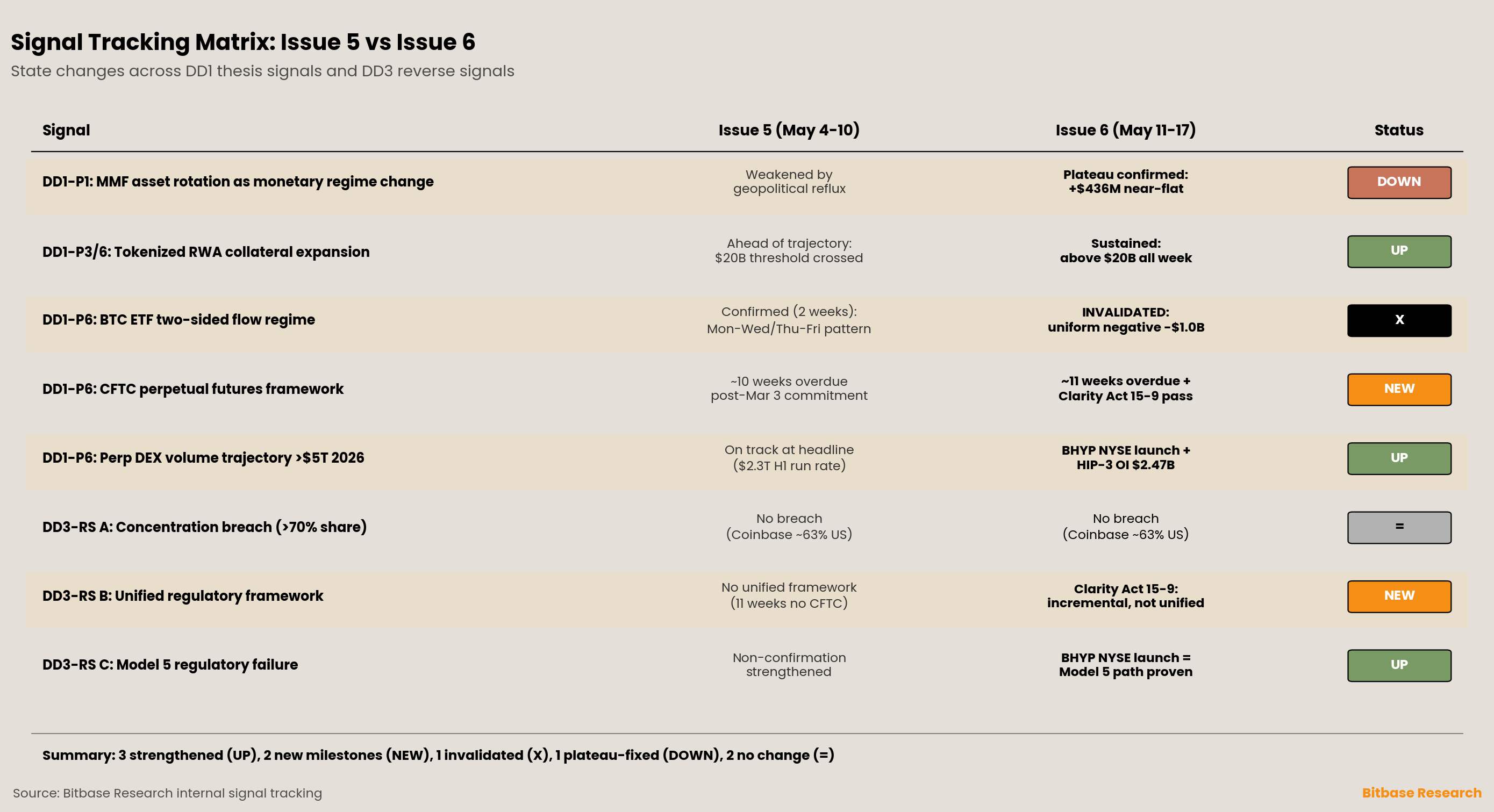
Five Deep Dive 1 signals plus three Deep Dive 3 reverse signals remain under continuous audit. This issue records four signals shifting state—matching Issue 5 as the largest single-issue change since tracking began.
SIGNAL—Deep Dive 1 Part 1: "MMF asset scale inflection point." STATUS: Plateau-fixed (downgraded from "weakened" in Issue 5). ICI's May 14 release reported total MMF assets +$436M to $7.75 trillion for the week ended May 13 [8]—a near-flat reading following the prior week's geopolitically-driven +$122.35 billion surge. The four-week rolling average is now decisively above the $7.70 trillion structural threshold. The geopolitical-reflux thesis from Issue 5 is confirmed: assets are not reverting but have fixed at the high plateau. Strait of Hormuz flow remains depressed (~2 mb/d versus ~20 mb/d pre-war [41]); Brent closed above $109 Friday (+8.1% W/W) [42]. The signal cannot return to confirmation status until the geopolitical premium drains and assets revert below $7.70 trillion. This is the second consecutive downgrade of a previously confirmed signal.
SIGNAL—Deep Dive 1 Part 6: "Whether CME crypto derivatives OI persistently holds above $30B by 2027." STATUS: On track. No new CME quarterly OI data published this week. CME bitcoin volatility futures launch scheduled June 1, 2026 (subject to regulatory approval) remains on track per the announcement during Consensus 2026 week. Signal evaluated against full-year 2026 and 2027 data when published.
SIGNAL—Deep Dive 1 Parts 3 and 6: "Tokenized RWA as common collateral infrastructure." STATUS: Ahead of trajectory, sustained. Tokenized RWA total maintained above the $20 billion threshold first crossed in early May. CoinGecko's 2026 RWA Report placed tokenized U.S. Treasuries at approximately $12.88 billion by early April [38]; CoinShares' 2026 outlook cited onchain Treasuries rising from $3.91B to $8.68B during 2025 (a ~122% single-year gain). No major new cross-border atomic settlement followed the May 6 Ondo-JPMorgan-Mastercard-Ripple event; the institutional integration appears to be in an evaluation period rather than acceleration. Stablecoin total market cap $322.74 billion; USDT $189.6B (~59% share), USDC $77.9B [39].
SIGNAL—Deep Dive 1 Part 6: "Whether the U.S. CFTC approves more licensed entities to offer perpetual swap-style products by 2027." STATUS: Commitment ~11 weeks overdue + parallel legislative track now established. Selig's March 3 commitment of "next month or so" is now approximately eleven weeks overdue with no framework, no staff letter, and no rulemaking published. The CFTC still operates with one Senate-confirmed commissioner. Critically, the Senate Banking Committee's 15-9 passage of the Clarity Act on May 14 establishes a parallel legislative track that may render the CFTC administrative framework redundant [23]. Senator Cramer (R-ND): "Today's successful bipartisan markup of the Clarity Act in the Banking Committee establishes American regulatory guardrails around this emerging technology." [45]. The signal direction has bifurcated: the administrative path remains stalled, but the legislative path advanced materially. Framework update: future evaluations of this signal must account for both tracks.
SIGNAL—Deep Dive 1 Part 6: "Whether perpetual DEX annual trading volume holds above $5 trillion in 2026." STATUS: On track, structurally reinforced. Bitwise's BHYP NYSE launch [24][25] and 21Shares' THYP Nasdaq launch [32] mark the first month of multi-issuer U.S. spot Hyperliquid product competition—a foundational institutional on-ramp for HYPE. HIP-3 open interest reached $2.47 billion aggregate at mid-month peak, with trade.xyz capturing 93.7% of HIP-3 market share [35]; Hyperliquid's core perp OI was approximately $1.65 billion per CoinGlass on May 18 [36]. HIP-3 deployed markets now likely exceed core OI—a structural inversion that materially changes the platform's identity. Aggregate Perp DEX volume direction remains supportive of the $5 trillion 2026 threshold; internal composition continues to diversify.
SIGNAL (Deep Dive 3 Reverse Signal A)—Market-share concentration above 70%. STATUS: No model concentration breach. BitMEX Q1 attribution (Binance 62.7%, Hyperliquid 29.7%) remains the most recent independent reading; Coinbase US derivatives share continues around 63%. No new third-party data this week. The five-model coexistence thesis from Deep Dive 3 holds.
SIGNAL (Deep Dive 3 Reverse Signal B)—Cross-architecture unified regulatory framework. STATUS: No unified framework, but incremental legislative progress recorded. CFTC perpetual guidance pending (see Signal D1-Part 6 above). ESMA, FCA, MAS, JFSA, BIS, Basel: no unified statement issued during the week. The Clarity Act's 15-9 committee passage is incremental progress within the U.S. jurisdiction but does not constitute a cross-architecture framework. Hong Kong stablecoin licensing continued at the same pace as before the Trump-Xi summit—no summit-level coordination [22]. The five-model regulatory divergence documented in Deep Dive 3 remains the state of record.
SIGNAL (Deep Dive 3 Reverse Signal C)—Model 5 regulatory failure. STATUS: Further strengthened non-confirmation. The Bitwise BHYP launch on NYSE Friday May 15 [24][25] is the single most consequential Model 5 event since Issue 5's Kraken-Bitnomial close, and one of the most consequential since Deep Dive 3's April 23 publication. A first-of-kind U.S. spot Hyperliquid ETF on a senior national exchange, with in-house staking, materially confirms that Model 5 (on-chain native with regulated U.S. wrapper) is a viable convergence rail. Combined with HIP-3 OI inversion above Hyperliquid's core OI [35][36], the model is empirically strengthened. No transaction has been blocked, unwound, or restructured. The signal direction is now strongly non-confirming of the Model 5 regulatory-failure hypothesis posed in Deep Dive 3.
References
[1] Crypto Times, "Bitcoin ETFs Post $1B Weekly Outflow, Halting Six-Week Inflow Streak," May 16, 2026. https://www.cryptotimes.io/2026/05/16/bitcoin-etfs-post-1b-weekly-outflow-halting-six-week-inflow-streak/
[2] 99Bitcoins, "Jane Street Slashes Bitcoin ETF Holdings by 71%: Is TradFi Rally Cooling?," May 13, 2026. Q1 2026 13F filing disclosed cut from 20.3M to 5.9M shares in IBIT, ~60% reduction in FBTC. https://99bitcoins.com/news/bitcoin-btc/jane-street-bitcoin-etf-holdings-71-percent-cut/
[3] Trading Economics, "US 10 Year Treasury Note Yield," May 15, 2026. https://tradingeconomics.com/united-states/government-bond-yield
[4] Yahoo Finance, "Bitcoin USD (BTC-USD) Price History," May 11-17, 2026. https://finance.yahoo.com/quote/BTC-USD/history/
[5] CoinDesk, "Why is bitcoin (BTC) down today: Surging bond yield, inflation worries rattle crypto, stocks, gold," May 15, 2026. https://www.coindesk.com/markets/2026/05/15/bitcoin-tumbles-below-usd79-000-as-rising-bond-yields-inflation-worries-rattle-markets
[6] CNBC, "30-year Treasury yield tops 5.1%, highest in nearly a year," May 15, 2026. Fed funds futures probability and 2026/2027 rate path. https://www.cnbc.com/2026/05/15/treasury-yields-surge-as-inflation-data-points-to-tricky-rates-path.html
[7] Trading Economics, "United States Dollar Index," May 15, 2026. https://tradingeconomics.com/united-states/currency
[8] PR Newswire (via ICI), "ICI: Money Market Fund Assets Reach $7.75 Trillion Continuing Upward Trend," May 14, 2026. +$436M near-flat reading for week ended May 13. https://www.prnewswire.com/news-releases/ici-money-market-fund-assets-reach-7-75-trillion-continuing-upward-trend-302772972.html
[9] Bloomberg, "Trump's Fed Chair Pick Kevin Warsh Confirmed by Senate," May 13, 2026. Final 54-45 vote; Fetterman as only Democrat in support. https://www.bloomberg.com/news/articles/2026-05-13/senate-confirms-warsh-to-lead-fed-as-trump-tests-its-autonomy
[10] CNBC, "Kevin Warsh wins Senate confirmation as the next Federal Reserve chair," May 13, 2026. First FOMC scheduled June 16-17. https://www.cnbc.com/2026/05/13/kevin-warsh-wins-senate-confirmation-as-the-next-federal-reserve-chair.html
[11] Al Jazeera, "Kevin Warsh confirmed to US Federal Reserve board in close Senate vote," May 12, 2026. 51-45 procedural cloture. https://www.aljazeera.com/economy/2026/5/12/kevin-warsh-confirmed-to-us-federal-reserve-board-in-close-senate-vote
[12] CNBC, "Fed nominee Warsh filings detail vast wealth, far exceeding past chairs," April 14, 2026. Senate disclosure form citations. https://www.cnbc.com/2026/04/14/federal-reserve-warsh-wealth.html
[13] BlockchainReporter, "Bitcoin Price Today: BTC At $80,832 as Powell Exits and Warsh Takes Over," May 15, 2026. Warsh crypto holdings disclosure (Solana, dYdX, Flashnet) and "sustainable store of value" quote. https://blockchainreporter.net/bitcoin-price-today-btc-at-80832-as-powell-exits-and-warsh-takes-over-the-pattern-everyone-is-watching/
[14] Federal Reserve, "Board of Governors—News and Events," May 15, 2026. Powell named chair pro tempore pending Warsh's swearing-in. https://www.federalreserve.gov/newsevents.htm
[15] CNN Business, "Powell, the most battle-tested Fed chair, finishes his term," May 15, 2026. Exit profile including advice-to-Warsh quote and Eccles 1948 precedent. https://www.cnn.com/2026/05/15/economy/fed-chair-jerome-powell-exit
[16] U.S. Bureau of Labor Statistics, "Consumer Price Index—April 2026 (USDL-26-0721)," May 12, 2026. Core CPI +0.4% MoM. https://www.bls.gov/news.release/cpi.htm
[17] U.S. Bureau of Labor Statistics, "Producer Price Index—April 2026 (USDL-26-0723)," May 13, 2026. Final demand +1.4%. https://www.bls.gov/news.release/ppi.nr0.htm
[18] U.S. Bureau of Labor Statistics, "Producer Price Indexes—April 2026 (full release)," May 13, 2026. "Largest advance since rising 1.7 percent in March 2022." https://www.bls.gov/news.release/pdf/ppi.pdf
[19] Wikipedia, "2026 state visit by Donald Trump to China," last edited May 16, 2026. Schedule, delegations, agenda, Great Hall and Zhongnanhai venues. https://en.wikipedia.org/wiki/2026\_state\_visit\_by\_Donald\_Trump\_to\_China
[20] Al Jazeera, "Trump-Xi summit: China, US disagree on what they agreed on," May 15, 2026. Differing US-Chinese readouts; no joint communiqué. https://www.aljazeera.com/news/2026/5/15/trump-xi-summit-china-us-disagree-on-what-they-agreed-on
[21] CBS News, "In China summit, Trump touts 'fantastic trade deals' with Xi as nations try to stabilize relationship," May 15, 2026. Trump statement on tariffs; Capital Economics assessment. https://www.cbsnews.com/news/trump-wraps-up-visit-with-xi-in-china/
[22] Hong Kong Monetary Authority, "Granting of stablecoin issuer licences," April 10, 2026. First two licenses to HSBC and Anchorpoint. https://www.hkma.gov.hk/eng/news-and-media/press-releases/2026/04/20260410-4/
[23] TheStreet, "LIVE: Clarity Act enters final stage after Senate Committee vote," May 14, 2026. 15-9 committee vote; Gallego/Alsobrooks defection; Warren and Cramer quotes; Witt July 4 target. https://www.thestreet.com/crypto/markets/live-clarity-act-enters-final-stage-after-senate-committee-vote
[24] PR Newswire, "Bitwise Launches Spot Hyperliquid ETF (BHYP); Offers Exposure to Leading Onchain Derivatives Exchange, With Staking Rewards," May 15, 2026. Hougan quote; product details. https://www.prnewswire.com/news-releases/bitwise-launches-spot-hyperliquid-etf-bhyp-offers-exposure-to-leading-onchain-derivatives-exchange-with-staking-rewards-302772855.html
[25] Phemex, "Bitwise BHYP: First Spot Hyperliquid ETF Launches on NYSE," May 15, 2026. 0.34% fee, 0% waiver structure. https://phemex.com/blogs/bitwise-first-spot-hyperliquid-etf-nyse-staking
[26] Invezz, "Why crypto stocks Coinbase, Robinhood, Strategy are sliding today," May 15, 2026. Friday percentage moves for COIN/HOOD/MSTR/GLXY/CRCL. https://invezz.com/uk/news/2026/05/15/why-crypto-stocks-coinbase-robinhood-strategy-are-sliding-today/
[27] U.S. Securities and Exchange Commission, "Strategy 8-K filing," May 11, 2026. 535 BTC purchase at $80,340 average; 818,869 total holdings. https://www.sec.gov/Archives/edgar/data/0001050446/000119312526215754/mstr-20260504.htm
[28] BeInCrypto, "Why MicroStrategy's Latest Bitcoin Buy Signals Bigger Shift Ahead," May 11, 2026. ATM funding structure analysis; Phong Le quote; BTC Yield. https://beincrypto.com/strategy-535-btc-slowdown-shift/
[29] CoinDesk, "Strategy's Michael Saylor says selling bitcoin to fund dividends is 'inconsequential,'" May 11, 2026. Saylor "nothing burger" quote. https://www.coindesk.com/markets/2026/05/11/a-big-nothing-burger-a-q-and-a-with-strategy-s-michael-saylor-on-selling-bitcoin
[30] Tradingkey, "Coinbase Stock Rally Stalls. Sued by New York State Over 'Prediction Market Gambling,'" April 2026. $2.2 billion penalty sought; federal court removal. https://www.tradingkey.com/analysis/stocks/us-stocks/261810753-crypto-coinbase-coin-prediction-exchange-tradingkey
[31] Benzinga, "New York Attorney General Sues Coinbase Over Prediction Markets," April 2026. Grewal quote on federal oversight. https://www.benzinga.com/markets/prediction-markets/26/04/51951130/new-york-attorney-general-sues-coinbase-over-prediction-markets-coin-slides-6
[32] CoinMarketCap, "Bitwise Hyperliquid ETF Launches on NYSE as HYPE Interest Grows," May 15, 2026. THYP Day-1 and cumulative volume figures. https://coinmarketcap.com/academy/article/bitwise-hyperliquid-etf-bhyp-launches
[33] U.S. Securities and Exchange Commission, "Grayscale HYPE ETF—Form S-1/A Amendment 2," May 11, 2026. Staking functionality addition. https://www.sec.gov/Archives/edgar/data/0002107730/000119312526215888/hype\_s-1\_amendment\_2.htm
[34] CoinMarketCap, "Hyperliquid (HYPE) Drops 3.2% Amid ETF Launch, Whale Activity," May 17, 2026. https://coinmarketcap.com/top-stories/6a02a711b0f1223930f7b368/
[35] Bitget, "Hyperliquid's HIP-3 Smashes Open Interest All-Time High—What's Next for HYPE?," May 2026. $2.47 billion HIP-3 OI; trade.xyz 93.7% share. https://www.bitget.com/asia/news/detail/12560605406876
[36] CoinGlass, "Hyperliquid (HYPE) Price Today, Futures & Spot Data," accessed May 18, 2026. Core perp OI ~$1.65 billion. https://www.coinglass.com/currencies/HYPE
[37] Across Protocol, "HIP-4: Hyperliquid's Next Big Move Into Outcome Markets," May 2026. USDH sunset to USDC settlement migration. https://across.to/blog/hip-4
[38] CoinGecko, "RWA Report 2026," 2026. Tokenized U.S. Treasuries ~$12.88B by early April. https://www.coingecko.com/research/publications/rwa-report-2026
[39] Bitcoin News, "Stablecoin Market Adds $2 Billion in 7 Days as USDT Holds Near $190 Billion," May 2026. Total market cap, per-issuer figures, USDG +11.89% W/W. https://news.bitcoin.com/stablecoin-market-adds-2-billion-in-7-days-as-usdt-holds-near-190-billion/
[40] Bitrue, "Stablecoin Trends May 2026: USDT vs USDC, Market Cap & GENIUS Act Explained," May 2026. GENIUS Act July 18, 2026 compliance date. https://www.bitrue.com/blog/stablecoin-trend-may-2026
[41] International Energy Agency, "The Middle East and Global Energy Markets—April 2026 Oil Market Report," April 2026. Hormuz flow ~20 mb/d to 2 mb/d. https://www.iea.org/topics/the-middle-east-and-global-energy-markets
[42] Trading Economics, "Brent Crude Oil," May 15, 2026. https://tradingeconomics.com/commodity/brent-crude-oil
[43] U.S. Energy Information Administration, "May 2026 Short-Term Energy Outlook," May 2026. Brent/WTI forecasts through 2027. https://www.eia.gov/outlooks/steo/pdf/steo\_full.pdf
[44] Federal Register, "NYSE Texas Rule 7.37 amendment (SR-NYSETEX-2026-14)," May 14, 2026. Companion tokenization filings published May 14-15, 2026. https://www.federalregister.gov/documents/2026/05/14/2026-09602/self-regulatory-organizations-nyse-texas-inc-notice-of-filing-and-immediate-effectiveness-of
[45] U.S. Senator Kevin Cramer (R-ND), "Senate Banking Committee Passes Clarity Act," May 14, 2026. Cramer quote on regulatory guardrails. https://www.cramer.senate.gov/news/press-releases/senate-banking-committee-passes-clarity-act