
The compliant-centralized track posted a third consecutive positive ETF week. The MMF drop held below threshold for a second week, confirming the diagnostic from Issue 2. And TradFi perpetuals—a category that did not exist a year ago—entered the dual-track scoreboard for the first time.
Week of April 20–24, 2026
Bitbase Research · April 27, 2026
Market Insights is Bitbase Research's short-wave companion to our Deep Dive flagship series. Each edition reviews the most structurally meaningful developments of the preceding week in compliant crypto derivatives and on-chain native infrastructure, mapped against the long-wave framework set out in our flagship reports. Beginning with this issue, our scoreboard expands to include a third lens—TradFi-perpetual and tokenized-RWA flows—drawn from the five-model taxonomy we developed in our Deep Dive on crypto-exchange TradFi expansion. Our goal is not to report prices. It is to audit, in real time, whether the data is confirming or falsifying the theses we have staked in public.
1. The one chart that matters
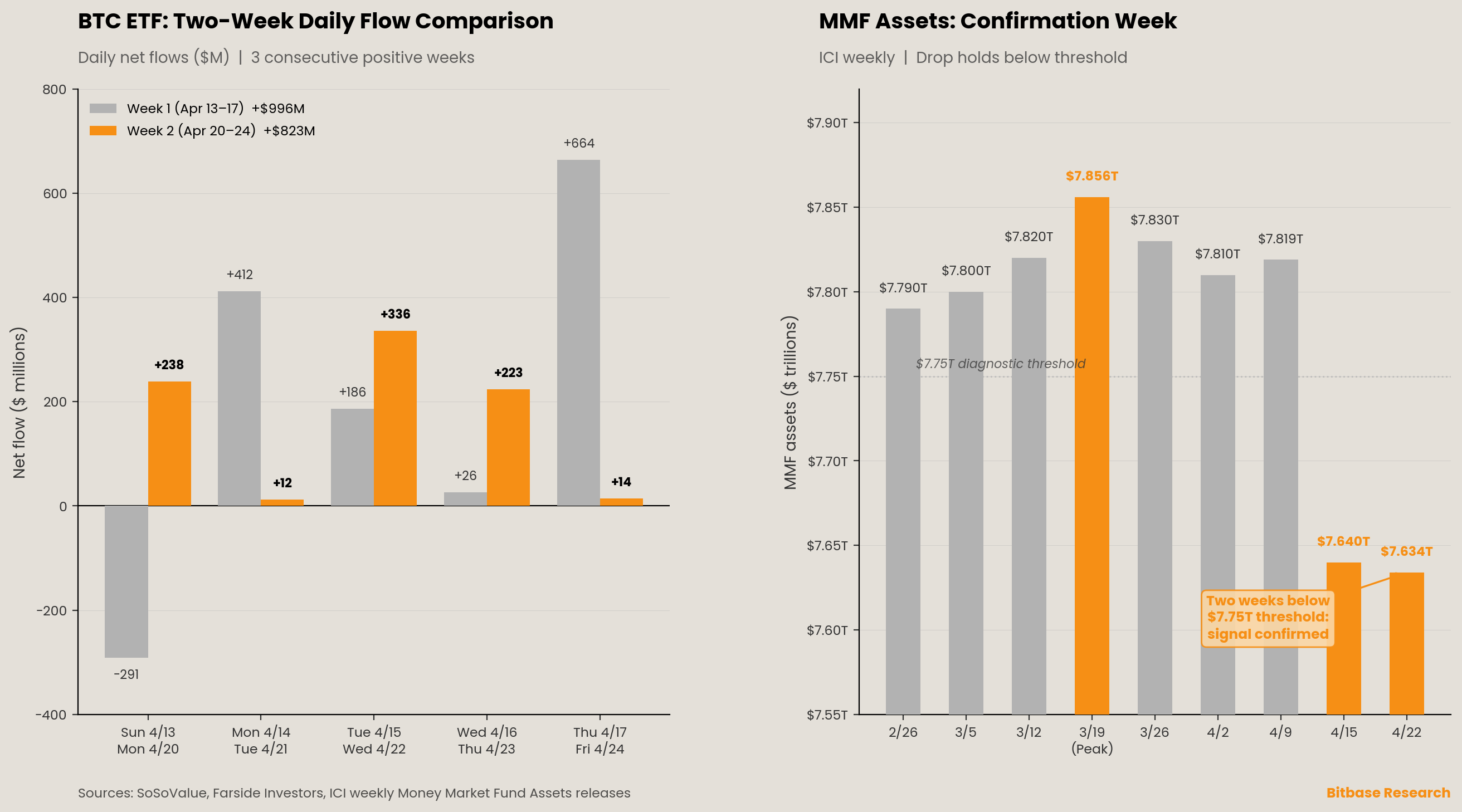
The two panels capture the structural story of the week. On the left, the side-by-side comparison of the two most recent trading weeks shows a consistent pattern: the compliant-centralized track is absorbing capital at a steady cadence, but the daily distribution differs. Week 1 (April 13–17) was bookended by extremes—a $291 million Sunday outflow followed by a $664 million Thursday inflow tied to the Strait of Hormuz reopening [1]. Week 2 (April 20–24) was smoother, with no single day exceeding $336 million and no day in net outflow territory [2]. The five-day total of +$823 million [2] is below Week 1's $996 million but above Week 0's $786 million [3], making this the third consecutive week of net inflows and the longest sustained streak since mid-January 2026. Cumulative spot Bitcoin ETF AUM crossed approximately $102 billion by April 23, with cumulative net inflows since the January 2024 launch reaching approximately $58 billion [4]. IBIT alone now holds more than 800,000 BTC, accounting for the majority of category flows during the streak [4].
On the right, the ICI weekly money market fund release dated April 23, 2026 reports total MMF assets at $7.634 trillion for the week ended April 22—a marginal $5.56 billion decline from the prior week [5]. Two structural readings follow. First, the assets did not rebound: the $175.8 billion drop reported in Issue 2 was not a tax-season transient that reversed within a single week. Second, the assets remained below the $7.75 trillion diagnostic threshold we set in Issue 2 for two consecutive weeks. By the conditions we stated publicly, the MMF inflection-point signal from Deep Dive Part 1, Section 1.4 has now reached its first level of empirical confirmation. The four-week rolling average reading at the end of April will be the next checkpoint. We are not yet calling the signal fully confirmed—that requires additional weeks of below-threshold data—but the early-stage hypothesis from our Inaugural Edition has held through three successive readings.
2. This week's structural signal
The structural signal this week is a continuation rather than an event. Three observations carry the period forward.
First, the Iran ceasefire that whipsawed prices in Week 1 was extended indefinitely. On April 22, U.S. President Trump's announcement of an indefinite extension of the U.S.-Iran ceasefire removed the most acute geopolitical tail risk that had shaped the prior two weeks of price action [6]. Bitcoin briefly touched $79,388 on Wednesday evening before easing, supported by Strategy's $2.54 billion purchase of 34,164 BTC at an average cost of $74,395—Strategy's largest single acquisition since November 2024 [6]. By Friday's close on April 24, BTC was approximately $77,650; by April 25–26 weekend pricing it was approximately $77,381 to $77,934 [7]. The price range for the week was therefore narrower than Week 1's $70,741–$77,102 corridor, but the floor lifted: the lows of the week sat around $74,000 rather than $70,000.
Second, the ETF-channel rotation that defined Issue 2 broadened. ETH ETFs posted a five-day total of approximately +$155.6 million for April 20–24, with daily flows of +$67.8M / +$43.3M / +$96.4M / -$75.9M / +$23.4M [8]. The 10-day inflow streak that ETH ETFs had built earlier in the month broke on April 23 with the $75.9 million single-day outflow [9], but the broader pattern—concurrent BTC and ETH inflows over a multi-week window—continues to validate that the institutional allocation channel is widening, not rotating. SOL and XRP ETFs posted positive but small flows ($2.4M and several million respectively over the week) [8]. The breadth of the compliant-centralized track is the structural fact, not the magnitude of any single day.
Third, and this is the analytical addition this issue introduces: the TradFi-perpetual category is now large enough to require its own scoreboard cell.
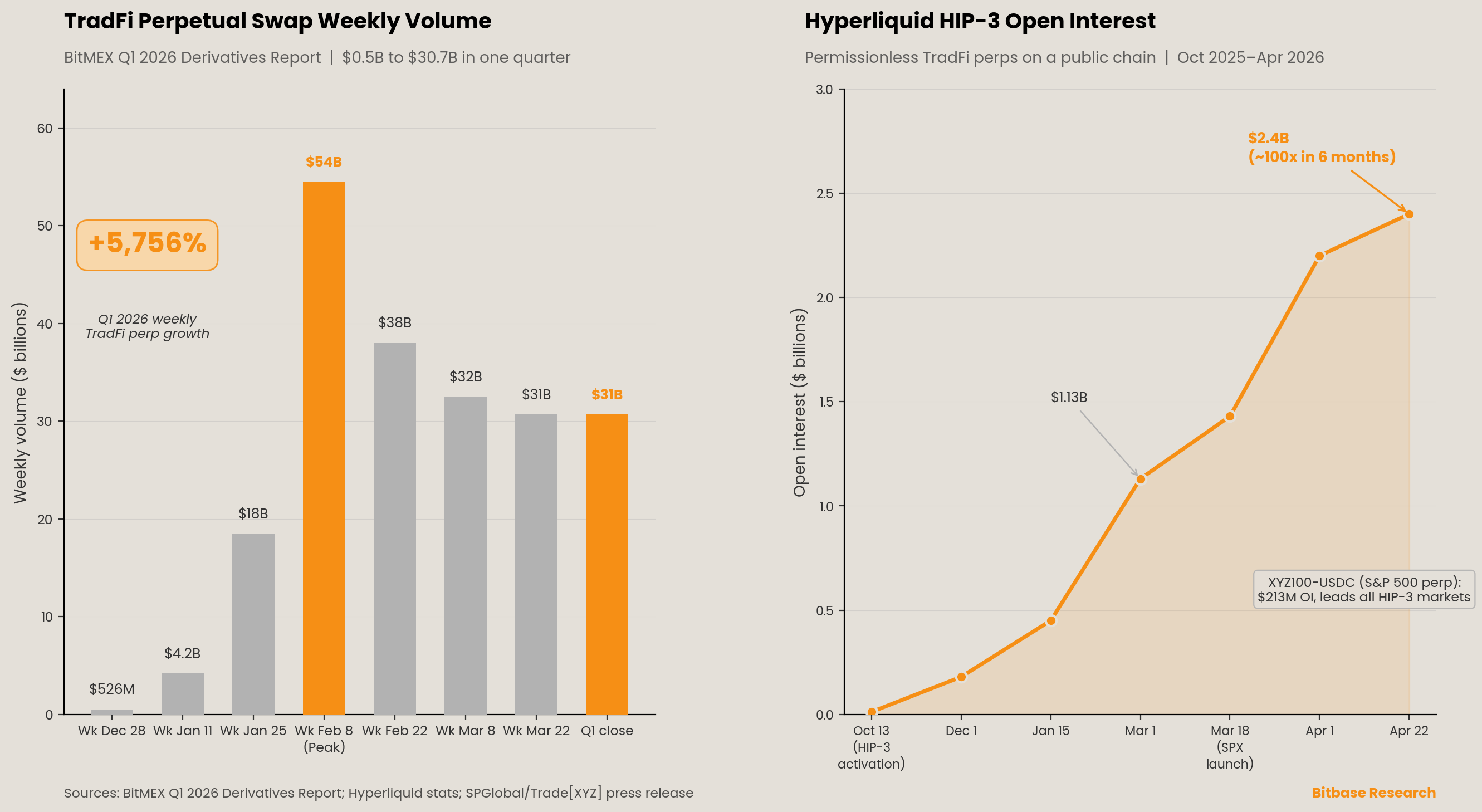
BitMEX's Q1 2026 Derivatives Report, published April 9, 2026, finds that TradFi-perpetual weekly volume grew from $525.8 million in late December 2025 to $30.7 billion by end-March 2026, with a peak of $54.5 billion in the week of February 8 [10]. Commodity perpetuals alone grew from $38.1 million weekly to $25 billion (silver 34.8%, crude oil 27.7%, gold 27.5%) [10]. Equity perpetuals grew approximately 908% to $4.9 billion weekly [10]. These figures originate from BitMEX's venue-aggregated analysis across Binance, Hyperliquid, OKX, Bitget, and BitMEX APIs covering 122 TradFi contracts; no independent replication by Kaiko, CCData, or Coin Metrics has yet been published. We treat the BitMEX numbers as method-transparent and directionally robust, with the caveat that the originator is itself a participant in the category.
3. Dual-track scoreboard, expanded
This issue introduces a third lens. The original two-track structure remains: compliant-centralized on one side, on-chain native on the other. What changes is that we now break out a TradFi-perpetual & RWA layer that cuts across both tracks and is drawn directly from the five-model taxonomy in our Deep Dive 2.
Compliant-centralized track. The +$823 million weekly BTC ETF inflow [2] and +$155.6 million ETH ETF inflow [8] continue the pattern of multi-asset institutional allocation. MSBT continued to accumulate during the week, though we await month-end disclosure for the precise number; on the trajectory established in its first eight trading days, the fund remains broadly on the path to Balchunas's $5 billion Year 1 AUM projection [11]. Total category AUM at $102 billion [4] places spot BTC ETFs in the top tier of all U.S.-listed ETFs by assets. The XRP and SOL ETF complex continues to log modest positive flows, confirming that the breadth of the compliant-centralized track is no longer BTC-only.
On-chain native track. The Perp DEX cooldown described in Issues 1 and 2 has not been broken at the monthly level, but Hyperliquid's HIP-3 sub-segment is the structural exception. Open interest on HIP-3 markets grew from $1.13 billion on March 1 to $2.2 billion on April 1 to approximately $2.4 billion by mid-April—roughly 100x growth in six months since the October 13, 2025 mainnet activation [12]. Trade[XYZ]'s XYZ100-USDC contract (the licensed S&P 500 perpetual launched March 18, 2026 [13]) leads all HIP-3 markets at approximately $213 million in open interest [12]. Felix Protocol's CL-USDC crude oil perpetual continues to operate as Hyperliquid's third-most-traded product behind BTC and ETH per JPMorgan's March research note [14]. The narrative we set in Issue 2—that broader Perp DEX volume is in cooldown while HIP-3 deployer volume is rising—remains intact and is now visible at the open-interest level, not just at trading-volume level.
TradFi-perpetual & tokenized-RWA layer (new). Introduced this issue. The BitMEX Q1 2026 figures place this layer at $30.7 billion weekly volume and 1.72% of total crypto derivatives [10]. Tokenized U.S. Treasuries reached $13.53 billion on April 12, 2026 with the broader RWA market at $29.22 billion [15]. Tokenized Treasury market structure has shifted: Circle's USYC at approximately $2.67–2.9 billion now leads BlackRock's BUIDL at $2.42–2.5 billion, the first sustained position rotation at the top of the category since BUIDL's March 2024 launch [15][16]. Backed Finance's xStocks tokenized equity layer (the substrate beneath Kraken's February 24, 2026 tokenized-equity perpetual launch [17]) and Ondo Global Markets together hold the majority of tokenized-equity AUM, currently approximately $960 million in aggregate. The category's growth is broad-based across Models 1, 3, and 4 in our Deep Dive 2 taxonomy; no single architectural model has crossed the 70% concentration threshold that would falsify the five-model coexistence thesis.
4. On the radar—week of April 27 to May 3
-
End-of-month MMF read. ICI's release dated April 30, 2026 (covering the week ended April 29) is the diagnostic test for whether the MMF inflection-point signal moves from "first confirmation" to "sustained confirmation." If assets remain below $7.7 trillion, the four-week rolling average drops below $7.75 trillion, and the signal we set in Issue 2 has been reached on multiple readings. If assets rebound above $7.8 trillion, the late-April reading reverts to a tax-season transient interpretation.
-
CFTC perpetual-futures framework: now eight weeks overdue. Chairman Selig's March 3 commitment to a perpetual futures framework "in the next month or so" [18] has now lapsed by approximately eight weeks. April 22 reporting from Forex News (citing Bloomberg coverage of Kalshi and Polymarket entering the perpetual-futures pipeline [19]) suggests private-sector preparation continues even without a published framework. The CFTC continues to operate with one Senate-confirmed commissioner. We classify continued silence as an active pressure point on Deep Dive 2's Signal C—the regulatory failure scenario for Model 5.
-
TradFi-perpetual weekly volume update. BitMEX's Q1 report ended on the week of March 22; April data is not yet aggregated. The next BitMEX or independent replication that captures April monthly volume will be the test of whether the category is sustaining $30+ billion weekly or accelerating toward the $100 billion threshold BitMEX projects could be reached within 2026 [10].
-
HYPE ETF pipeline. Bitwise's BHYP filing remains in SEC review [20]; Grayscale's GHYP S-1 (filed March 20, 2026) remains in standard review [21]. Bitwise added a fee structure (0.67%) and ticker, which Bloomberg's Balchunas has noted typically signals that a launch is imminent. Any SEC action on these filings would be a Model 4–to–Model 1/5 cross-track interoperability signal per Deep Dive 2 Chapter 6.
-
Iran ceasefire durability. Trump's April 22 announcement of indefinite extension is conditional on continued bilateral compliance. Reports of Iranian forces firing on ships near the Strait of Hormuz—referenced in 24/7 Wall St. coverage of the ceasefire [22]—have already added uncertainty. A ceasefire collapse would re-introduce the volatility regime that defined Issues 1 and 2.
5. Signal tracking update
Five Deep Dive 1 signals plus three Deep Dive 2 reverse signals are now under continuous audit. Each carries the same SIGNAL / STATUS format we used in Issues 1 and 2.
SIGNAL—Deep Dive 1 Part 1: "MMF asset scale inflection point." STATUS: First-stage confirmation reached. Two consecutive weeks below the $7.75 trillion diagnostic threshold ($7.640 trillion on April 15; $7.634 trillion on April 22) [5]. The week-over-week change of -$5.56 billion in the second week rules out a tax-season-only interpretation: had the April 15 drop been driven solely by tax payments, the rebound channel would have re-entered by April 22. The signal is not yet fully confirmed—a four-week rolling average reading below $7.75 trillion on the April 30 release would constitute the next stage. We commit to publishing a status update with each subsequent ICI release.
SIGNAL—Deep Dive 1 Part 6: "Whether CME crypto derivatives OI persistently holds above $30B by 2027." STATUS: On track. No new CME quarterly data since Issue 2. The expansion of the spot ETF complex (BTC, ETH, XRP, SOL all posting positive weekly flows) continues to add institutional distribution nodes that did not exist at the Deep Dive 1 cutoff. Signal will be assessed against full-year 2026 and 2027 CME data when published.
SIGNAL—Deep Dive 1 Parts 3 and 6: "Tokenized RWA as common collateral infrastructure." STATUS: On track. Tokenized U.S. Treasuries at $13.53 billion as of April 12 [15]—within $500 million of the symbolic $14 billion threshold and tracking ahead of the original Deep Dive 1 trajectory. Stablecoin market cap continues to compound above $320 billion. The category is functioning as the shared substrate predicted in our Deep Dive 1 framework.
SIGNAL—Deep Dive 1 Part 6: "Whether the U.S. CFTC approves more licensed entities to offer perpetual-contract-style products by 2027." STATUS: Active pressure point. Chairman Selig's March 3 commitment now eight weeks overdue. Bloomberg, CoinDesk, and Forex News reporting confirms continued private-sector mobilization (Kalshi, Polymarket, Robinhood waiting on guidance) [19][22]. The Coinbase Derivatives BTC and ETH "perpetual-style futures" launched July 2025 and Bitnomial's full perpetuals self-certification April 2025 remain the only U.S.-domiciled perpetuals offerings. Continued silence through Q2 2026 close would represent meaningful delay.
SIGNAL—Deep Dive 1 Part 6: "Whether perpetual DEX annual trading volume holds above $5 trillion in 2026." STATUS: On track at the headline level, mixed underneath. March 2026 broader Perp DEX volume of $699 billion annualizes to approximately $8.4 trillion [Issue 2 reference]. April fragmentation is real: HIP-3 deployer volume is rising sharply (Trade[XYZ] alone reportedly $100 billion cumulative since October 2025, $600 billion annualized [13]) while non-HIP-3 Perp DEX volume continues the cooldown documented in Issues 1 and 2. The aggregate $5 trillion threshold remains comfortably above the trend, but the composition is shifting toward HIP-3 deployers and away from generalist Perp DEX venues.
SIGNAL (NEW, Deep Dive 3 Reverse Signal A)—Market-share concentration above 70%. STATUS: No model concentration breach. By BitMEX Q1 2026 attribution, Binance (Model 1) holds 62.7% of TradFi-perpetual weekly volume; Hyperliquid (Model 4) holds 29.7%; BitMEX itself, Bitget (Model 2), and others hold the remainder [10]. No single architectural model exceeds 70% of category volume. The five-model coexistence thesis we set in Deep Dive 2 holds at the Q1 2026 boundary.
SIGNAL (NEW, Deep Dive 3 Reverse Signal B)—Cross-architecture unified regulatory framework. STATUS: No unified framework published. CFTC perpetual-futures guidance pending (see Signal D1-Part 6 above). ESMA, FCA, MAS, JFSA: no unified statement on USDT-settled vs. CFD vs. licensed-overlay DEX perpetual classification. IOSCO's October 2025 thematic review (FR/13/2025) found "significant progress is being made, but there is still much more to be done"—no commitment to a unified perpetuals framework as of the Deep Dive 2 cutoff [Deep Dive 2 reference]. Signal remains in non-confirmation; the five-model regulatory divergence remains the documented state.
SIGNAL (NEW, Deep Dive 3 Reverse Signal C)—Model 5 regulatory failure. STATUS: No regulatory failure event. ICE-OKX investment closed March 5, 2026, no regulatory unwind action [Deep Dive 2 reference]. NYSE Rule 7.50 became effective on filing April 17, 2026 and remains within the 60-day SEC suspension window—we will report status at the 60-day mark on June 16, 2026 [Deep Dive 2 reference]. Kraken-Bitnomial acquisition announced April 17, 2026 with up to $550 million consideration; closing pending regulatory approval [Deep Dive 2 reference]. None of the three named transactions has been blocked, unwound, or restructured. Signal in non-confirmation.
We will continue tracking each signal against weekly data arrival and publish the first consolidated Signal Tracking report in Q4 2026.
References
[1] CoinDesk, "Ether outpaces bitcoin as ETF flows split and Ethereum activity jumps 41% on-week," April 14, 2026. https://www.coindesk.com/markets/2026/04/14/ether-outpaces-bitcoin-as-etf-flows-split-and-ethereum-activity-jumps-41-on-week
[2] The Coin Republic, "Bitcoin ETF Weekly Inflows Hit $823M As Investors Book $5.46B Profits," April 26, 2026. Farside Investors data: weekly net inflows for April 20–24 totaled $823.7 million; daily flows: April 20 +$238M, April 21 +$11.8M, April 22 +$335.8M, April 23 +$223.3M, April 24 +$14.4M. https://www.thecoinrepublic.com/2026/04/26/bitcoin-etf-weekly-inflows-hit-823m-as-investors-book-5-46b-profits/
[3] 24/7 Wall St., "Bitcoin (BTC) Spot ETFs Pulled $3.7B Over 8 Weeks After 4 Months of Outflows," April 25, 2026. Weekly inflow trajectory: week ending April 10 +$786M; week ending April 17 +$996M; week ending April 24 +$823M. https://247wallst.com/investing/2026/04/25/bitcoin-btc-spot-etfs-pulled-3-7b-over-8-weeks-after-4-months-of-outflows/
[4] CoinDesk, "Bitcoin ETFs Just Pulled $2 Billion in 8 Days While Short-Term Holders Quietly Started Selling," April 24, 2026. SoSoValue data: cumulative ETF inflows since January 2024 launch reached approximately $58 billion; total category AUM $102 billion as of April 23. https://www.coindesk.com/markets/2026/04/24/bitcoin-etfs-just-pulled-usd2-billion-in-8-days-while-short-term-holders-quietly-started-selling
[5] ICI, "Money Market Fund Assets," release dated April 23, 2026 (data for week ended April 22). Total assets $7.634 trillion, down $5.56 billion from prior week. https://www.ici.org/research/stats/mmf
[6] Tokodigi, "Bitcoin Price Today (April 2026): Live Data, Drivers & Context," accessed April 26, 2026. Strategy purchase of 34,164 BTC at average $74,395 = $2.54 billion, largest acquisition since November 2024. Trump's indefinite extension of U.S.-Iran ceasefire announced April 22. https://www.tokodigi.com/bitcoin-price/
[7] Yahoo Finance, BTC-USD historical prices, accessed April 26, 2026. Spot price approximately $77,381–$77,934 over April 25–26 weekend. https://finance.yahoo.com/quote/BTC-USD/history/
[8] AMBCrypto, "ETFs weekly recap—How did Bitcoin, Ethereum, Solana and XRP do this week?," April 26, 2026. ETH ETF daily flows for April 20–24: +$67.8M, +$43.3M, +$96.4M, -$75.9M, +$23.4M. https://ambcrypto.com/etfs-weekly-recap-how-did-bitcoin-ethereum-solana-and-xrp-do-this-week/
[9] Blockhead, "Bitcoin ETF Inflows Extend to Eight Days as Ethereum Funds Reverse Course," April 24, 2026. ETH ETF 10-day inflow streak broken by $75.9 million net outflow on April 23. https://www.blockhead.co/2026/04/24/bitcoin-etf-inflows-extend-to-eight-days-as-ethereum-funds-reverse-course/
[10] BitMEX (Shang Wu), "Q1 2026 Derivatives Report: The TradFi Perpetual Swap Revolution," published April 9, 2026. TradFi-perpetual weekly volume grew from $525.8 million to $30.7 billion (+5,756.8%); peak $54.5 billion in week of February 8; commodity perpetuals +65,463% to $25 billion weekly; XAG 34.8%, CL 27.7%, XAU 27.5% of commodity volume in week of March 15; equity perpetuals +908% to $4.9 billion; Binance 62.7% market share, Hyperliquid 29.7%, BitMEX +1,322.6% growth. https://www.bitmex.com/blog/2026q1-derivatives-report
[11] Bloomberg Intelligence, Eric Balchunas (Senior ETF Analyst), MSBT Year 1 AUM projection of $5 billion, public commentary on X, April 8–9, 2026.
[12] CryptoBriefing, "Hyperliquid's S&P 500 perpetual tops $100 million in daily volume after licensed launch," March 21, 2026. Aggregate HIP-3 open interest reached approximately $1.43 billion at launch and continued to grow. KuCoin News, "Hyperliquid Drives Financial Market Unbundling with S&P 500 Futures and 24/5 Trading Proposals." Open interest March 1: $1.13 billion; April 1: $2.2 billion. https://cryptobriefing.com/sp-500-perpetuals-hyperliquid-launch/ ; https://www.kucoin.com/news/flash/hyperliquid-drives-financial-market-unbundling-with-sp-500-futures-and-24-5-trading-proposals
[13] S&P Dow Jones Indices / Trade[XYZ], "S&P Dow Jones Indices Licenses S&P 500® to Trade[XYZ] for Perpetual Contracts on Hyperliquid," March 18, 2026. XYZ markets exceeded $100 billion in volume since October 2025 with annualized run rate above $600 billion. https://press.spglobal.com/2026-03-18-S-P-Dow-Jones-Indices-Licenses-S-P-500-R-to-Trade-XYZ-for-Perpetual-Contracts-on-Hyperliquid
[14] CoinDesk, "Hyperliquid oil volume booming thanks to war in Middle East: JPMorgan," March 20, 2026. JPMorgan note led by Managing Director Nikolaos Panigirtzoglou: Crude oil perpetual peaked at approximately $1.7 billion daily volume with $300 million open interest; oil ranked third by volume on Hyperliquid behind BTC and ETH. https://www.coindesk.com/business/2026/03/20/iran-war-volatility-is-driving-oil-trading-boom-on-hyperliquid-says-jpmorgan
[15] CoinSpectator, "Tokenized US Treasuries Near $14B as Circle, Blackrock Lead RWA Market Growth," April 13, 2026. RWA.xyz data: tokenized U.S. Treasuries at $13.53 billion on April 12, 2026; total RWA market $29.22 billion. https://news.bitcoin.com/tokenized-us-treasuries-near-14b-as-circle-blackrock-lead-rwa-market-growth/
[16] CoinReporter, "Tokenized U.S. Treasuries hit $14B, but will retail ever buy into the safest asset on-chain?," April 24, 2026. Updated rankings: Circle USYC $2.9 billion, BlackRock BUIDL $2.5 billion, Centrifuge JTRSY $1.5 billion, Franklin Templeton BENJI $1 billion, Ondo USDY $972 million. https://www.coinreporter.io/2026/04/tokenized-u-s-treasuries-hit-14b-but-will-retail-ever-buy-into-the-safest-asset-on-chain/
[17] Kraken (Payward), "Announcing the world's first regulated, tokenized-equity perpetual futures, using xStocks," February 24, 2026. https://blog.kraken.com/product/xstocks/tokenized-equity-perpetual-futures
[18] CoinDesk, "CFTC Chief Selig to Clear Path for U.S. Perpetual Futures in Coming Weeks," March 3, 2026. https://www.coindesk.com/policy/2026/03/03/cftc-chief-selig-to-clear-path-for-u-s-perpetual-futures-in-coming-weeks
[19] FX Leaders, "Crypto Exchanges Line Up for US Perpetual Futures as Regulators Prepare to Open the Door," April 22, 2026. https://www.fxleaders.com/news/2026/04/22/crypto-exchanges-line-up-for-us-perpetual-futures-as-regulators-prepare-to-open-the-door/
[20] SpazioCrypto, "Bitwise Files HYPE ETF BHYP: Hyperliquid to Wall St," April 11, 2026. https://en.spaziocrypto.com/defi/bitwise-hype-etf-bhyp-hyperliquid-wall-street-sec/
[21] SEC EDGAR, Grayscale HYPE ETF (GHYP), Form S-1, filed March 20, 2026, Filing No. 333–294493. https://www.sec.gov/Archives/edgar/data/0002107730/000119312526117603/ck0002107730-20260320.htm
[22] CP24, "Crypto exchanges gear up to launch U.S. perpetual futures ahead of rule change," April 22, 2026. https://www.cp24.com/news/money/2026/04/22/crypto-exchanges-gear-up-to-launch-u-s-perpetual-futures-ahead-of-rule-change/
The next Market Insights issue covers the week of April 27 to May 3, 2026. Market Insights is published by Bitbase Research alongside our Deep Dive flagship series.