Crypto futures trading is a way to bet on the price of a cryptocurrency without actually owning it. Instead of holding coins, you trade a contract whose value tracks the price, and in crypto that contract is almost always a perpetual future. It offers leverage and the ability to profit in both directions, along with real risk. Here is what it is, how perpetuals work, and why it is not for beginners.
What futures are
A futures contract is an agreement to trade an asset's price rather than the asset itself. When you trade crypto futures you never take custody of the coin; you take a position that gains or loses as the price moves. That lets you go long — betting the price rises — or go short — betting it falls — which spot buying alone cannot do. Your profit or loss is settled in cash, usually a stablecoin, not in the underlying coin.
Perpetual futures
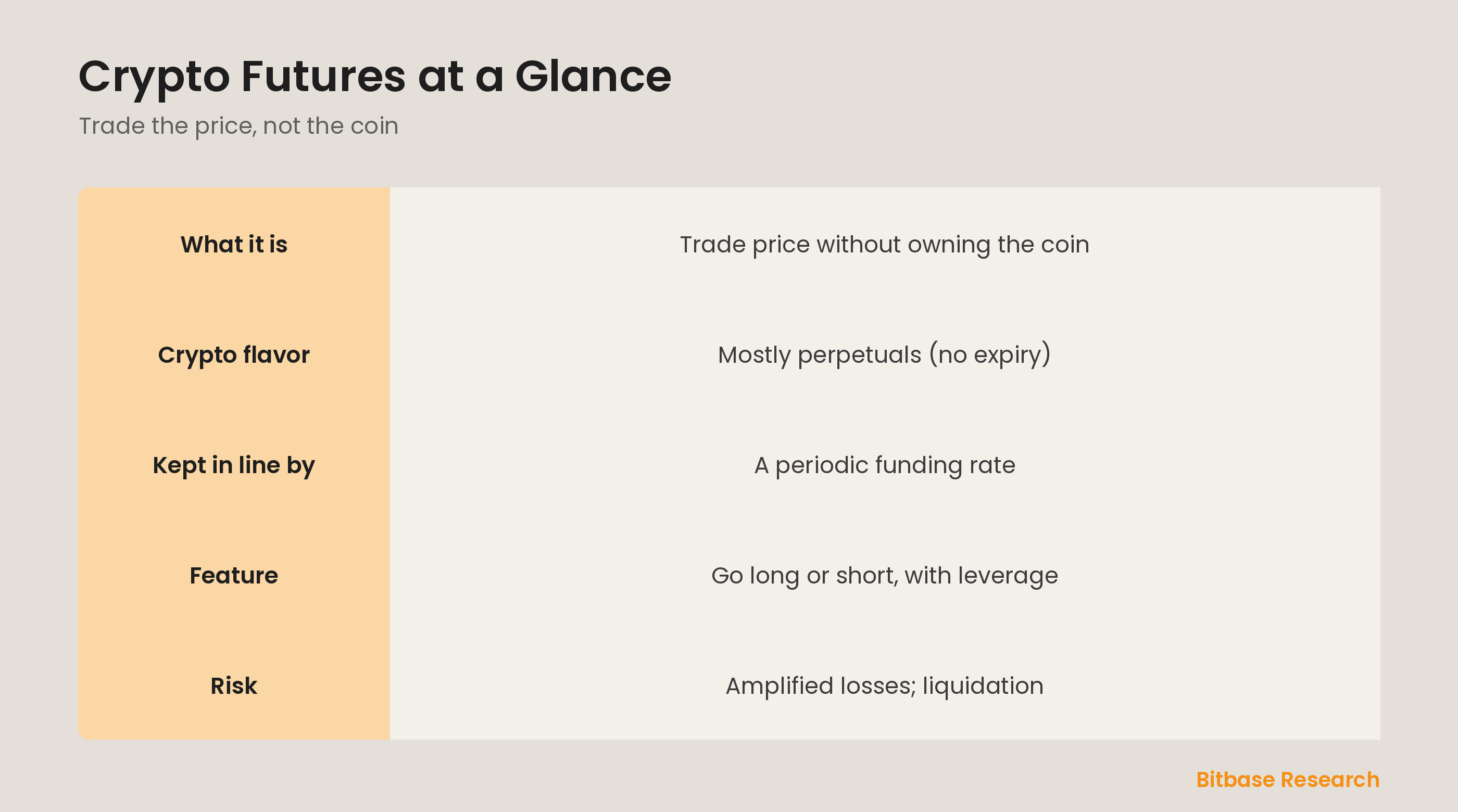
Traditional futures expire on a set date, but crypto is dominated by perpetual futures, or “perps,” which never expire. To keep a perp's price anchored to the real spot price, exchanges use a recurring payment called the funding rate: when the perp trades above spot, longs pay shorts, and when it trades below, shorts pay longs. This gentle pressure nudges the contract back toward the actual market price so you can hold a position indefinitely.
Leverage and why it is risky
Futures let you trade with leverage — controlling a position much larger than the money you put up. With 10x leverage, $1,000 of collateral controls a $10,000 position, so a 1% price move becomes a 10% swing on your money. That magnifies gains, but it magnifies losses just as much, and if losses eat through your collateral the position is liquidated. Higher leverage means a smaller adverse move is enough to wipe you out.
Who it is for
Because of leverage and liquidation, crypto futures are an advanced, high-risk product, not a starting point. Prices can move sharply, funding accrues while you hold, and a heavily leveraged position can be closed in minutes for a total loss of its margin. Traders who use futures do so with strict risk controls — modest leverage, a stop-loss, and only capital they can afford to lose. For most people, spot is the safer place to begin.
The bottom line
Crypto futures trading lets you speculate on price, long or short, without owning the coin, mostly through perpetual contracts kept in line by a funding rate. Its appeal is leverage and flexibility; its danger is that the same leverage amplifies losses and can trigger liquidation fast. Treat it as a tool for experienced traders with disciplined risk management, not a shortcut to quick gains. To keep learning the fundamentals, follow more from Bitbase Academy.
Disclaimer: This article is educational content from Bitbase Academy, provided for information only. It does not constitute investment, trading, tax, or financial advice. Crypto assets are volatile; assess your own risk. Written as of June 2026; refer to the latest official information.
References
[1] Britannica Money, "Perpetual Futures: Meaning, Regulation, and Example" britannica.com
[2] Investopedia, "Futures Contract: Definition, Types, Mechanics, and Uses" investopedia.com
[3] CFTC, "Customer Advisory: Understand the Risks of Virtual Currency Trading" cftc.gov