
The story of crypto can feel like a chaotic blur of booms, crashes, and jargon. But viewed as a timeline, it resolves into a handful of distinct eras, each with its own character, its own mania, and its own lesson. Organising crypto's past into these phases is the clearest way to understand how it evolved — and to see the repeating rhythm underneath the noise.
Why think in eras
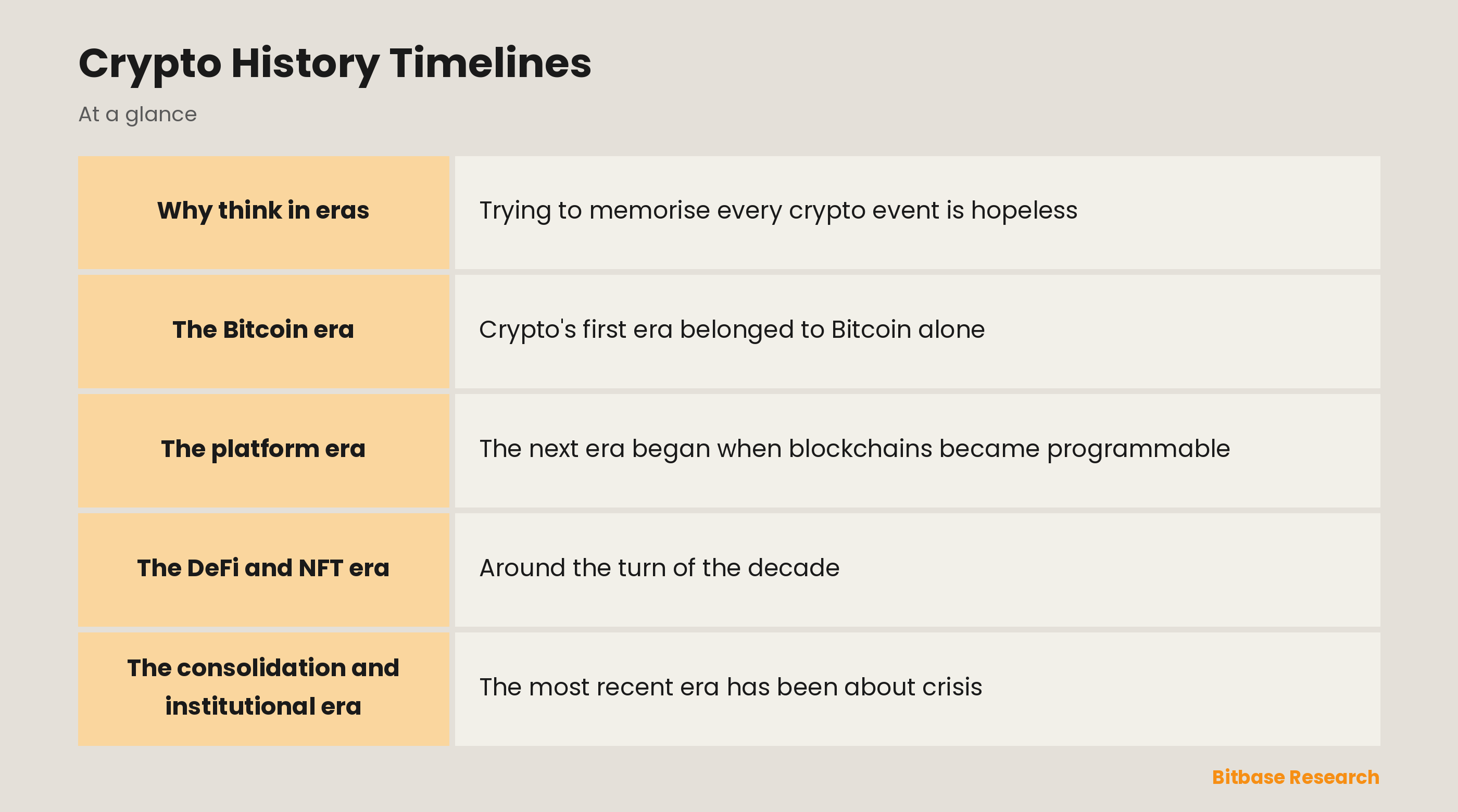
Trying to memorise every crypto event is hopeless; there are too many. A far more useful approach is to group the history into eras, each defined by a dominant technology or theme. Seen this way, crypto's past becomes a map rather than a list, showing how one breakthrough set up the next and how the whole field kept reinventing itself. Eras also reveal a pattern: each begins with genuine innovation, swells into speculative excess, then corrects, leaving durable infrastructure behind.
The Bitcoin era
Crypto's first era belonged to Bitcoin alone. Building on decades of cryptography and the cypherpunk movement, Bitcoin launched at the end of the 2000s as a way to move value without banks. For its early years, the entire field essentially was Bitcoin: a small community of enthusiasts, tiny prices, and the slow discovery that a decentralised digital money could actually work. This foundational era established the core ideas — scarcity, decentralisation, self-custody — on which everything later would build.
The platform era
The next era began when blockchains became programmable. With Ethereum and the rise of smart contracts in the mid-2010s, developers could issue their own tokens and build applications, and a wave of new projects raised money through token sales. This era proved a blockchain could be a platform, not just a currency, but it also produced enormous speculation and many failed or fraudulent projects. It ended, as eras do, in a sharp crash that cleared away the weakest experiments.
The DeFi and NFT era
Around the turn of the decade, two connected movements defined the next phase. Decentralised finance turned smart contracts into open lending, trading, and yield, letting people access financial services without intermediaries. Alongside it, non-fungible tokens brought verifiable digital ownership of art, collectibles, and culture into the mainstream, drawing in a wholly new audience. This era pushed crypto far beyond payments into finance and culture, before its own speculative peak gave way to a downturn.
The consolidation and institutional era
The most recent era has been about crisis, cleanup, and adoption at once. Major collapses erased trust and accelerated regulation, while surviving institutions and clearer rules pulled crypto closer to the mainstream financial system. Regulated investment products, tokenized real-world assets, and formal legal frameworks marked a shift from wild frontier toward regulated infrastructure. This era is defined less by a single technology than by crypto growing up, integrating with the traditional finance it once sought to bypass.
The bottom line
Crypto history reads most clearly as a sequence of eras: a foundational Bitcoin era, a programmable platform era, a DeFi-and-NFT era of finance and culture, and a consolidation era of crises and institutional adoption. Underneath runs a recurring rhythm of innovation, speculation, crash, and consolidation, roughly echoing the four-year cycle many observers track. Knowing the eras turns a confusing history into a coherent story — and a useful lens for recognising which phase the market may be in now.
Disclaimer: This article is educational content from Bitbase Academy, provided for informational purposes only. It is not investment, trading, tax, or financial advice. Written as of July 2026; rely on the latest official information.
References
[1] CoinGecko, "A timeline of crypto history" coingecko.com
[2] Britannica, "Cryptocurrency history" britannica.com