Proof of work (PoW) and proof of stake (PoS) are the two main consensus mechanisms — the systems a blockchain uses to agree on who adds the next block. They reach the same goal in very different ways. This guide explains how each works and how they compare.
What a consensus mechanism is
A public blockchain has no central authority, so it needs a way for a decentralized network to agree on which transactions are valid and who gets to add the next block. That system is called a consensus mechanism, and the two most important are proof of work and proof of stake.
Proof of work (PoW)
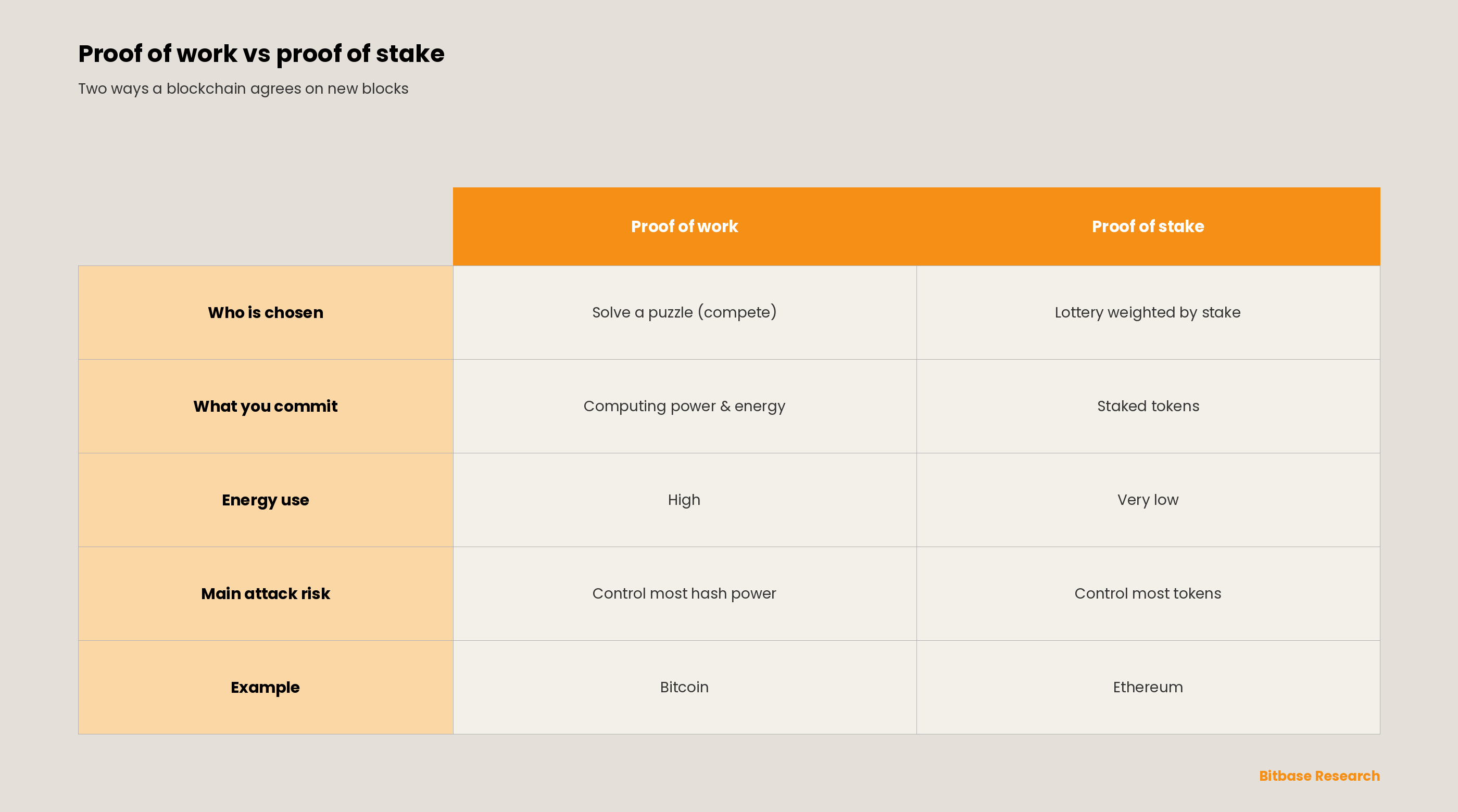
In PoW, "miners" compete to solve a hard mathematical puzzle by brute force. The first to solve it adds the next block and earns a reward. Solving requires enormous computing power and energy, which is what makes the chain expensive to attack. Bitcoin is the best-known PoW network.
Proof of stake (PoS)
In PoS, "validators" lock up (stake) the network's tokens for the right to add blocks, chosen in a lottery-like way. Honest validation earns staking rewards; dishonest behavior can cost them their stake. PoS uses a tiny fraction of the energy of PoW. Ethereum switched from PoW to PoS in 2022.
PoW vs PoS at a glance
How they compare
PoW's security comes from hash power — an attacker would need to control most of it (a "51% attack"). PoS's security comes from staked capital — an attacker would need a large majority of the tokens. PoW is battle-tested but energy-hungry; PoS is far more efficient and easier to scale, though newer.
The bottom line
PoW and PoS solve the same problem — agreeing without a middleman — with different costs: energy for PoW, locked capital for PoS. Knowing the difference helps you understand how a given coin is secured. To keep learning the fundamentals, follow more from Bitbase Academy.
Disclaimer: This article is educational content from Bitbase Academy, provided for information only. It does not constitute investment, trading, tax, or financial advice. Written as of June 2026; refer to the latest authoritative sources.
References
[1] Fidelity, "Proof of Stake vs Proof of Work: What You Need to Know." fidelity.com
[2] Kraken, "Proof of Work vs Proof of Stake." kraken.com