
A consensus mechanism is the method that lets a blockchain's many nodes agree on the "state of the ledger" without a central authority. It decides which transactions are valid and can be written to the chain, keeping order within decentralization. This guide explains it.
The problem it solves
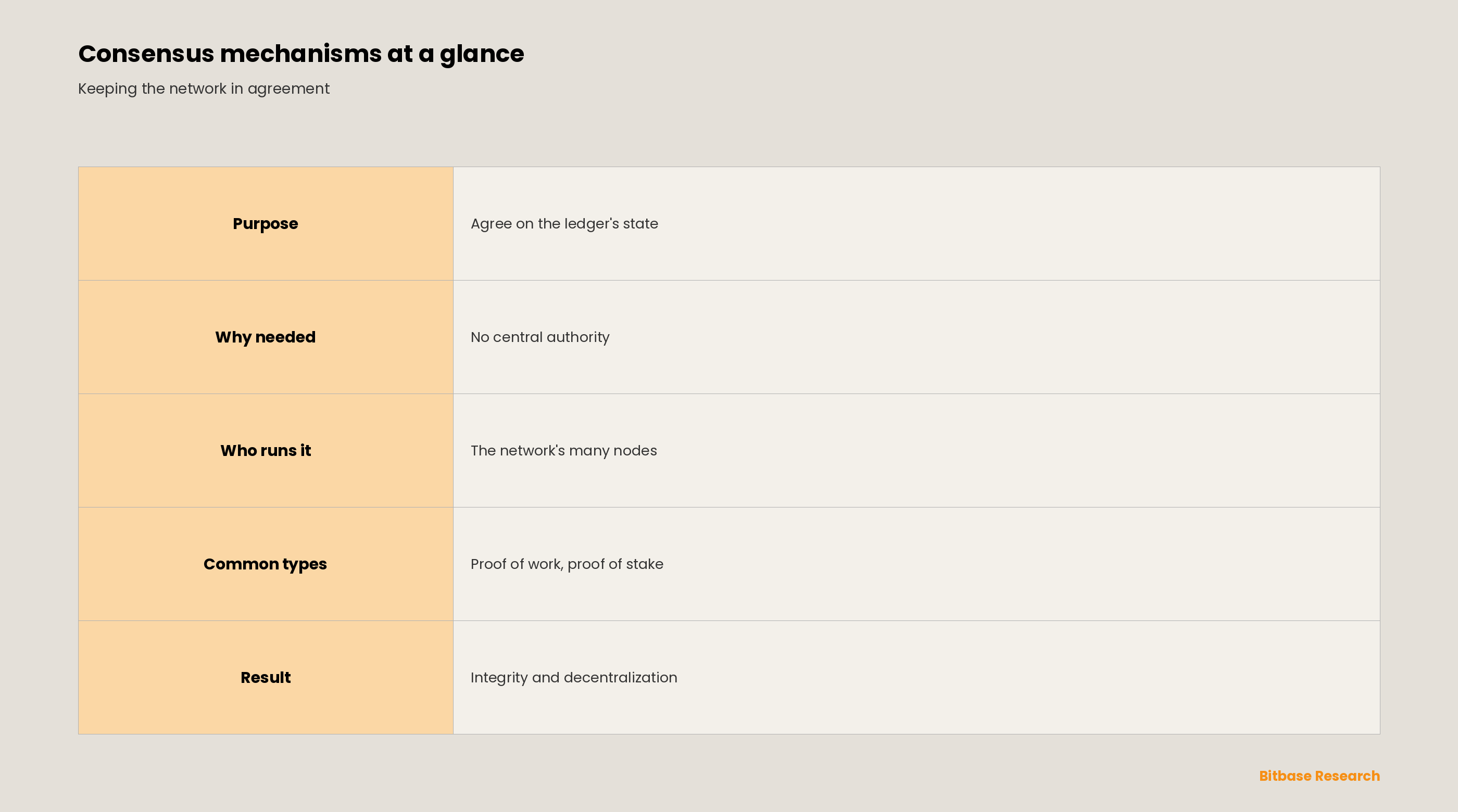
A blockchain has no central authority, so it needs a way for nodes to agree on "which transactions are valid" [1]. A consensus mechanism is exactly that set of rules: it lets protocol-layer nodes independently agree on the ledger's state, updating the chain and preserving its integrity [2].
Consensus mechanisms at a glance
Common consensus mechanisms
The two best known are proof of work (PoW) and proof of stake (PoS): the former competes on computing power, the latter on staking and random selection [1]. There are also many variants, each striking a different balance between security, decentralization, and energy use.
The bottom line
A consensus mechanism is the core rule that lets a decentralized network "agree," deciding how transactions are validated and recorded. Understanding it is the key to seeing how different blockchains differ. To keep learning the fundamentals, follow more from Bitbase Academy.
Disclaimer: This article is educational content from Bitbase Academy, provided for information only. It does not constitute investment, trading, tax, or financial advice. Written as of June 2026; refer to the latest official information.
References
[1] Hacken, "Consensus Mechanisms In Blockchain: A Deep Dive Into The Different Types." hacken.io
[2] IMF, "Blockchain Consensus Mechanisms: A Primer for Supervisors (2025 Update)." imf.org