Every blockchain needs a way to record who owns what, and two designs dominate. Bitcoin uses the UTXO model, tracking coins as discrete unspent outputs; Ethereum uses the account model, keeping a running balance for each address like a bank ledger. Here is how the two differ, what each is good at, and which chains use which.
The two models
In the UTXO model, there is no balance stored anywhere. Coins exist as separate unspent outputs, and your holdings are the sum of the ones you control — much like carrying cash. In the account model, the blockchain keeps a global list of accounts, and each address has a stored balance that goes up and down as value moves in and out. Sending funds simply subtracts from one account and adds to another, the way a bank statement works.
How balances and state differ
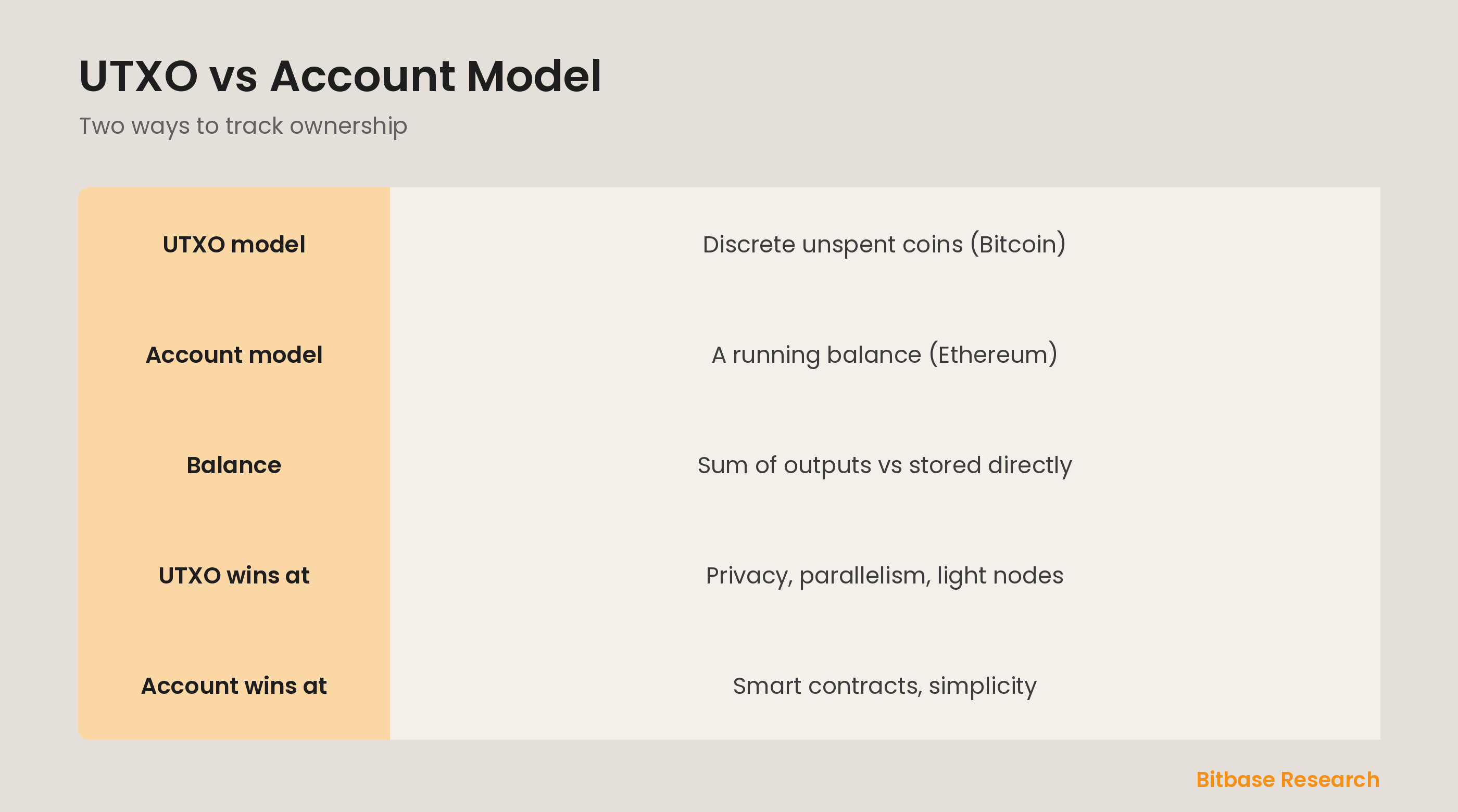
The difference shows up in how “state” is kept. A UTXO chain only needs the current set of unspent outputs to validate a transaction, and a wallet must add up its outputs to display a balance. An account chain stores each balance directly, along with a nonce that counts an account's transactions to prevent replays, and — for contracts — code and storage. That stored, always-current state is what makes the account model so natural for applications.
What each is good at
The UTXO model tends to win on privacy, because a fresh address can be used for every change output, and on parallelism, since independent outputs can be processed side by side; light clients also benefit from only needing the current output set. The account model wins on simplicity and programmability: balances are easy to read, and smart contracts that hold and update state are far easier to build, which is why decentralized applications cluster on account-based chains.
Which chains use which
Bitcoin is the original UTXO chain, and Litecoin and Cardano (with its extended eUTXO variant) follow the same lineage. Ethereum popularized the account model, and BNB Smart Chain and Tron — being EVM-style and TRON networks built for tokens and contracts — use it too. Neither model is simply better; they reflect different priorities, with UTXO leaning toward sound-money simplicity and accounts toward flexible applications.
The bottom line
UTXO and account are two answers to the same question: how to record ownership on a shared ledger. Bitcoin's outputs behave like cash you spend and get change from; Ethereum's accounts behave like balances that tick up and down. Knowing which model a chain uses explains its privacy properties, how its fees are calculated, and why some networks are built for payments while others are built for apps. To keep learning the fundamentals, follow more from Bitbase Academy.
Disclaimer: This article is educational content from Bitbase Academy, provided for information only. It does not constitute investment, trading, tax, or financial advice. Crypto assets are volatile; assess your own risk. Written as of June 2026; refer to the latest official information.
References
[1] Ethereum.org, "Ethereum Accounts" ethereum.org
[2] Investopedia, "Unspent Transaction Output (UTXO): Definition and Uses" investopedia.com
[3] Bitcoin Developer Reference, "Transactions" developer.bitcoin.org