
Inaugural edition. The first major U.S. bank issues its own spot Bitcoin ETF — and the dual-track framework gets its first weekly stress test.
Week of April 6–12, 2026
Bitbase Research · April 13, 2026
Market Insights is Bitbase Research’s short-wave companion to our Deep Dive flagship series. Each edition reviews the most structurally meaningful developments of the preceding week in compliant crypto derivatives and on-chain native infrastructure, mapped against the long-wave framework set out in our flagship report on the 2026–2030 dual-track divergence. Our goal is not to report prices. It is to audit, in real time, whether the data is confirming or falsifying the theses we have staked in public.
The one chart that matters
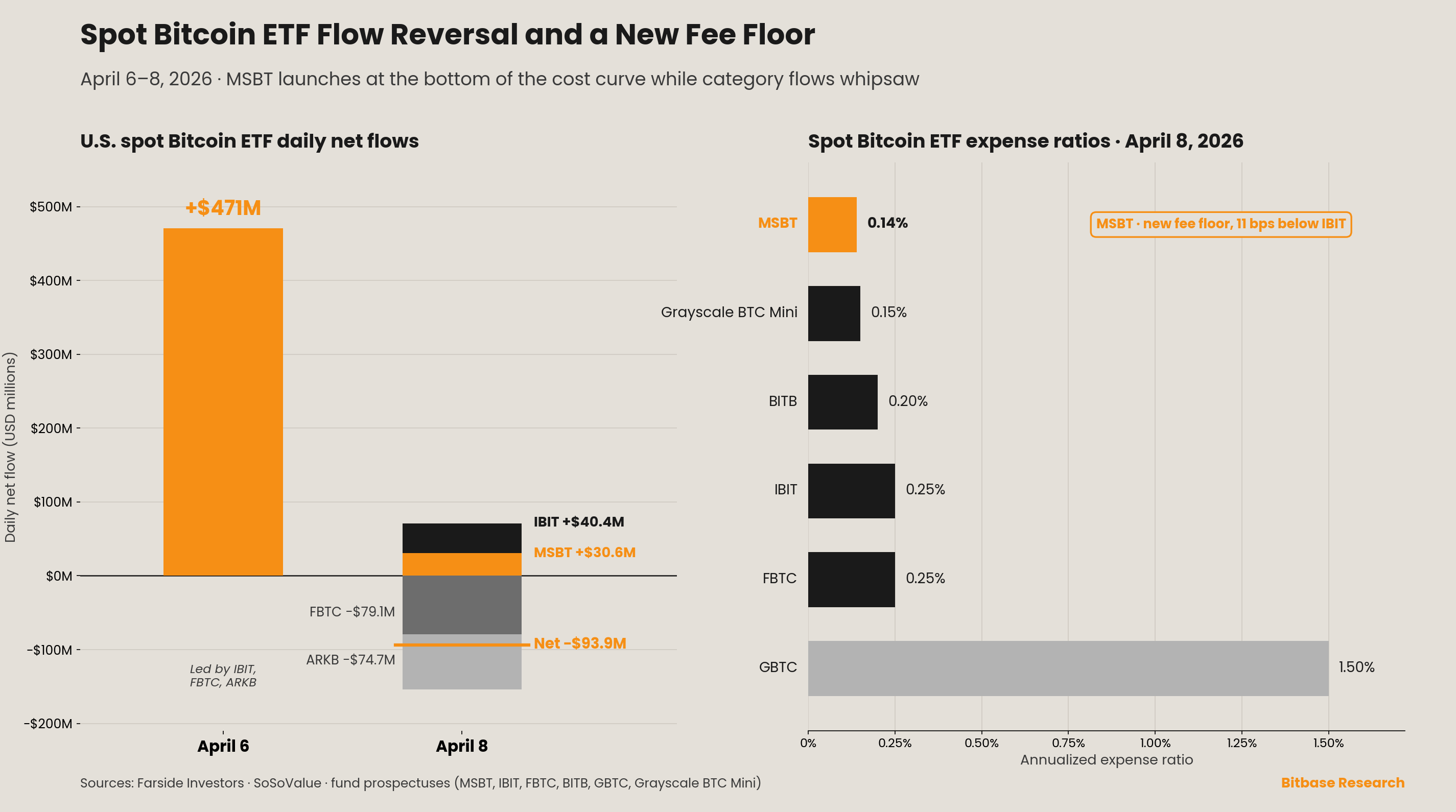
The two panels encode the week’s defining tension. On the left, the April 6 inflow surge of $471M [2] and the April 8 category-wide outflow of $93.9M [4] look contradictory until you isolate the fund-level detail: MSBT’s debut inflow of $30.6M and IBIT’s continued accumulation of $40.4M were running against a headwind of $79.1M in FBTC redemptions and $74.7M in ARKB redemptions [4]. The reversal was not a verdict on MSBT. It was rotation within the category, concurrent with broader macro repricing in a market where Bitcoin sits roughly 20% below its late-2025 highs [5]. The right panel adds structural context: MSBT’s 14-basis-point fee [1] now anchors the bottom of the cost curve, sitting 11 basis points below IBIT and a full 136 basis points below GBTC. Fee compression in a single week does not shift multi-year AUM trajectories, but it resets the competitive floor for every issuer in the category.
This week’s structural signal
April 8, 2026, registered as a tier-1 institutional node on the compliant-centralized track. Morgan Stanley Investment Management launched the Morgan Stanley Bitcoin Trust (NYSE Arca: MSBT), a passive exchange-traded product tracking the CoinDesk Bitcoin Benchmark 4 PM NY Settlement Rate [1]. The fund carries an annualized sponsor fee of 0.14%, the lowest in the U.S. spot Bitcoin ETF category as of launch, undercutting both Grayscale’s Bitcoin Mini Trust at 0.15% and BlackRock’s IBIT at 0.25% [1][3]. Coinbase and BNY provide custodial services [1].
What separates MSBT from every prior entrant is the distribution infrastructure behind it. Morgan Stanley’s wealth management network comprises approximately 16,000 financial advisors, and the firm oversees approximately $6 trillion to $8 trillion in client assets through its wealth management division [3]. Morgan Stanley is the first major U.S. commercial bank to issue a spot Bitcoin ETF under its own brand. No prior spot Bitcoin ETF issuer — BlackRock, Fidelity, Invesco, VanEck, ARK 21Shares, Grayscale, Bitwise, Franklin Templeton, WisdomTree, or Valkyrie — is a U.S. commercial bank with an embedded advisory distribution layer of this scale [1].
Day 1 net inflows reached $30.6M per Farside Investors, with trading volume of approximately 1.6 million shares [4]. Bloomberg senior ETF analyst Eric Balchunas placed the debut in the top 1% of all ETF launches ever recorded and set a Year 1 AUM projection of $5 billion, noting that Morgan Stanley’s advisory network constitutes a “captive audience” with few parallels among competing issuers [6]. Day 2 added $14.9M [4], bringing the two-day cumulative to approximately $45.5M. Amy Oldenburg, Morgan Stanley’s Head of Digital Asset Strategy, stated on Bloomberg Television on April 9 that MSBT delivered “the best first day of trading for any of our ETFs” [6].
MSBT is one component of a broader institutional crypto buildout. In January 2026, Morgan Stanley filed S-1 registration statements with the SEC for an Ethereum Trust with staking and a Solana Trust [3]. In February, it applied to the OCC for a National Trust Bank Charter under the name Morgan Stanley Digital Trust, National Association, designed to custody digital assets and facilitate staking on a fiduciary basis [3]. The bank also plans to offer retail crypto spot trading for BTC, ETH, and SOL through E*Trade in H1 2026, using Zerohash as settlement infrastructure [3]. Taken together, these filings describe not a single product launch but a full-spectrum institutional stack spanning ETPs, custody, staking, and retail distribution.
As we argued in Part 1 Section 1.4 of our flagship Deep Dive, the macro liquidity transmission channel is undergoing an asymmetric switch toward institutional allocation. MSBT validates Thesis 3: the institutional allocation channel is widening not because of price momentum, but because distribution infrastructure is being constructed inside the compliance perimeter of the largest wealth management platforms. Yet the same week illustrates why the Deep Dive explicitly cautioned that “institutional allocation does not equal sustained price appreciation.” On April 6, the spot Bitcoin ETF category absorbed $471M in net inflows, the strongest single day since late February [2]. Two days later, on MSBT’s own launch day, the broader category recorded net outflows of $93.9M, driven by $79.1M in FBTC redemptions and $74.7M in ARKB redemptions [4]. The five-day trading week (April 6–10) settled at approximately +$789M in net inflows per SoSoValue [4], a strong aggregate number that nonetheless exhibited sharp intra-week reversals. Cumulative net inflows into U.S. spot Bitcoin ETFs since their January 2024 launch stood at approximately $56.5 billion as of April 9 [4], with total category AUM of $88.7 billion [3]. IBIT remained the dominant fund through the week with approximately $53–55 billion in AUM, maintaining a category share in the high 50% to low 60% range [3].
MSBT now takes its place as the fourth node in a sequence of compliant-track milestones that has accelerated over seven months: CME’s $39 billion crypto open-interest record on September 18, 2025 [11]; Bitnomial’s launch of CFTC-regulated BTC and ETH margin collateral in September 2025 [14]; Kraken’s xStocks tokenized-equity perpetual futures on February 24, 2026 [15]; and MSBT on April 8, 2026 [1]. Each node occupies a different product category — exchange-traded derivatives, regulated margin, tokenized equity perpetuals, bank-issued spot ETPs — and together they trace the expanding surface area of the compliant-centralized track.
Dual-track scoreboard
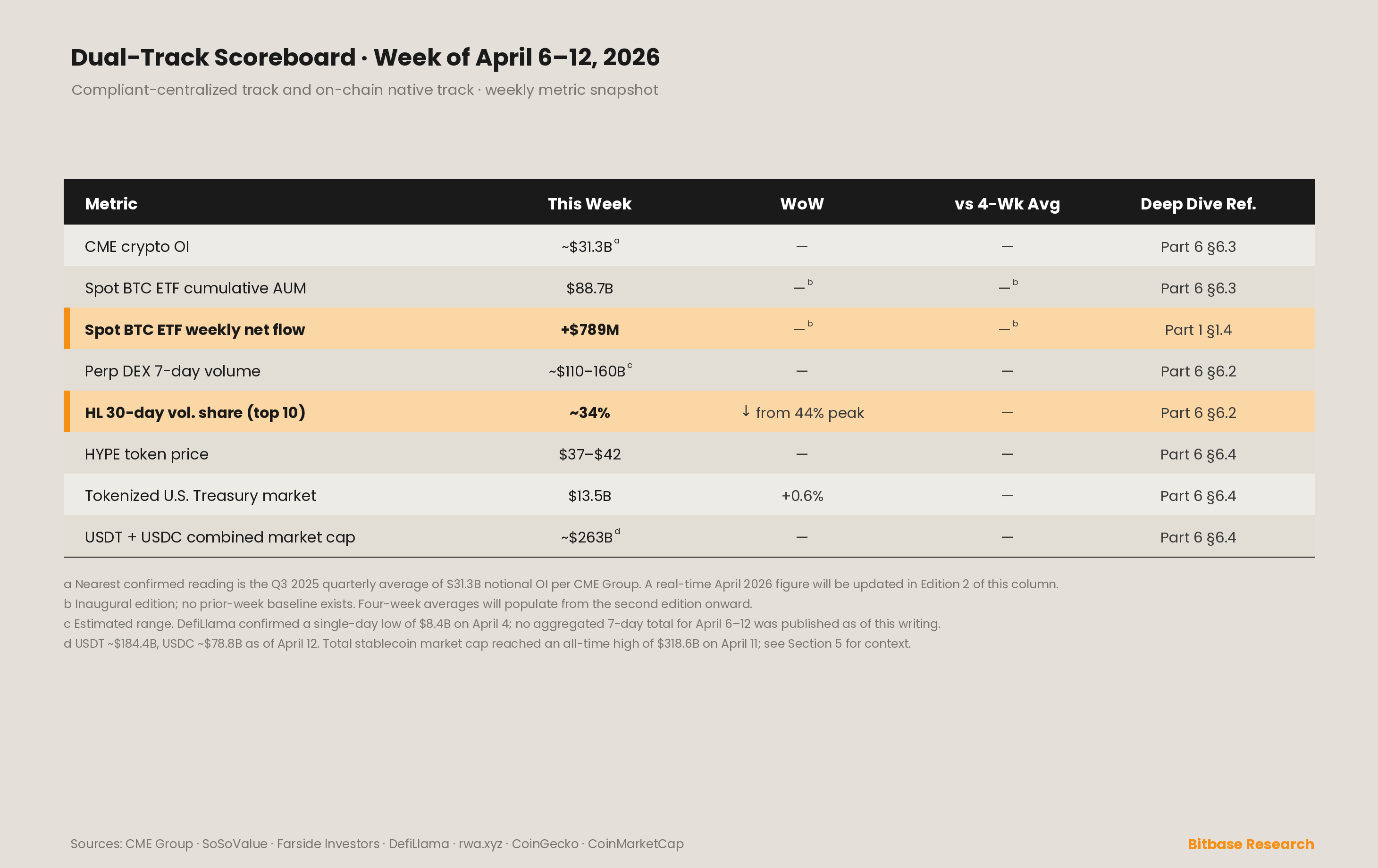
Two cells deserve attention. On the compliant-centralized track, the weekly net flow of +$789M is the category’s strongest week since late February, but its significance lies less in the dollar figure than in the structural event embedded within it: the arrival of a bank-issued spot ETP that widens the institutional allocation channel described in our flagship Deep Dive [4]. On the on-chain track, the Perp DEX cooldown is real. DefiLlama recorded $8.4 billion in daily volume on April 4, the first sub-$10B reading since September 2025 [7]. Hyperliquid’s 30-day share of top-10 Perp DEX volume has compressed to roughly 34%, down from a 44% peak in late March [7]. Per our flagship Deep Dive, the on-chain expansion hypothesis within Thesis 1 is built on multi-quarter cumulative volume trends, not any single week. A market-wide drawdown of approximately 20% year to date, combined with speculative leverage unwinding under broader macro repricing, is consistent with the macro liquidity transmission framework in Part 1. This is a cooldown, not a structural refutation. But sustained sub-$10B daily volume, if it persists into late April, would represent the first empirical pressure point on the on-chain track’s growth trajectory.
On the radar — week of April 13–19
MSBT Week 2 flow trajectory. The two-day cumulative of $45.5M sets a plausible pace, but Year 1 outcomes depend on whether Morgan Stanley’s advisory network begins systematic allocation in size. Whether Week 2 sustains above $30M in daily net inflows would imply an average run-rate consistent with Balchunas’s $5B Year 1 projection — approximately $20M average daily inflows across 252 trading days, with normal advisor-network activation curves typically front-loading the second-half of Year 1 [6].
CFTC perpetual contracts framework. Chairman Selig’s March 3 Milken Institute remarks — “perpetual futures here in the U.S. in the next month or so” [9] — have now factually lapsed without a published framework. Any movement this week would be a tier-1 signal for the compliant-centralized track and directly informs Part 4 of our Deep Dive. Continued silence is also informative; the CFTC currently operates with only one Senate-confirmed commissioner.
March PPI and the Fed Beige Book. The Bureau of Labor Statistics releases March PPI on April 14; the Federal Reserve publishes its Beige Book on April 15 [8]. Both feed into the MMF-siphon-inflection-point signal tracked in Part 1 Section 1.4 of our flagship. A hot PPI print would delay the conditions under which money market fund assets begin rotating toward risk assets, reinforcing the $7.856T ceiling observed in the ICI data (see Section 5).
Perp DEX volume: recovery or continued cooldown? The most consequential on-chain data point this week is whether daily Perp DEX volume rebounds above $10B on a sustained basis [7]. A second consecutive week averaging below that threshold would be the first empirical challenge to Thesis 1’s on-chain expansion component.
GHYP and the altcoin ETF pipeline. Grayscale’s HYPE ETF (ticker GHYP) S-1 remains under standard SEC review since its March 20 filing [12]; Bitwise filed a second amendment to its own HYPE ETF on April 10. Any SEC action on either filing would be a cross-track interoperability signal per Part 6 Section 6.4 of our Deep Dive, bridging on-chain native tokens and compliant ETF wrappers.
Signal tracking update
This section functions as a running audit of the forward-looking hypotheses in our Deep Dive’s “Signals We Are Monitoring” lists, updated with each edition. Each entry follows a standard SIGNAL / STATUS format, enabling continuous tracking across editions. A consolidated Signal Tracking report will follow in Q4 2026.
SIGNAL — Deep Dive Part 1: “MMF asset scale inflection point.” STATUS: Early signal holds. ICI data shows total money market fund assets peaked at $7.856 trillion for the week ended March 18, 2026, and have since pulled back to $7.819 trillion as of April 8 [8]. The ceiling has not been breached in any subsequent week. This is consistent with the Deep Dive’s hypothesis that the MMF peak may mark the onset of a gradual siphon toward risk-asset allocation, but confirmation requires a sustained decline in the Q2 rolling four-week average, which has not yet materialized. Next update requires the ICI release covering the week ended April 15.
SIGNAL — Deep Dive Part 6: “Whether CME crypto derivatives OI persistently holds above $30B by 2027, confirming structural vs cyclical institutional demand.” STATUS: On track. The most recent quarterly average was $31.3B in Q3 2025 [11], and the MSBT launch adds a new institutional distribution channel that did not exist at the flagship’s data cutoff. The compliant-centralized track thesis gains one new validating node. This validates Thesis 3, though a definitive assessment requires continuous quarterly data through 2027. The Q4 Signal Tracking report will audit this with full-year data.
SIGNAL — Deep Dive Part 3 and Part 6: “Tokenized RWA as common collateral infrastructure — whether the tokenized U.S. Treasury market exceeds $25B by 2027, and whether the broader stablecoin layer continues to expand as the public settlement base for both tracks.” STATUS: On track. The total stablecoin market capitalization reached an all-time high of $318.6B on April 11 per DefiLlama, with USDT at approximately $184.4B and USDC at approximately $78.8B. The tokenized U.S. Treasury market stood at approximately $13.5B as of April 13 per rwa.xyz [10], a modest weekly increase. Both data points are consistent with the Deep Dive’s argument that the on-chain settlement base is expanding as a shared substrate beneath both compliant-centralized and on-chain native derivatives infrastructure.
We will track additional signals against each weekly data arrival and publish the first consolidated Signal Tracking report in Q4 2026.
References
[1] Morgan Stanley, “Morgan Stanley Investment Management Enters Digital Investments Universe With Launch of Morgan Stanley Bitcoin Trust,” press release, April 8, 2026. morganstanley.com
[2] CoinDesk, “Bitcoin ETF Inflows Hit Highest Level Since February,” April 7, 2026. coindesk.com
[3] SoSoValue, U.S. spot Bitcoin ETF data, reported via FinTech Weekly, April 8, 2026. fintechweekly.com
[4] Farside Investors, U.S. spot Bitcoin ETF daily flow data, April 6–10, 2026, reported via Bitcoin Magazine, April 10, 2026. bitcoinmagazine.com
[5] Bloomberg, “Morgan Stanley Debuts Bitcoin ETF as Price Slump Rattles Holders,” April 8, 2026. bloomberg.com
[6] Bloomberg Intelligence, Eric Balchunas (Senior ETF Analyst), MSBT launch analysis and Year 1 AUM projection, public commentary on X and Bloomberg Television, April 8–9, 2026; Amy Oldenburg (Head of Digital Asset Strategy, Morgan Stanley), Bloomberg Television interview, April 9, 2026. Coverage compiled by Bitcoin Magazine and Fortune.
[7] DefiLlama, Perpetual DEX daily volume data, April 2026. defillama.com
[8] ICI, “Money Market Fund Assets,” release dated April 9, 2026 (data for week ended April 8). ici.org
[9] CoinDesk, “CFTC Chief Selig to Clear Path for U.S. Perpetual Futures in Coming Weeks,” March 3, 2026. coindesk.com
[10] rwa.xyz, Tokenized U.S. Treasuries Dashboard, accessed April 13, 2026. app.rwa.xyz
[11] CME Group, Cryptocurrency Quarterly Insights Report, Q3 2025 (published October 2025). cmegroup.com
[12] SEC EDGAR, Grayscale HYPE ETF (GHYP), Form S-1, filed March 20, 2026, Filing No. 333–294493.
[13] CoinGecko, Hyperliquid (HYPE) market data, accessed April 13, 2026. coingecko.com
[14] Bitnomial, “Bitnomial Launches Crypto Margin Deposits for Leveraged Perpetuals, Futures and Options Trading,” press release, September 9, 2025. prnewswire.com
[15] CoinDesk, “Kraken Rolls Out Crypto-Style 24/7 Perpetuals Trading for Tokenized U.S. Stocks,” February 24, 2026. coindesk.com
The next Market Insights issue covers the week of April 13–19, 2026. Market Insights is published by Bitbase Research alongside our Deep Dive flagship series.