The rate constraint that gated the bottom in Issue 12 cracked this week—and the same force that bound the June lows released the July bounce. The break came from the labor side: with the holiday pulling the print forward to July 2, June nonfarm payrolls landed cold at +57,000 against a roughly 110,000 consensus, unemployment ticked to 4.2% only because participation fell to a March-2021 low of 61.5%, and April and May were revised down a combined 74,000. New Fed Chair Kevin Warsh had already softened the tone on July 1, saying inflation risks "have come down," and the two together read as bad-news-is-good-news for a market whose live Fed debate is about hikes, not cuts: CME-implied odds of a September hike fell from about 65% to roughly 50%. Bitcoin, which had first broken the baseline's ~$59,000 target to a ~21-month low near $57,750 on June 30, reversed hard—retaking $60,000 on the Warsh comment, topping $62,000 on the jobs miss, and closing above $63,000 by July 4, up about 3.6% on the week; Ether led the rebound at roughly +11.5%. The spot-Bitcoin-ETF picture turned with it: the ~10-day, ~$2.7 billion outflow streak snapped on July 2 with a +$223.5 million session—the first green day in two months—though BlackRock's IBIT stayed red for an eleventh straight day and the four-day week was still net negative near −$526 million. Two things did not confirm the turn. The macro green light did not trigger: the 2-year yield closed at 4.137% and the dollar index near 100.8, both moving toward but neither clearing their thresholds. And the one confirmation leg that had held all along broke form: Strategy reported zero Bitcoin bought for June 22–28, held flat at 847,363 BTC, and—for the first time in the Saylor era—authorized a framework to sell up to $1.25 billion of bitcoin. The door cracked open; it has not yet swung.
Week of June 29 to July 5, 2026
Bitbase Research · July 6, 2026
The one chart that matters
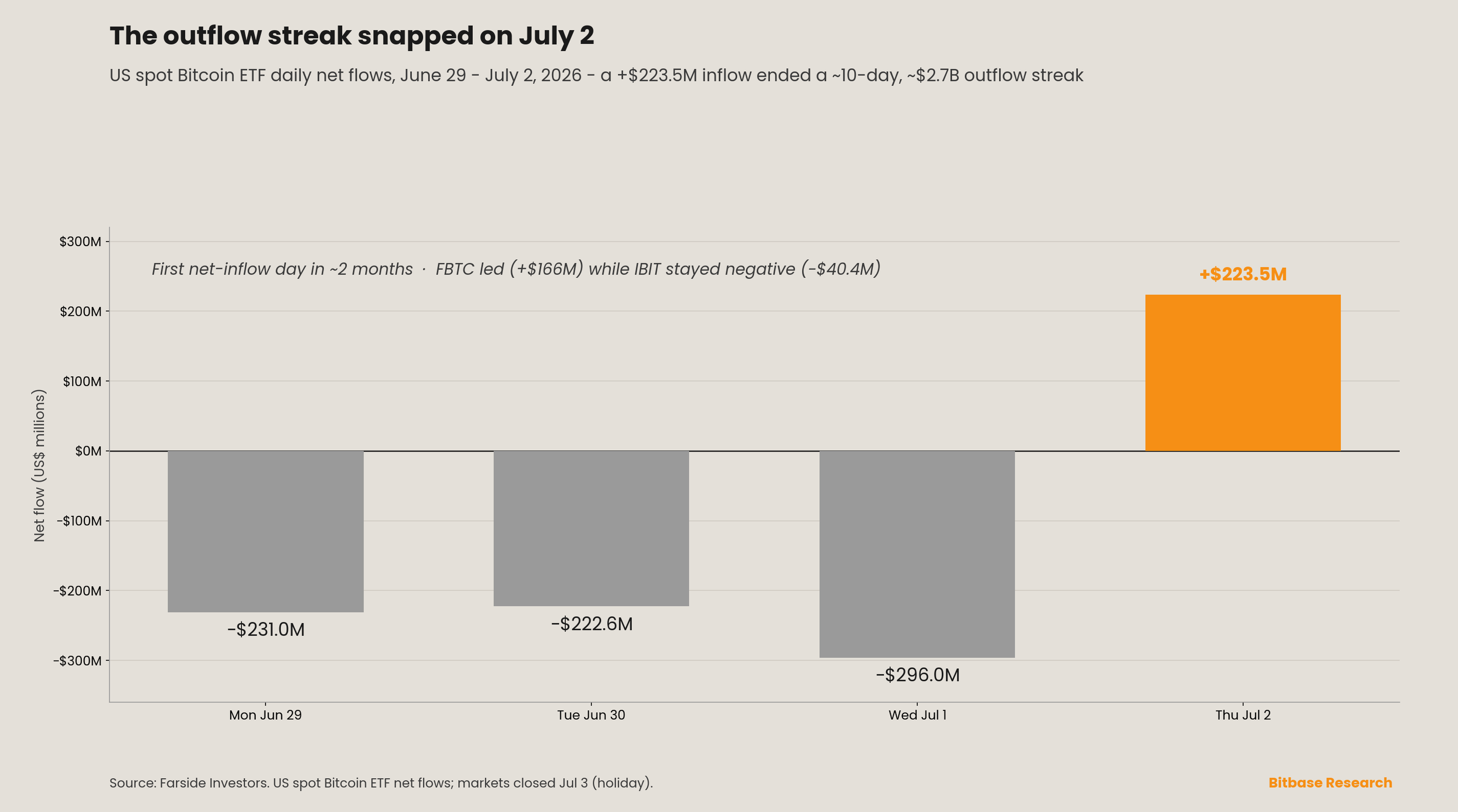
The single most legible turn of the week is in the flows. For four trading days—the holiday closed US markets Friday July 3, so the week's ETF tape ends Thursday July 2—spot Bitcoin ETFs printed −$231.0 million, −$222.6 million and −$296.0 million before reversing to +$223.5 million on July 2, the session widely framed as ending a roughly 10-day, ~$2.7 billion outflow streak [1][2][3]. The reversal was not led by the usual bellwether: Fidelity's FBTC took in about $166 million and ARK's ARKB about $92 million, while BlackRock's IBIT stayed negative at −$40.4 million, an eleventh straight outflow day that analysts flagged as a mixed signal beneath a green headline [1][3]. The streak's end is the market-structure event; the full four-day week was still net negative near −$526 million (the sum of Farside's daily prints), and June closed as the worst-ever month for US spot Bitcoin ETFs at roughly $4.5 billion of redemptions [3]. The demand vacuum that defined the June lows did not fill—but for the first time since late April, it stopped deepening.
This week's structural signal
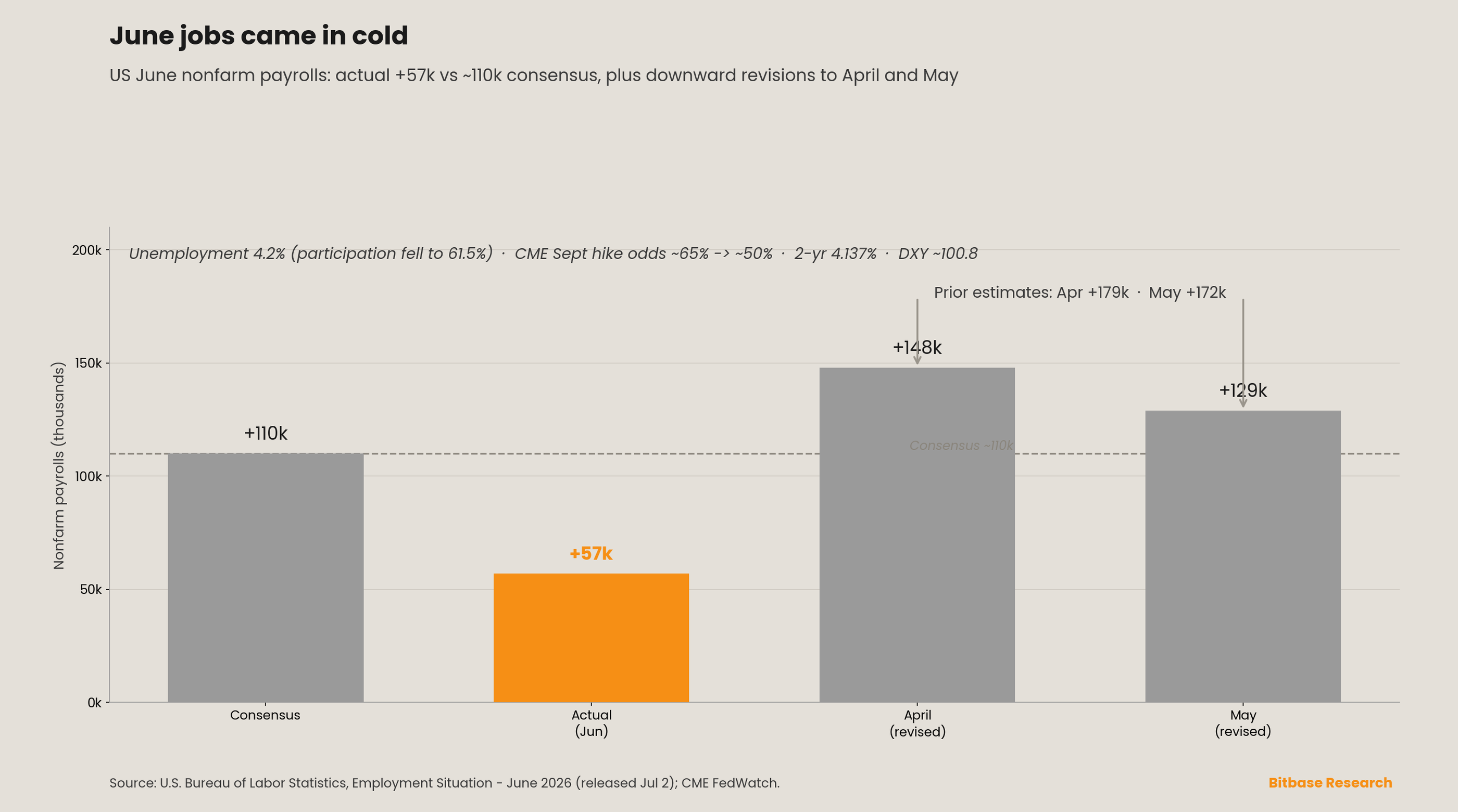
Issue 12's structural signal was inflation confirming the hawkish path—May PCE at a three-year high. This week's is the first genuine dovish crack, and it came from labor. The June employment report, pulled forward to July 2 by the Independence Day holiday, printed +57,000 nonfarm payrolls—the weakest in four months and roughly half the ~110,000 consensus—with April cut to +148,000 and May to +129,000 (−74,000 combined) [4][5]. The unemployment rate ticked down to 4.2%, but for the wrong reason: labor-force participation fell three-tenths to 61.5%, its lowest since March 2021, which flatters the jobless rate rather than reflecting strength; leisure and hospitality shed 61,000 jobs [4]. Wage growth held in line at +3.5% year over year. Warsh kept the official tone cautious—prices are still "too high"—but the tape treated the miss as bad-news-is-good-news, dropping the September hike probability from about 65% to roughly 50% [5]. The transmission was textbook and partial: the 2-year yield eased to 4.137%, the dollar index fell about 0.6% to near 100.8—its worst week since April—and gold rose about 2.2% toward $4,180, its first weekly gain since May [6][7][8]. Neither rate leg cleared the line the series has drawn for a macro all-clear (Section on the radar), but both moved the right way for the first time since the June FOMC.
Dual-track scoreboard
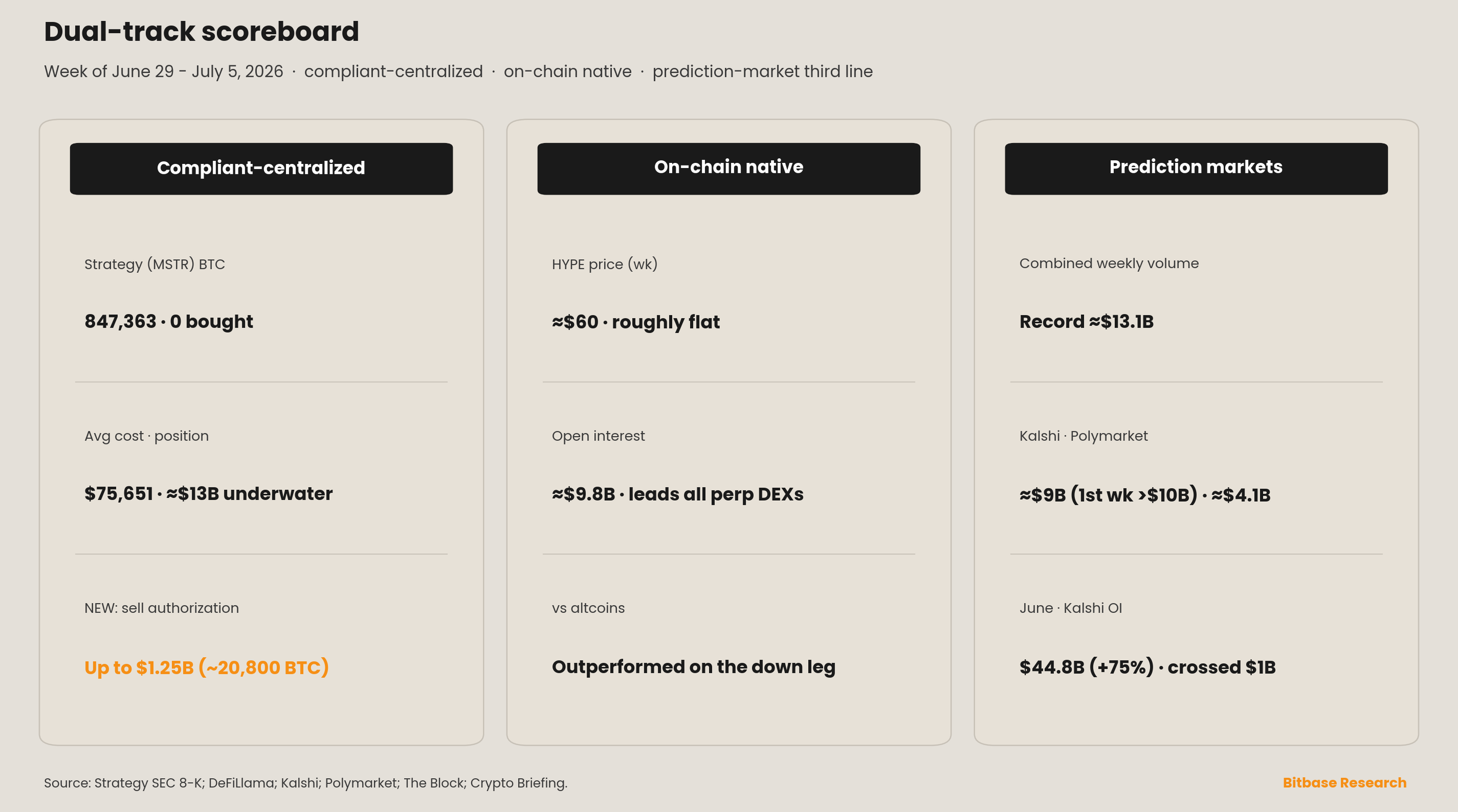
Compliant-centralized track. The one confirmation leg that had held since Issue 10 broke form. Strategy's weekly 8-K, filed June 29, reported zero Bitcoin acquired for June 22–28; holdings stayed flat at 847,363 BTC at an average cost of $75,651 (aggregate about $64.1 billion), unchanged from Issue 12 [9][10]. In the same filing, under a new "Digital Credit Capital Framework," the board authorized a Bitcoin Monetization Program that permits selling bitcoin to raise up to $1.25 billion for a USD reserve, preferred dividends and buybacks—the first sell authorization in the company's Bitcoin era, reversing Saylor's four-year "never sell" stance [10][11]. Raising the full amount would require selling roughly 20,800 BTC (~2.5% of the position); MSTR shares rose about 3% on the news even as the plan was named a market overhang earlier in the week [11][12]. With Bitcoin near $60,000 against a $75,651 average, the position stayed roughly $13 billion underwater, narrowing only as the weekend recovery lifted spot back above $63,000 [9]. The read has changed: corporate-treasury conviction is no longer an unqualified confirmation leg—buying has halted and, for the first time, a selling mechanism exists.
On-chain native track. Where Issue 12 saw HYPE re-couple lower with the majors, this week it held its relative ground. HYPE traded roughly flat near $60.19, off about 2–4% versus the $62.91 baseline, while ETH fell about 8% and DOGE about 12% at mid-week—the on-chain-native bellwether outperformed a sliding altcoin complex during the risk-off leg, then participated in the recovery [12][13]. The platform's structural footprint held and firmed: open interest of about $9.8 billion still leads all perpetual DEXs, with roughly $48.6 billion of 7-day and $245 billion of 30-day perp volume (DeFiLlama) [13]. The distinction the series draws holds—HYPE's price level is a token event, and the perpetual-DEX signal tracks volume, not price. A near-term token event sits just outside the window: a Core Contributor unlock of about 9.92 million HYPE (~1% of supply) on July 6 [13].
Prediction-market third line. The line kept setting records. Per multiple trackers, combined weekly notional reached about $13.1 billion—Kalshi roughly $9 billion (its first week above $10 billion during the tournament) and Polymarket about $4.1 billion—and June closed as a record month at $44.8 billion combined, up about 75%, with Kalshi at $31.5 billion [14][15]. Kalshi's aggregate open interest crossed $1 billion for the first time (about $1.16 billion), and its "World Cup Winner" market carried more than $832 million in bets [16]. The 2026 World Cup remained the driver; the marquee in-window result went the home side's way this time, with the United States beating Bosnia and Herzegovina 2–0 on July 1 to reach the Round of 16—its first World Cup knockout win since 2002—though Folarin Balogun's red card clouds the next match [17]. The distributional and venue-level questions the series has tracked remain open; more than a dozen US state authorities have now taken legal action against the sports contracts driving the volume [15].
On the radar—week of July 6 to July 12
The window ahead is defined by whether the dovish crack widens or the rate constraint reasserts.
June CPI (mid-July) and the follow-through from the jobs miss. The labor print opened the door; June CPI is the more decisive disinflation test. A cool CPI stacked on a cold payroll would be the first back-to-back crack in the constraint since the June FOMC; a hot CPI re-anchors the hawkish read and the September-hike debate.
Strategy's next weekly disclosure (expected Monday July 6) and the sell mechanism. With purchases halted and a monetization program now authorized, the watch shifts from how much Strategy buys to whether it buys at all—and whether any bitcoin is sold under the new framework. Watch SEC EDGAR for the 8-K.
The CLARITY Act after a missed July 4. The market-structure bill did not reach a Senate floor vote by the White House's July 4 target and stalled; Congress returns around July 13, putting a realistic window in late July or early August before the recess [18][19]. Separately, the SEC's June 30 request for comment on "novel" ETFs—a 60-day period aimed at building one asset-neutral framework rather than case-by-case approvals—is the more consequential near-term regulatory track [20].
The HYPE unlock and the perp-DEX signal. The July 6 Core Contributor unlock of about 1% of supply is a token-level test of demand depth; the volume signal the series actually tracks is unaffected unless open interest breaks lower.
The rate path and the dollar. The green light is unchanged and specific: the 2-year yield back below roughly 4.0% and the dollar index below 100, produced by a sustained disinflation sequence. Both are now within striking distance—4.137% and ~100.8—but until they clear, the rate constraint is loosening, not released.
Signal tracking update
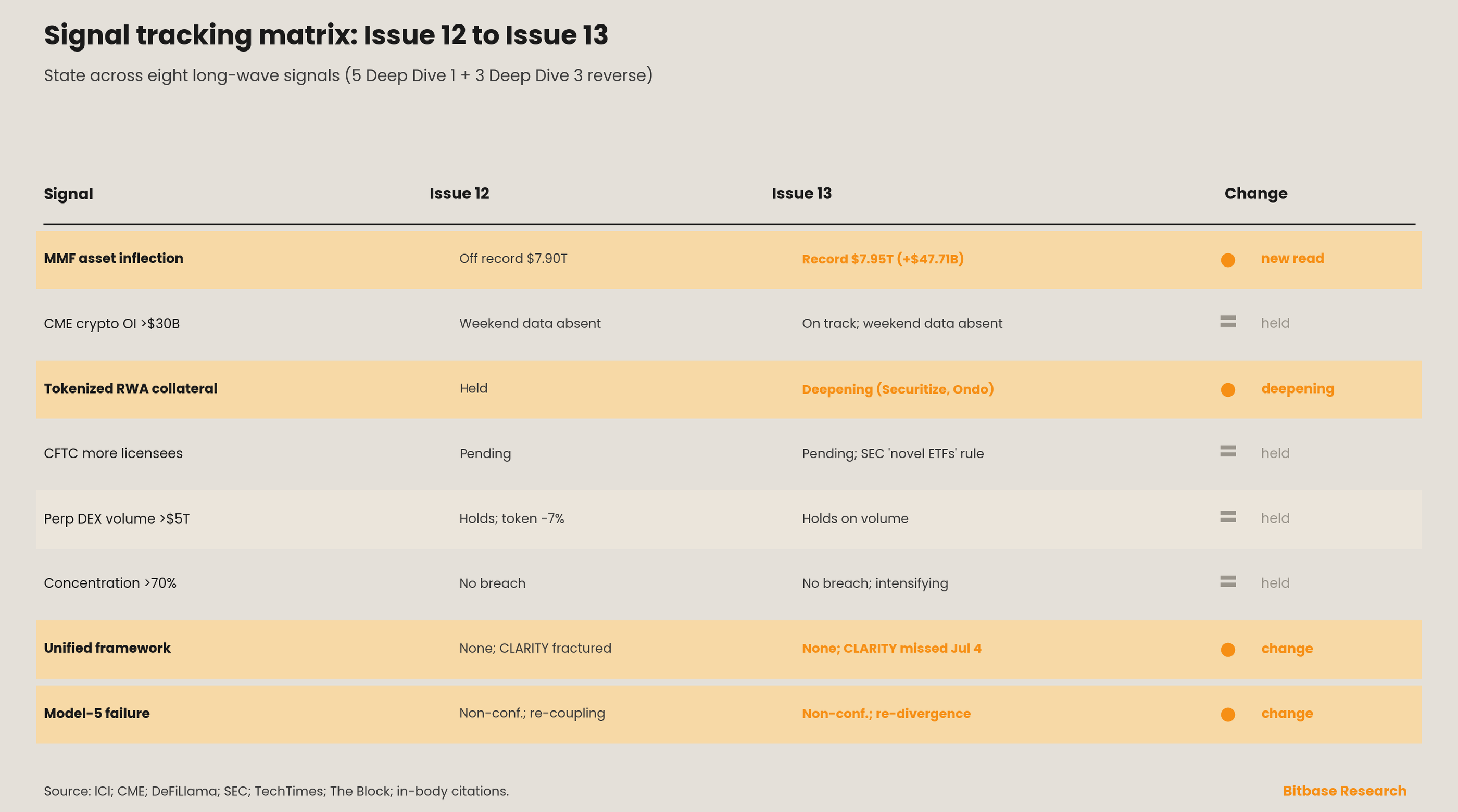
SIGNAL—Deep Dive 1 Part 1: "MMF asset scale inflection point." STATUS: Record high; still no rotation. Per the Investment Company Institute, total money-market-fund assets rose $47.71 billion to a fresh record $7.95 trillion for the week ended July 1 (released July 2), reversing the prior week's drawdown—government funds up $34.11 billion, prime up $11.36 billion [21]. Cash built to a new record even as equities rose and Bitcoin recovered; a fresh record inflow during a relief rally is the opposite of the reallocation this signal tracks. The cash wall is larger, not rotating.
SIGNAL—Deep Dive 1 Part 6: "Whether CME crypto derivatives OI persistently holds above $30B by 2027." STATUS: On track; weekend data still absent. No Tier-1 source published a standalone 24/7 crypto weekend-volume record for the June 29–July 5 weekend, the same gap flagged since Issue 10; CME's 24/7 complex has been live since May 29. CME Bitcoin-futures open interest is reported near $6.3 billion with options skewed defensively, though that figure is carried at lower confidence pending a clean CME print. The signal stays on track against full-year data.
SIGNAL—Deep Dive 1 Parts 3 and 6: "Tokenized RWA as common collateral infrastructure." STATUS: Deepening. The RWA layer added surface area in-window—Securitize listed publicly and Ondo launched tokenized equity products—extending the infrastructure build the signal tracks, with the synthetic pre-IPO sub-layer still carrying Issue 11's fragility qualifier (both items single-source, directional) [22]. The signal holds and firms.
SIGNAL—Deep Dive 1 Part 6: "Whether the U.S. CFTC approves more licensed entities to offer perpetual swap-style products by 2027." STATUS: Pending; a new federal track opened. No new CFTC licensing action was confirmed in-window, but the SEC's June 30 "novel ETFs" comment period is the salient administrative development—an attempt to standardize the framework under which event-contract, staking-yield and altcoin-basket products reach market [20]. The administrative track holds at pending, now with a live rulemaking attached.
SIGNAL—Deep Dive 1 Part 6: "Whether perpetual DEX annual trading volume holds above $5 trillion in 2026." STATUS: Holds on volume. Hyperliquid's footprint—open interest near $9.8 billion, the largest of any perpetual DEX, with 30-day volume around $245 billion—held through a volatile week even as HYPE's price stayed roughly flat [13]. The signal tracks volume, not price. The signal holds.
SIGNAL (Deep Dive 3 Reverse Signal A)—Market-share concentration above 70%. STATUS: No single-venue breach; concentration intensifying. IBIT's dominance of Bitcoin-ETF flows (and its outsized share of June's redemptions), Kalshi's roughly 69% of prediction-market volume with open interest now past $1 billion, and Hyperliquid's lead in perpetual-DEX open interest all point to intensifying within-rail concentration, but no single venue breached 70% of its defined market in-window. The five-model coexistence thesis holds.
SIGNAL (Deep Dive 3 Reverse Signal B)—Cross-architecture unified regulatory framework. STATUS: No unified framework; a missed target and a new standardizing attempt. The CLARITY Act missed its July 4 target without a floor vote and stalled to a late-July/early-August window [18][19]. Cutting the other way, the SEC's June 30 move to build one asset-neutral "novel ETFs" framework is the first in-window step toward standardization across product types [20]. The five-model regulatory divergence remains the state of record—now with a legislative stall and a nascent administrative convergence attempt side by side.
SIGNAL (Deep Dive 3 Reverse Signal C)—Model 5 regulatory failure. STATUS: Non-confirming (sustained), with a re-divergence. The reverse signal positing regulatory failure for the on-chain-native model stays non-confirming: the track functioned through the week with no regulatory-failure event, and its bellwether outperformed the altcoin complex on the down leg. Where Issue 12 recorded a re-coupling under a binding rate constraint, this week's loosening was accompanied by relative on-chain-native strength—a market-behavior observation consistent with the dimension below, not a state change.
New dimension—the rate constraint is the master variable, in both directions
Issue 12's candidate dimension was one-sided: when the rate constraint binds hard, even the on-chain-native track re-couples lower. This week completes the symmetry. The same variable that gated the bottom released the bounce—a cold labor print and a dovish chair, not any crypto-native catalyst, carried Bitcoin off a ~21-month low and back above $63,000, with the highest-beta assets (Ether +11.5%) leading precisely because the constraint eased. The corollary matters for how the series reads confirmation: the two legs that are genuinely crypto-native—the ETF bid and Strategy's treasury buying—did not lead the turn and, in Strategy's case, inverted it, halting purchases and authorizing sales at the lows. For now the master variable is exogenous and macro; the crypto-native confirmation legs are followers, and one of them has begun to face the other way. The test of the dimension is the next constraint move: if June CPI cools and the 2-year clears 4.0% with the dollar below 100, the reflex says beta leads again; if the constraint re-binds, the June pattern repeats.
Caveats
Date integrity. US equity and bond markets were closed Friday July 3 for the observed Independence Day holiday, so TradFi and ETF data anchor to end-of-day Thursday July 2; crypto-native prices extend through Sunday July 5. The June jobs report (July 2) and the ICI money-market release (July 2) are in-window. June CPI, the World Cup Round of 16, and any post-window Strategy disclosure fall after this window.
Verification status. The load-bearing figures—the June payrolls print and revisions; the market transmission (2-year and 10-year yields, the dollar index, gold); the spot Bitcoin and Ether ETF daily flows and the July 2 reversal; Strategy's holdings, average cost and the sell authorization; the ICI money-market figure; and the United States–Bosnia result—have been traced to primary or named Tier-1 sources. Figures carried at lower precision are noted in-line.
Data-caliber conflicts and gaps flagged. No clean Tier-1 exact Sunday July 5 closing print exists for Bitcoin or Ether; the anchored figures are CoinDesk's July 4 reads (Bitcoin above $63,000, about +3.6% on the week; Ether near $1,793, about +11.5%). The weekly ETF totals (Bitcoin about −$526 million; Ether about −$14 million) are arithmetic sums of Farside's daily prints, not independently published weekly figures. Exact weekly percentage moves for Brent and WTI were unavailable from Tier-1; only levels (about $72 and about $68–69) are confirmed. The CME Bitcoin open-interest figure (about $6.3 billion) is single-source and carried at low confidence. Several CLARITY Act specifics—the reported conflict-of-interest figure, the Section 604 and stablecoin-yield fights, and the reduced odds—are single-sourced and softened accordingly. HYPE's exact Sunday close and perp-volume detail are single-source (DeFiLlama); a corrupted third-party price snapshot was discarded.
Source attribution. US spot Bitcoin and Ether ETF flow figures are Farside Investors as cited, subject to T+1 revision and not issuer-direct; Strategy holdings and the capital framework are from the company's SEC 8-K as reported; payrolls figures are from the BLS release as reported by named outlets; market levels are per named Tier-1 financial outlets; money-market-fund figures are from the ICI release.
Causation discipline. All causal attributions—the cold labor print and dovish chair driving Bitcoin higher, the ETF streak snapping as rate-hike fear receded, Strategy's pivot as a treasury-strategy shift, cash building rather than rotating—reflect the cited outlets' framing and named analysts' reasoning, not independent Bitbase inference.
References
[1] CoinDesk, "Finally. $221 million flow into Bitcoin ETFs, ending a painful 10-day outflow streak," July 3, 2026. coindesk.com
[2] TechTimes, "Bitcoin ETF Outflow Streak Ends at $2.7B as June Jobs Data Cools Rate Risk," July 3, 2026. techtimes.com
[3] Farside Investors, Bitcoin ETF flows (daily), retrieved July 5, 2026. farside.co.uk
[4] U.S. Bureau of Labor Statistics, "The Employment Situation — June 2026," July 2, 2026. bls.gov
[5] CoinDesk, "Crypto bulls on firmer footing as U.S. rate-hike risk recedes," July 3, 2026. coindesk.com
[6] CNBC, "Dollar heads for weekly drop as jobs data dims Fed hike bets," July 3, 2026. cnbc.com
[7] CNBC, "U.S. Treasury yields and the June jobs report," July 2, 2026. cnbc.com
[8] Reuters, "Gold heads for weekly gain as weak U.S. jobs data lowers rate-hike bets," July 3, 2026. reuters.com
[9] Strategy Inc., purchases disclosure, retrieved July 5, 2026. strategy.com
[10] U.S. SEC, Strategy Inc. Form 8-K (event date June 29, 2026), CIK 0001050446. sec.gov
[11] CoinDesk, "Strategy opens the door to selling bitcoin under new capital plan—here's what it means," June 29, 2026. coindesk.com
[12] CoinDesk, "Ether, Solana and Dogecoin slide as Strategy's bitcoin-sales plan pressures market," June 30, 2026. coindesk.com
[13] DeFiLlama, Hyperliquid protocol metrics, retrieved July 5, 2026. defillama.com
[14] Crypto Briefing, "World Cup prediction-market volumes hit record highs," July 4, 2026. cryptobriefing.com
[15] The Block, "Kalshi and Polymarket combined volume surges 75% to $45 billion in June," July 1, 2026. theblock.co
[16] The Block, "World Cup boom sends Polymarket volume up 300% while Kalshi sets open-interest records," 2026. theblock.co
[17] ESPN, "USA beats Bosnia & Herzegovina to reach 2026 World Cup Round of 16," July 1, 2026. espn.com
[18] TechTimes, "Senate crypto bill misses July 4: three unresolved fights, three weeks left," July 4, 2026. techtimes.com
[19] The Block, "Senate races to advance crypto legislation as housing-bill turmoil threatens timeline," 2026. theblock.co
[20] CoinDesk, "SEC giving 'novel' ETFs a rethink as it opens comment period on overhauling U.S. rules," June 30, 2026. coindesk.com
[21] Investment Company Institute, "Money Market Fund Assets," July 2, 2026. ici.org
[22] Yahoo Finance, "Crypto news today — Securitize public listing; Ondo tokenized stocks," July 3, 2026. finance.yahoo.com