Ethereum is a decentralized blockchain platform for building applications with smart contracts — programs that run automatically when their conditions are met. ETH is its native coin and the second-largest cryptocurrency. This guide explains what Ethereum is and how it differs from Bitcoin.
Beyond digital money
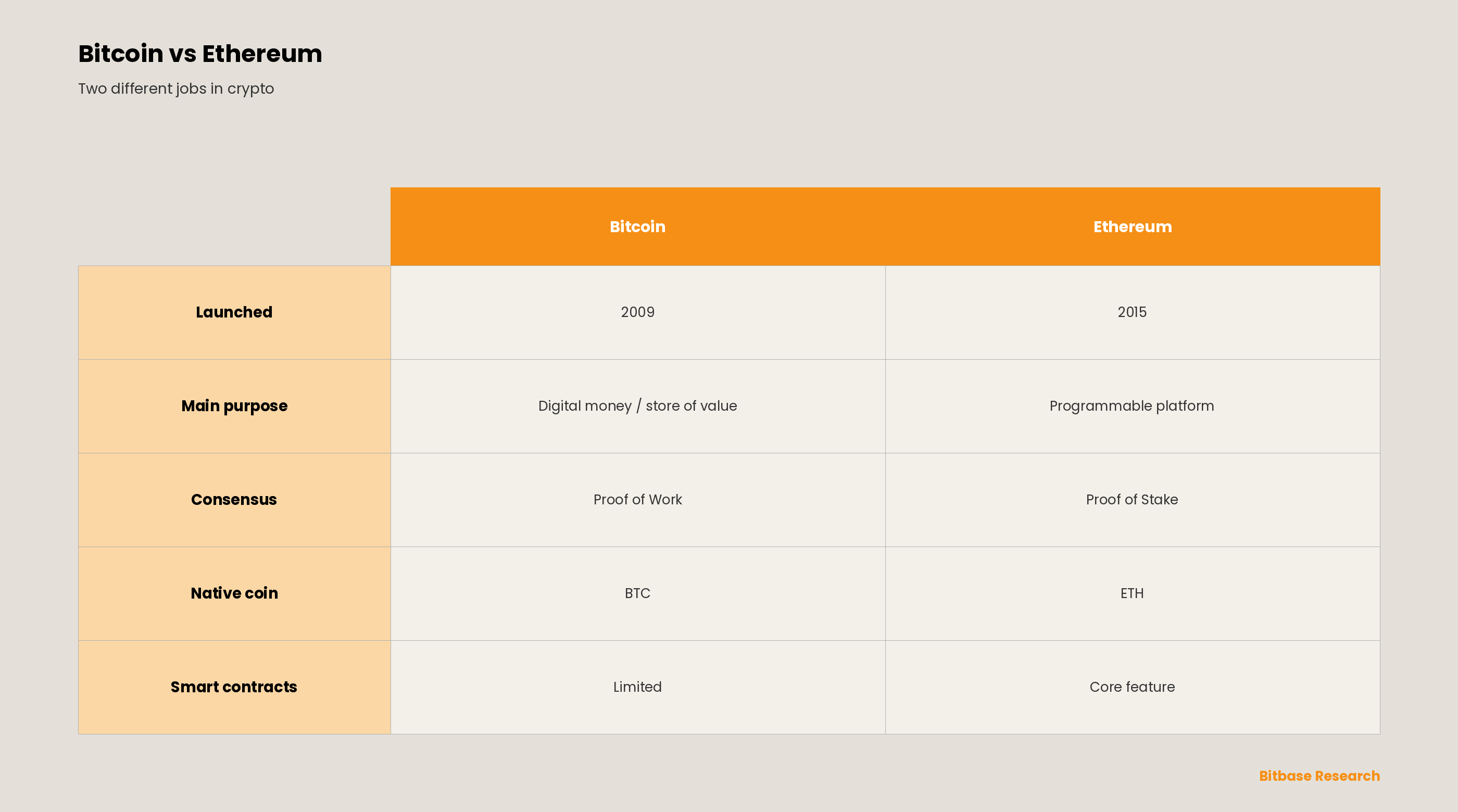
Bitcoin was designed mainly as digital money. Ethereum, launched in 2015, went further: it is a programmable platform where developers deploy smart contracts and decentralized applications (dapps) [1]. This is why Ethereum underpins much of DeFi, NFTs, and many stablecoins.
Smart contracts and ETH
A smart contract is code stored on the blockchain that executes automatically, with no intermediary. Running these computations requires ETH, Ethereum's native coin, to pay network fees (see our gas-fees guide). ETH is also widely held as an asset — the second-largest cryptocurrency, around $1,676 per ETH as of June 24, 2026 [2].
How Ethereum secures itself
In 2022, Ethereum switched from Proof of Work to Proof of Stake. Instead of miners, validators lock up (stake) ETH to propose and check blocks, and dishonest behavior can cost them their stake [1]. The change cut Ethereum's energy use dramatically.
Bitcoin vs Ethereum at a glance
The bottom line
Bitcoin is digital money; Ethereum is a programmable platform that money and apps are built on. Understanding that difference is key to making sense of most of crypto. To keep learning the fundamentals, follow more from Bitbase Academy.
Disclaimer: This article is educational content from Bitbase Academy, provided for information only. It does not constitute investment, trading, tax, or financial advice. Price data is current as of June 24, 2026; crypto assets are volatile, so refer to the latest market data.
References
[1] ethereum.org, "Proof-of-stake (PoS)." ethereum.org
[2] Coinbase, "Ethereum (ETH) Price." coinbase.com