
A stablecoin is a cryptocurrency designed to hold a steady value by pegging to a fiat currency — usually the US dollar. It works as crypto's safe haven and unit of account, and as a bridge between traditional finance and the on-chain world. This guide walks through what stablecoins are, their main types, how big the market is, and the risks and regulation around them.
What a stablecoin is
Most cryptocurrencies, such as BTC and ETH, swing sharply in price, which makes them awkward for everyday pricing and payments. A stablecoin is built to keep one token worth about one dollar — in other words, pegged 1:1 to the US dollar. To hold that peg, issuers typically keep reserves of equal value, or use over-collateralization and algorithms to balance supply and demand.
Put simply, a stablecoin combines the stability of the dollar with the portability of a blockchain: you can move "dollars" to the other side of the world in minutes, without routing through the traditional banking system.
The three main types
Stablecoins fall into three broad categories based on how they hold their peg.
Fiat-collateralized
The issuer holds reserves of equal value, such as cash and short-term US Treasuries, so each token is backed by roughly one dollar. USDT (Tether) and USDC (issued by Circle) are the leading examples and the two largest stablecoins.
Crypto-collateralized
These are minted against other crypto assets held as over-collateral, such as DAI. Because the collateral itself fluctuates, this type usually requires a collateral ratio above 100% and relies on smart contracts that liquidate positions automatically to defend the peg.
Algorithmic
Rather than full reserves, these rely on algorithms that adjust supply to hold the price. This design carries the highest risk — in May 2022, the algorithmic stablecoin TerraUSD (UST) collapsed and lost its peg, becoming one of the industry's hardest lessons.
How big is the stablecoin market
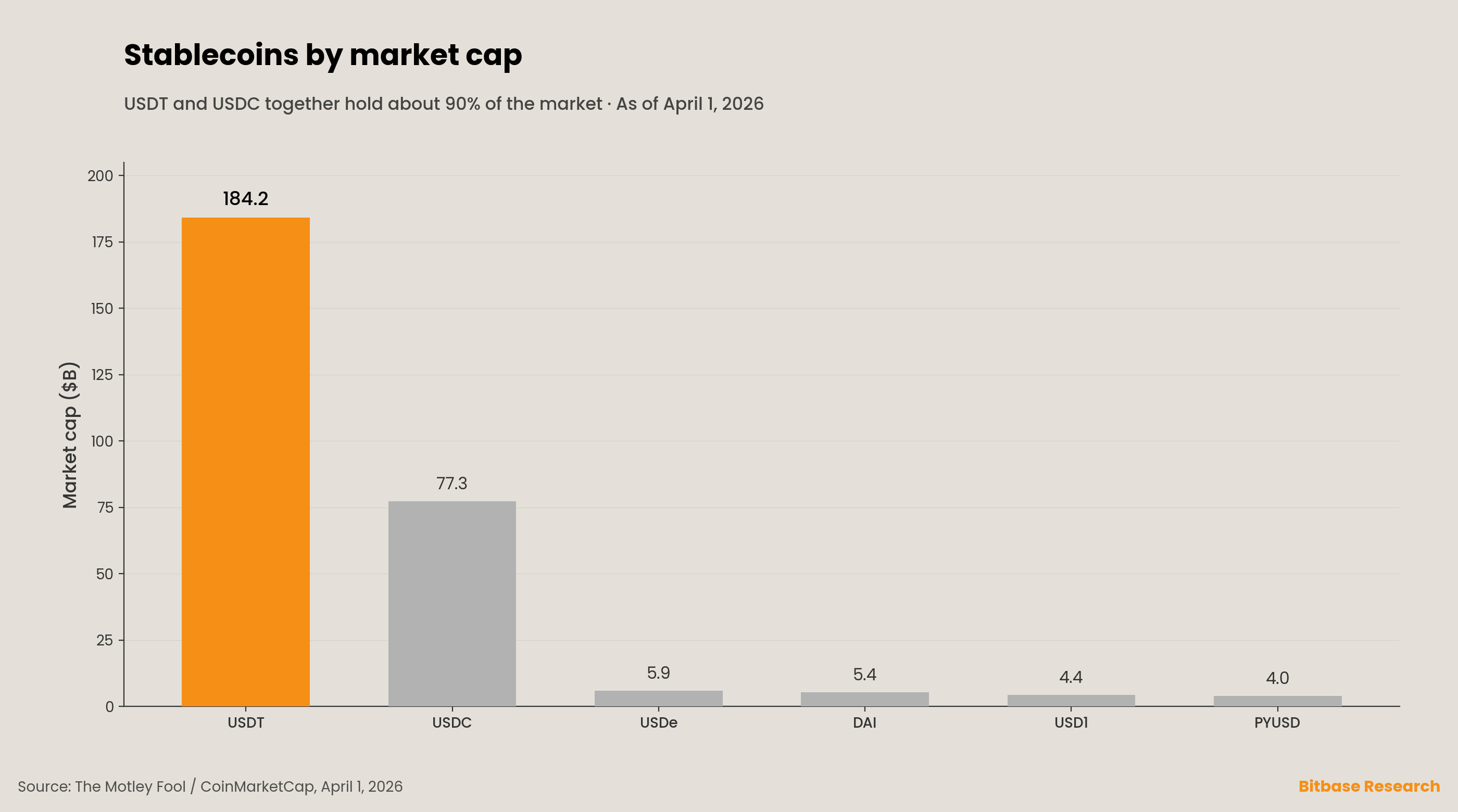
Stablecoins are no longer a niche idea. By mid-2026, the total stablecoin market cap had passed $300 billion [2], and it remains highly concentrated: USDT and USDC together account for about 90% of the market.
As of April 1, 2026, USDT led with a market cap of about $184.2 billion and roughly $76 billion in daily trading volume, while USDC was second at about $77.3 billion. Both dwarf the next names, such as Ethena USDe (about $5.9 billion) and DAI (about $5.4 billion) [1].
What people use stablecoins for
Stablecoins now run through almost every corner of crypto:
- Trading and pricing. On exchanges, stablecoins are the base currency for buying and selling crypto, and a place to wait out sharp volatility. - Cross-border transfers. On a blockchain, stablecoins move across borders cheaply and almost instantly, with no bank operating hours. - Fiat on- and off-ramps. They are a common bridge between fiat money and crypto assets. - DeFi and payments. They serve as collateral and settlement assets in decentralized finance; in payments, PayPal launched PYUSD, and USDC can already settle within the Visa network [1].
Risks and regulation
A stablecoin is only as "stable" as the mechanism and reserves behind it. Risks worth watching include de-pegging (as with UST), reserve transparency and issuer credit (questions about some issuers' reserves have persisted for years), and the possibility that a centralized issuer freezes an address.
Regulation is catching up quickly. The United States signed the GENIUS Act into law on July 18, 2025 — the country's first federal framework for payment stablecoins. It requires stablecoins to be fully backed 1:1 by US dollars or low-risk assets and limits issuance to "permitted issuers"; its implementing rules are still being written, with a statutory deadline of July 18, 2026 [3]. In the European Union, stablecoin rules under MiCA (covering e-money tokens, or EMTs, and asset-referenced tokens, or ARTs) have applied since June 30, 2024, with single-currency dollar and euro stablecoins classified as e-money tokens [4].
The bottom line
Stablecoins bring the dollar's stability on-chain. They are part of crypto's core infrastructure and a bridge between traditional finance and digital assets. Understanding their types, scale, and risks is the first step to making sense of the wider crypto ecosystem. To keep learning the fundamentals, follow more from Bitbase Academy.
Disclaimer: This article is educational content from Bitbase Academy, provided for information only. It does not constitute investment, trading, tax, or financial advice. Crypto assets are highly volatile, and stablecoins carry de-pegging, reserve, and regulatory risks; assess your own risk tolerance before participating. Data is current as of June 2026 and may change; refer to the latest disclosures from authoritative sources.
References
[1] The Motley Fool, "Which Stablecoins Are the Largest and Most Popular in 2026?" (data from CoinMarketCap, as of April 1, 2026). fool.com
[2] DefiLlama, "Stablecoins — Total Market Cap." defillama.com
[3] "GENIUS Act," Wikipedia (signed into law July 18, 2025). en.wikipedia.org
[4] ESMA, "Markets in Crypto-Assets Regulation (MiCA)." esma.europa.eu