A cryptocurrency exchange is a marketplace for buying, selling, and trading crypto. Its two main kinds — centralized (CEX) and decentralized (DEX) — differ most in one thing: who holds your funds. This guide explains how exchanges work and how to choose between a CEX and a DEX.
What a cryptocurrency exchange is
An exchange is a platform that matches buyers and sellers so you can swap one asset for another — crypto for crypto, or fiat for crypto. Think of it as the trading and conversion hub of the crypto world.
By how they operate, exchanges fall into two main types, and the core difference is who controls the private keys and the funds.
The two main types
Centralized exchange (CEX)
Run by a company that holds user funds (custodial), a CEX matches orders on its own order book, usually offers fiat on- and off-ramps, and requires KYC identity verification. It is beginner-friendly and has high liquidity. Bitbase is a centralized exchange.
Decentralized exchange (DEX)
A DEX is peer-to-peer and built on smart contracts. You trade directly from your self-custody wallet (non-custodial), usually without KYC, and trades settle on-chain where anyone can verify them. It prioritizes self-custody and permissionless access but has a steeper learning curve.
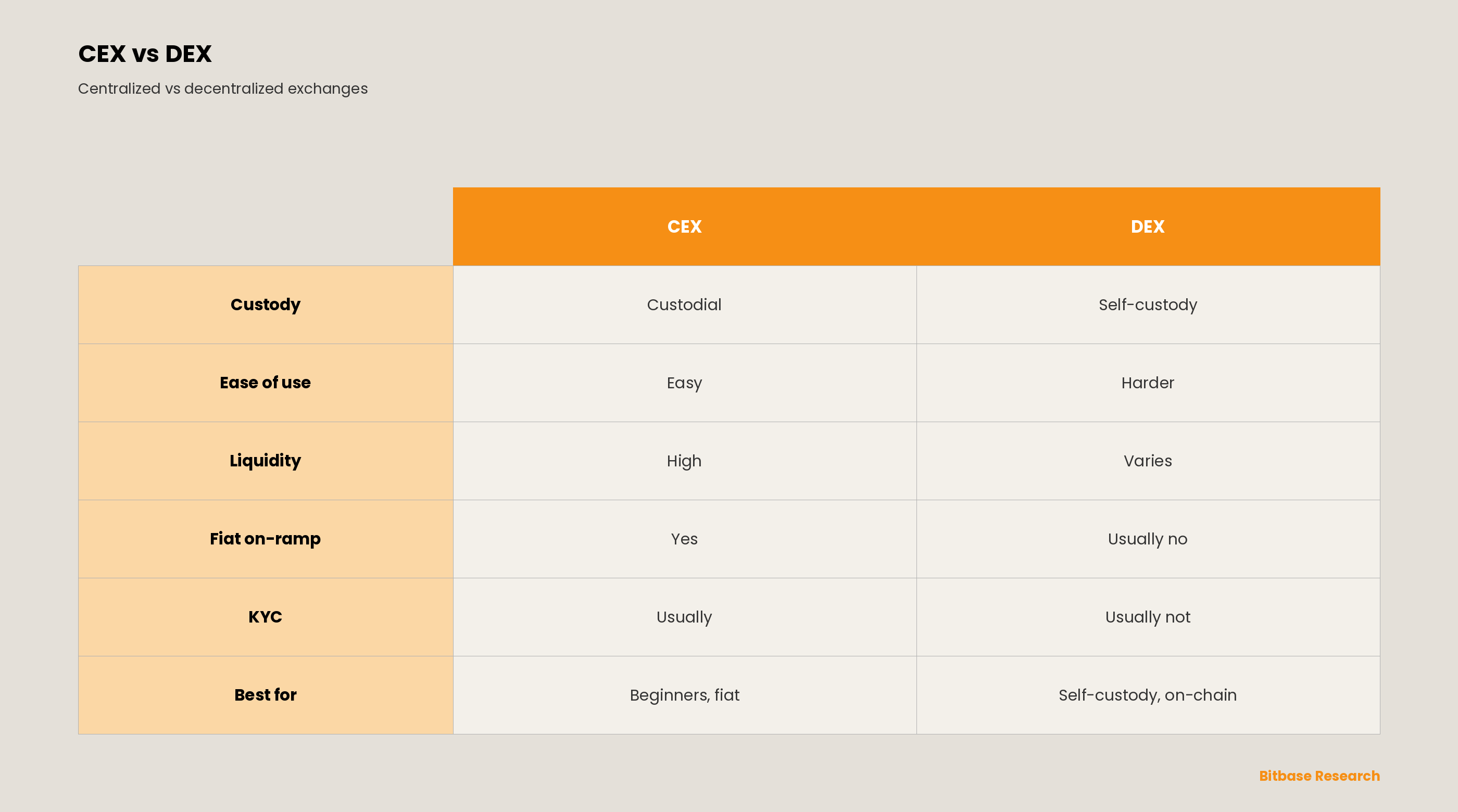
CEX vs DEX: which to use
Custody is the core difference: a CEX holds your keys, a DEX leaves them with you. Choose a CEX for ease, fiat access, and liquidity; choose a DEX for self-custody, on-chain trading, and permissionless access. Many people use both — a CEX to move money in and out, a DEX for on-chain trades.
What to check before you trade
- Security and track record. The platform's security history, operating record, and transparency. - Custody model. Whether the platform holds your funds or you self-custody — this decides where the risk sits. - Fees and assets. Trading fees, plus supported assets and networks. - Regulation and licensing. The rules in your region; frameworks such as the US GENIUS Act (for stablecoins) and the EU's MiCA are reshaping the landscape.
The bottom line
A cryptocurrency exchange is the main on-ramp to the crypto market, and the core divide between a CEX and a DEX is who holds your funds. Grasping that is the key to picking the right tool and managing risk. To keep learning the fundamentals, follow more from Bitbase Academy.
Disclaimer: This article is educational content from Bitbase Academy, provided for information only. It does not constitute investment, trading, tax, or financial advice. Crypto assets are highly volatile; assess your own risk tolerance before participating. Written as of June 2026; platform and regulatory details may change, so refer to the latest official information.
References
[1] Britannica Money, "Centralized vs. Decentralized Exchanges." britannica.com
[2] MoonPay, "CEX vs DEX: A Guide to Centralized and Decentralized Exchanges." moonpay.com