Margin trading in crypto means using borrowed funds so that your position is larger than the money you put in. Your own capital acts as collateral, called margin, and the borrowing gives you leverage. It can boost returns, but it magnifies losses just as much and adds the risk of liquidation. Here is what margin trading is, the two margin levels that matter, and why it cuts both ways.
What margin trading is
Normally you can only trade with the money you have. Margin trading changes that: you put up some capital as collateral and borrow against it to open a bigger position. The result is leverage — your exposure is a multiple of your own funds. Trade $1,000 as margin at 5x and you control a $5,000 position. Everything else about the trade is the same; you have simply borrowed to make it larger.
Initial and maintenance margin
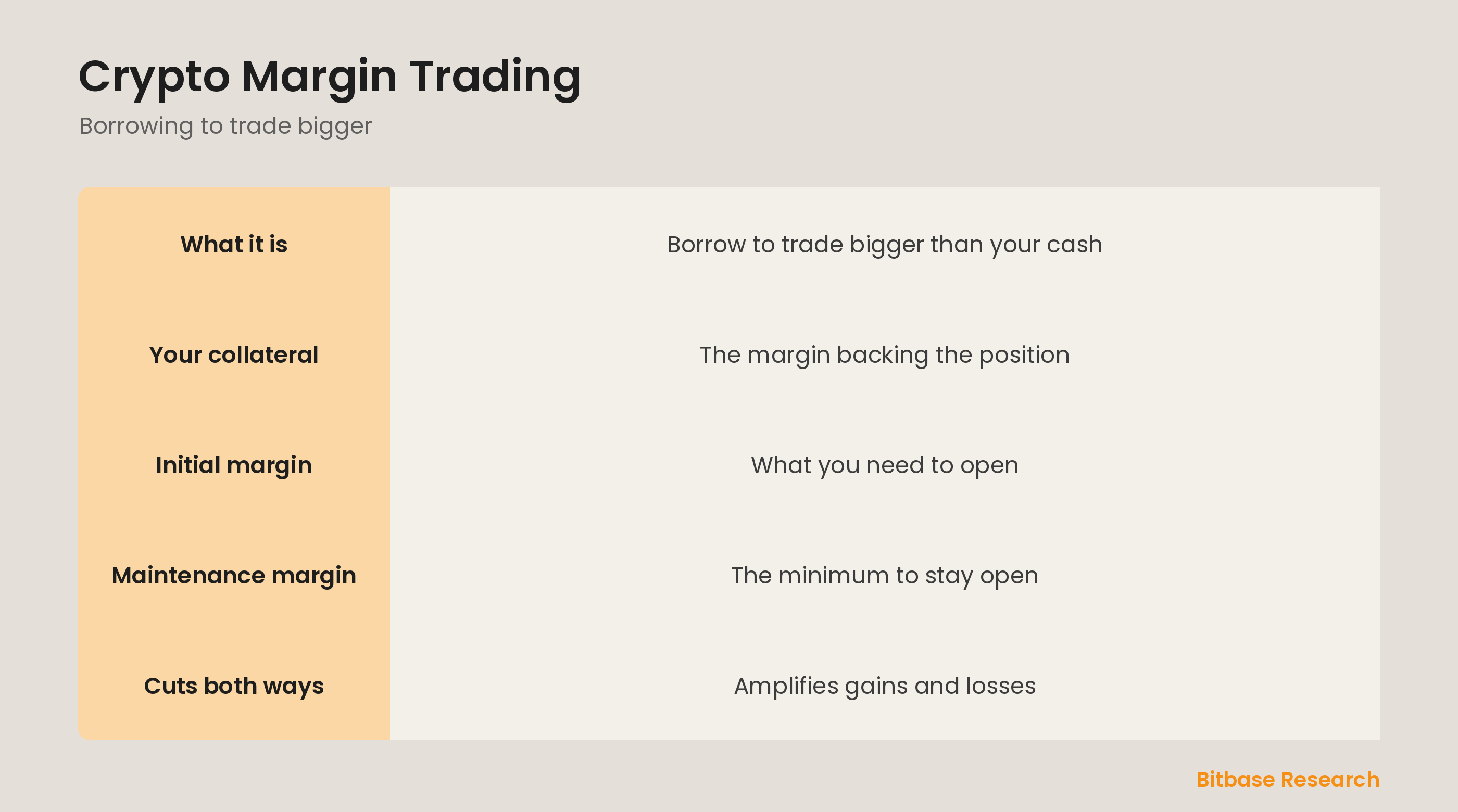
Two thresholds govern a margin position. The initial margin is the collateral you must post to open it — at 10x leverage, a $10,000 position needs $1,000 down. The maintenance margin is the smaller minimum you must keep in the account to hold the position open. If losses drag your collateral below the maintenance level, the position is at risk of liquidation, where the exchange force-closes it to stop your balance going negative.
It cuts both ways
Leverage is symmetrical: it scales gains and losses by the same factor. At 10x, a 1% move in your favour is a 10% gain on your margin, but a 1% move against you is a 10% loss. Because the losses land on a small pot of collateral, a modest adverse move can erase a large share of it, and a larger one can wipe it out entirely. That is the trade-off margin makes — bigger potential returns for a much higher chance of ruin.
Cross versus isolated margin
Exchanges usually offer two ways to assign collateral. With cross margin, your whole account balance backs the position, so it can survive deeper drawdowns but a bad trade can threaten everything. With isolated margin, only the collateral you allocated to that position is at stake, capping the damage to that amount if it is liquidated. Isolated margin is the more contained choice; cross margin gives a position more room but more exposure.
The bottom line
Margin trading lets you borrow to trade a position larger than your capital, turning a small stake into big exposure through leverage. The catch is that leverage amplifies losses exactly as much as gains and can trigger liquidation when your collateral runs low. Use it, if at all, with modest leverage and a clear plan — margin rewards discipline and punishes overconfidence quickly. To keep learning the fundamentals, follow more from Bitbase Academy.
Disclaimer: This article is educational content from Bitbase Academy, provided for information only. It does not constitute investment, trading, tax, or financial advice. Crypto assets are volatile; assess your own risk. Written as of June 2026; refer to the latest official information.
References
[1] Investopedia, "Margin: What It Is and How It Works" investopedia.com
[2] Britannica Money, "Perpetual Futures: Meaning, Regulation, and Example" britannica.com
[3] Investopedia, "Leverage: Definition, Example, and Formula" investopedia.com