When your private keys sit on a phone or computer, something has to stop a thief who steals the device from simply reading them. That something is encryption. Crypto wallet encryption scrambles your keys with a password so they are unreadable to anyone who cannot unlock them. It is a core defense, but it is often misunderstood as a full backup, which it is not. Here is what wallet encryption is, what it protects, and where its limits lie.
What wallet encryption is
Encryption is the process of scrambling data so it can only be read with the right key. In a crypto wallet, your private keys are stored on the device in encrypted form, locked behind a password you set. On disk they look like meaningless noise. Only when you enter the correct password does the wallet turn that noise back into usable keys, so the secret never sits on the device in plain, readable form.
How it works in practice
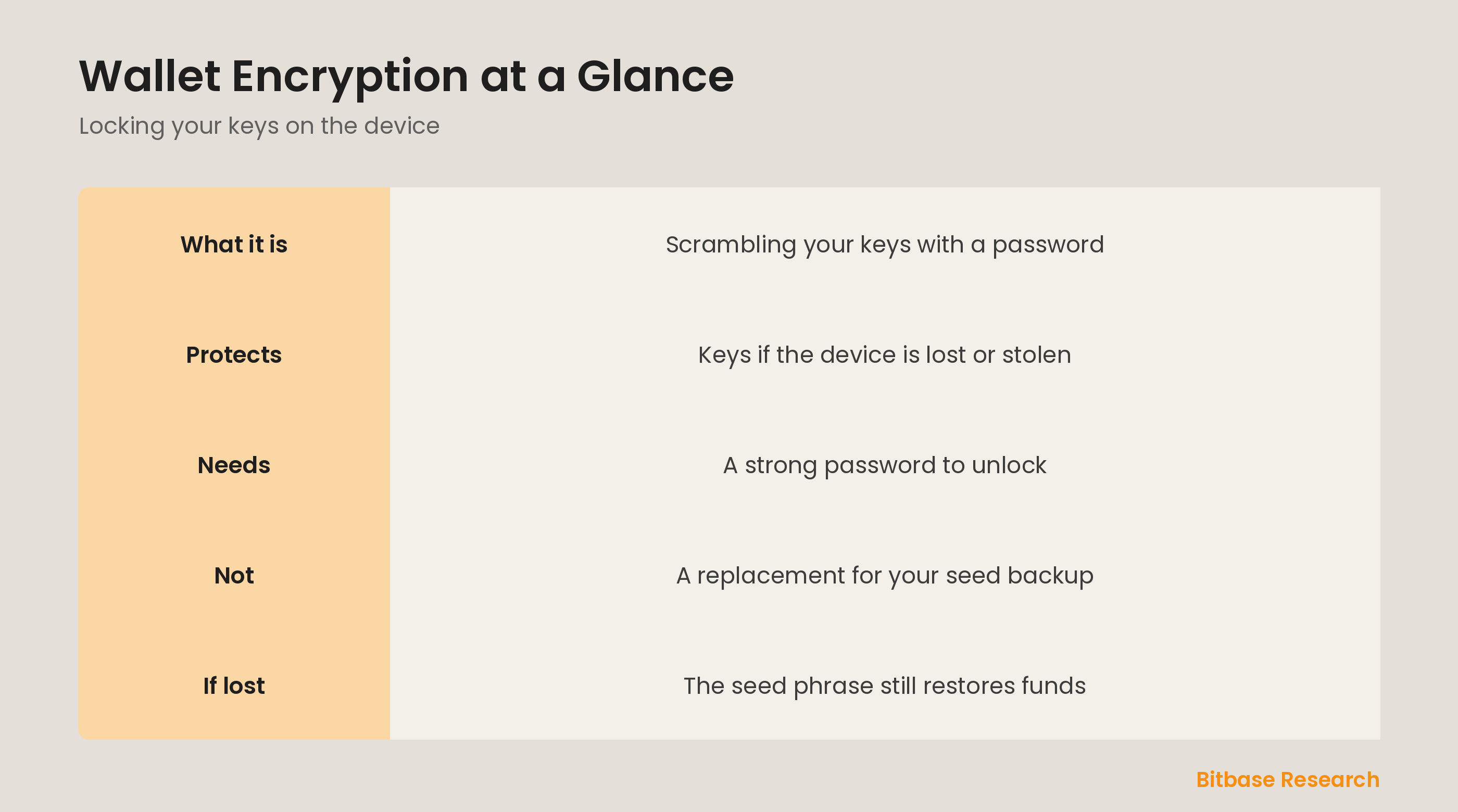
When you create or open the wallet, your password is run through a process that produces the key used to decrypt your stored private keys. Enter the right password and the wallet unlocks; enter the wrong one and the encrypted file stays gibberish. Because the password itself is not saved anywhere, the strength of your protection comes down to the strength of that password.
What it protects and what it does not
Encryption protects your keys if your device is lost, stolen, or accessed by someone else — without the password, the wallet file is useless to them. What it does not do is replace your recovery phrase. The encryption password unlocks this one copy on this one device; it will not restore your wallet on a new device if the old one is gone. For that, you still need your seed phrase backed up offline.
Using it well
Choose a strong, unique password for the wallet and do not reuse it elsewhere, since it is the single lock on your keys. Do not lose it — if you forget it and have no seed backup, the keys stay encrypted forever. And remember that entering your seed phrase into a fake app or website bypasses encryption entirely, so encryption is one layer, not a substitute for careful habits and an offline backup.
The bottom line
Crypto wallet encryption scrambles your private keys behind a password so a stolen device cannot reveal them. It is an essential on-device defense, but it is not a backup: if you lose the device, only your recovery phrase can restore the funds. Set a strong, unique password, keep it safe, and pair encryption with an offline seed backup so both a thief and an accident are covered. To keep learning the fundamentals, follow more from Bitbase Academy.
Disclaimer: This article is educational content from Bitbase Academy, provided for information only. It does not constitute investment, trading, tax, or financial advice. Crypto assets are volatile; assess your own risk. Written as of June 2026; refer to the latest official information.
References
[1] Investopedia, "Encryption: What It Is and How It Works" investopedia.com
[2] Investopedia, "Private Key: What It Is, How It Works, Best Ways to Store" investopedia.com
[3] Investopedia, "Cold Wallet: What It Is, How It Works, Types, and Examples" investopedia.com