
Even with a strong password and two-factor authentication, there is one nightmare scenario on an exchange: an attacker gets into your account and sends your crypto to their own address. A withdrawal whitelist is built to stop exactly that. It restricts where your funds can go, so that breaking into your account is not enough to steal from it. Here is what a withdrawal whitelist is, how it protects you, and the trade-off it asks in return.
What a withdrawal whitelist is
A withdrawal whitelist, sometimes called an address whitelist, is a list of crypto addresses you have pre-approved as allowed destinations. Once it is switched on, the exchange will only send your funds to an address on that list. Any attempt to withdraw to an address you have not added is simply refused, no matter who is logged in — including you, until you formally add the new address.
How it protects you
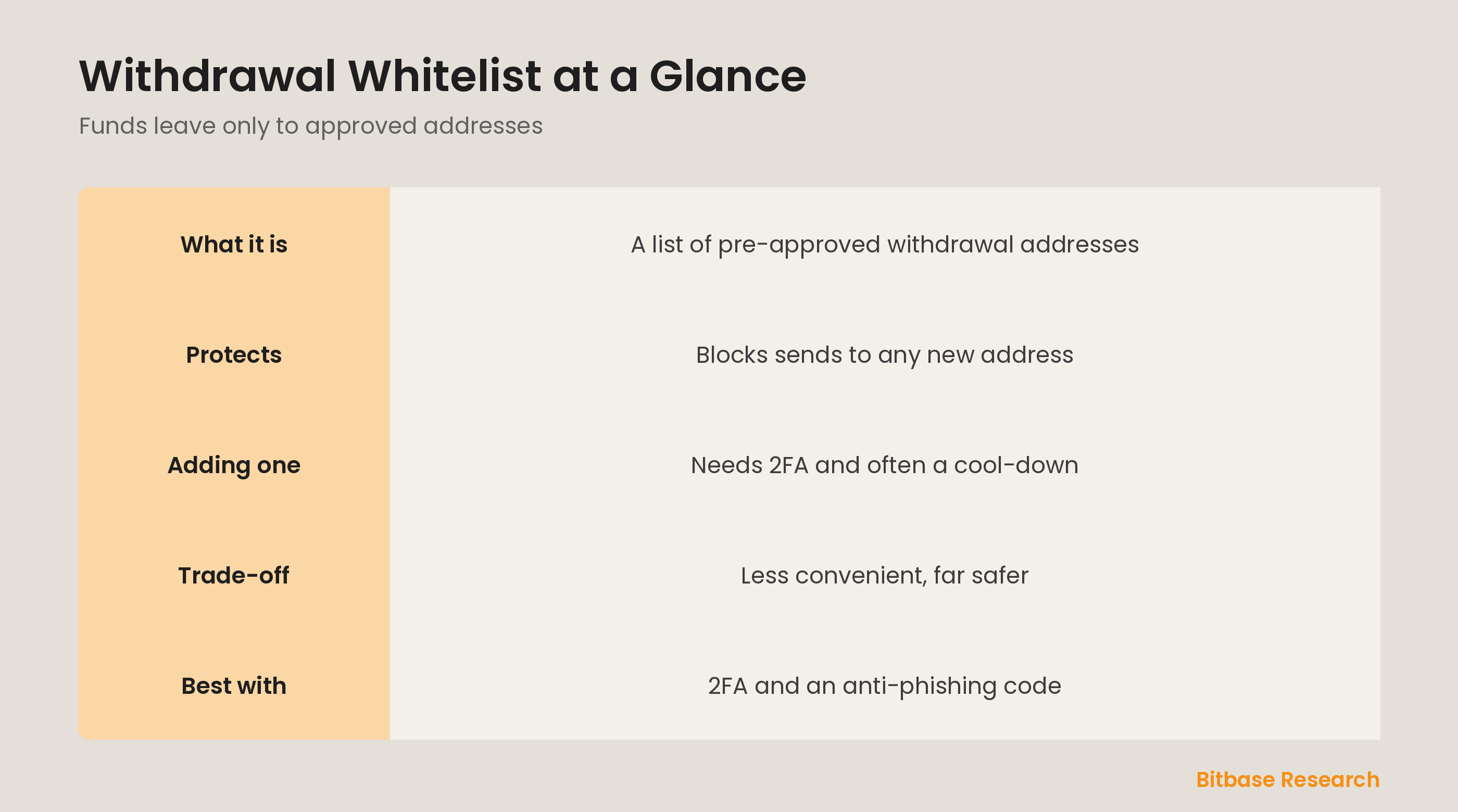
This closes the most damaging attack. Suppose someone steals your password and even passes your 2FA — normally they could withdraw everything to their own wallet. With a whitelist active, they cannot, because their address is not on your approved list. And adding a new address usually requires its own security checks and a delay, giving you time to notice and react before any funds can move to it.
How it works in practice
You turn on the whitelist in your exchange's security settings, then add the addresses you actually use, each confirmed with two-factor authentication. Many exchanges also enforce a cool-down period after you add an address, during which withdrawals to it are blocked. Some let you lock the setting so that any change to the list, or turning the feature off, triggers the same delay and verification.
The trade-off and how to use it well
The cost is convenience: sending to a brand-new address means adding it first and possibly waiting out the cool-down, which is a hassle when you are in a hurry. For most people that friction is well worth it, especially for accounts holding meaningful funds. Combine the whitelist with 2FA and an anti-phishing code for layered protection, and keep the list tidy by removing addresses you no longer use.
The bottom line
A crypto withdrawal whitelist restricts withdrawals to addresses you have pre-approved, so even an attacker who gets into your account cannot send funds to a new destination. Adding an address takes 2FA and often a cool-down, which trades a little convenience for a large gain in safety. Turn it on alongside 2FA and an anti-phishing code, and the most damaging account attack becomes far harder to pull off. To keep learning the fundamentals, follow more from Bitbase Academy.
Disclaimer: This article is educational content from Bitbase Academy, provided for information only. It does not constitute investment, trading, tax, or financial advice. Crypto assets are volatile; assess your own risk. Written as of June 2026; refer to the latest official information.
References
[1] Investopedia, "Cryptocurrency Explained With Pros and Cons for Investment" investopedia.com
[2] Investopedia, "Phishing: What It Is and How to Protect Yourself" investopedia.com
[3] CFTC, "Customer Advisory: Understand the Risks of Virtual Currency Trading" cftc.gov